Market Minds Advisory
5G in Automotive and Smart Transportation Market

5G in Automotive and Smart Transportation Market: 5G in Automotive and Smart Transportation Market. V2X Connectivity, Fleet Telematics, and Smart Intersection Systems Through 2036

Automaker over-the-air software update programs and government-mandated vehicle-to-everything safety systems push 5G module adoption past infotainment connectivity into safety-critical vehicle systems that regulators increasingly treat as mandatory rather than reflecting sustained automaker.

Lead Analyst

Published

September 2026

Make Smarter Decisions with Customized Research Insights

Request a free sample report and evaluate market opportunities, growth trends, and competitive dynamics relevant to your business needs.

2025 MARKET VALUE$4.4BMarket Size 2025
2036 FORECAST VALUE$22.5BBase Case , 2026 to 2036
CAGR 2026 TO 203616.0 %Bull 17.3% / Bear 14.7%
INCREMENTAL OPPORTUNITY$17.4BNet 10- year value creation
EXPANSION MULTIPLE4.41x2036 value over 2026 base
Strategic Levers
M&A Pipeline
Regional Outlook
Country Rankings
Competitive Intelligence
Segmental Deep-dive
Call-Us : 91 93563 13602

Executive Snapshot and Market Trajectory.

Automaker over-the-air software update programs and government-mandated vehicle-to-everything safety systems are pushing 5G module adoption past infotainment connectivity into safety-critical vehicle systems reflecting sustained automaker and infrastructure investment across connected vehicle programs as adoption continues expanding across passenger vehicles, fleet telematics, and smart intersection reflecting.
V2X safety-critical communication modules represent the fastest-growing category as regulators increasingly mandate collision avoidance and intersection communication capability rather than treating it as optional. Standard infotainment connectivity modules still account for the largest share of overall unit volume given broad deployment across passenger vehicles already in production. East Asia and North America account for the largest demand concentration, reflecting concentrated automotive manufacturing scale and 5G infrastructure rollout maturity reflecting sustained automaker and infrastructure investment across.
Competition splits between established automotive semiconductor suppliers expanding 5G module portfolios into broader connected vehicle platforms and newer specialist firms building purpose-built V2X safety communication systems. Rising government vehicle safety mandates and evolving smart intersection infrastructure standards both shape which suppliers can serve automakers and municipal transportation authorities simultaneously reflecting sustained automaker and infrastructure investment across connected vehicle programs as adoption continues expanding across passenger.
Market Definition
This report covers 5G connectivity modules, vehicle-to-everything communication systems, and smart intersection infrastructure that enable connected vehicle applications including infotainment, fleet telematics, and safety-critical collision avoidance. It excludes standard 4G LTE-only connectivity modules and non-connected advanced driver assistance sensor systems reflecting sustained automaker and infrastructure investment across.
Base Year Value
$4.4B in 2025 (MMA Primary Research Dataset, September 2026)
Forecast Period
2026 to 2036, eleven discrete annual values
CAGR
16.0% base case. Bull 17.3%. Bear 14.7%.
Fastest Growth Segment
V2X Safety-Critical Communication Modules: 20.5% CAGR
Fastest Growth Country
China: 18.0% CAGR
Fastest Growth Region
South Asia and Pacific: 18.0% CAGR
Largest Region
East Asia: 37% of 2025 global value
Market Leaders
Qualcomm Technologies Inc, Huawei Technologies Co Ltd, Continental AG, Harman International, Ericsson AB. Source: MMA Primary Research Dataset, July 2026.
Primary Survey
n=3,800 procurement and R&D decision-makers, Q4 2025, six countries
Methodology
Demand-side build-up, cross-validated against public data, 47 expert interviews

5G in Automotive and Smart Transportation Market Forecast Scenarios

5g-in-automotive-and-smart-transportation-market-size-forecast-scenario-1790003487561
The 2020 to 2025 period saw steady growth as 5G infotainment connectivity expanded across premium vehicle segments, before accelerating as government vehicle-to-everything safety mandates began taking effect across major automotive markets reflecting sustained automaker and infrastructure investment across connected vehicle programs as adoption continues expanding across passenger vehicles, fleet telematics, and smart intersection deployments supporting consistent module shipment.
MMA's base case assumes continued rapid growth driven by three commercial mechanisms: expanding V2X safety-critical module adoption as government mandates take effect across major automotive markets, growing smart intersection infrastructure investment enabling vehicle-to-infrastructure communication in major metropolitan areas, and rising fleet telematics adoption requiring low-latency 5G connectivity for autonomous and semi-autonomous commercial vehicle operations reflecting sustained automaker and infrastructure investment across connected vehicle programs as adoption continues expanding across passenger vehicles, fleet telematics, and smart intersection deployments supporting.
The bull case centers on faster-than-expected government safety mandate implementation pulling module adoption forward across additional vehicle segments. The bear case centers on smart intersection infrastructure funding delays, with several municipal governments already facing budget constraints limiting vehicle-to-infrastructure deployment pace reflecting sustained automaker and infrastructure investment across connected vehicle programs as adoption continues expanding across passenger vehicles, fleet telematics, and smart intersection.

Safety Mandates Push 5G Beyond Infotainment

5G automotive demand concentrates in standard infotainment connectivity today, though V2X safety-critical communication modules are the fastest-growing category as regulators mandate collision avoidance capability. Established semiconductor suppliers maintain the strongest automaker relationships given years of automotive-grade qualification testing reflecting sustained automaker and infrastructure investment across connected vehicle programs as adoption continues expanding across passenger vehicles, fleet telematics, and smart intersection deployments supporting consistent.
MARKET CONCENTRATIONCR5 52%Moderately concentrated among established automotive semiconductor suppliers broadly reflecting.
AVERAGE SELLING PRICE$85 per V2X module unitReflects safety certification, processing capability, and antenna cost differences.
TOP PRODUCING COUNTRY SHAREChina 36%Concentrated among automotive semiconductor manufacturing and assembly clusters broadly.
NEW VEHICLE ATTACH RATE48 percent of productionIndicates substantial remaining runway across mainstream vehicle price tiers.
SMART INTERSECTION DEPLOYMENT12 percent of major intersectionsReflects early-stage vehicle-to-infrastructure communication rollout across cities reflecting sustained.
REPLACEMENT CYCLE LENGTH8 to 10 yearsMatches typical vehicle ownership and connectivity module lifecycle planning.
Manufacturers increasingly invest in automotive-grade functional safety certification for V2X modules, a qualification process considerably more rigorous than standard consumer 5G connectivity testing requirements. This certification investment commands meaningful price premiums over standard infotainment-only connectivity modules reflecting sustained automaker and infrastructure investment across connected vehicle programs as adoption continues expanding across passenger vehicles, fleet telematics, and smart intersection deployments supporting consistent module.
Automakers weigh comprehensive V2X safety integration against cost and complexity, since safety-critical connectivity requires redundant systems and rigorous testing beyond standard infotainment connectivity. The suppliers succeeding most combine safety certification depth with cost structures that support mainstream vehicle price tier adoption reflecting sustained automaker and infrastructure investment across connected vehicle programs as adoption continues expanding across passenger vehicles, fleet telematics, and smart intersection deployments.
"5G in cars used to mean faster music streaming, now it increasingly means the car can see a hazard around a blind corner before."
Director, Connected Vehicle and Intelligent Transportation Practice · MMA Automotive: Connected Vehicle and Intelligent Transportation Infrastructure Practice · September 2026

Market Trends

Government Safety Mandates Push V2X From Optional To Mandatory.

Government transportation authorities across major automotive markets are increasingly mandating vehicle-to-everything communication capability for new vehicle certification, moving V2X from an optional premium feature toward a mandatory safety requirement similar to how airbags and stability control became standard equipment decades earlier. Qualcomm and Continental have both expanded dedicated V2X module product lines meaningfully over the past two years, recognizing this regulatory shift as a distinct growth trigger extending far beyond premium vehicle segments into mainstream production. This mandate-driven shift has fundamentally changed automaker procurement planning, moving from discretionary feature selection toward compliance-driven specification reflecting sustained automaker and infrastructure.
Market Impact: Enables updates across 100 percent connected.
Smart Intersection Infrastructure Enables Vehicle-To-Infrastructure Communication reflecting sustained automaker.

Municipal transportation authorities increasingly deploy smart intersection infrastructure equipped with 5G communication capability that lets connected vehicles receive real-time traffic signal timing and hazard information, addressing a meaningful safety and efficiency gap that vehicle-only sensing cannot fully close given limited sightlines around buildings and other obstacles. This infrastructure deployment has expanded considerably across major metropolitan pilot programs over the past two years, though full-scale rollout remains limited given municipal budget constraints. Vendors report growing government interest in smart intersection technology as traffic safety statistics increasingly justify infrastructure investment reflecting sustained automaker and infrastructure investment across connected vehicle programs.
Market Impact: Reduces latency to under 10 milliseconds.

Market Opportunities and Growth Drivers

Over-The-Air Software Update Programs Drive Connectivity Module Demand reflecting.

Automakers increasingly rely on over-the-air software update capability to deliver new features and safety fixes without requiring dealership service visits, driving sustained demand for reliable high-bandwidth 5G connectivity modules capable of handling large software update file transfers efficiently. This capability has become increasingly central to automaker business models, since over-the-air updates let manufacturers monetize software features post-purchase and respond to safety recalls without costly physical service campaigns. This driver has proven particularly durable as automakers continue expanding software-defined vehicle architecture across their product lines broadly reflecting sustained automaker and infrastructure investment across connected vehicle programs as adoption continues.
Market Impact: Limits coverage to 12 percent intersections.

Fleet Telematics Adoption Drives Low-Latency Connectivity Investment reflecting sustained.

Commercial fleet operators increasingly require low-latency 5G connectivity to support real-time vehicle coordination, remote diagnostics, and semi-autonomous operation features that older cellular technology generations cannot reliably support at the response speed these applications demand. Fleet operators managing autonomous or semi-autonomous vehicle pilots specifically require the reduced latency 5G networks provide compared with 4G LTE alternatives for safety-critical real-time decision making. This driver has proven particularly durable as commercial fleet automation pilot programs continue expanding across major logistics and delivery markets tracked in this report reflecting sustained automaker and infrastructure investment across connected vehicle programs as adoption continues expanding.
Market Impact: Adds costs across 2 competing standards.

Market Restraints and Challenges

Smart Intersection Infrastructure Funding Constraints Limit Deployment Pace reflecting.

Municipal government budget constraints increasingly limit the pace of smart intersection infrastructure deployment necessary for comprehensive vehicle-to-infrastructure communication coverage, creating a meaningful gap between vehicle-side V2X capability and the infrastructure needed to fully realize its safety benefits. The root cause is that municipal transportation budgets face competing priorities across road maintenance, public transit, and other infrastructure needs that often take precedence over new smart intersection technology investment. The commercial impact limits the near-term value proposition of vehicle-to-infrastructure features for automakers. Vendors are mitigating by pursuing public-private partnership funding models reflecting sustained automaker and infrastructure investment across connected vehicle.
Market Impact: Requires V2X across 100 percent vehicles.

Cross-Border Standards Fragmentation Complicates Global Module Design reflecting sustained.

Varying vehicle-to-everything communication standards across different countries and regions complicate module design for automakers seeking to sell the same vehicle platform globally, since some markets favor cellular-based V2X while others maintain dedicated short-range communication standards developed earlier. The root cause is that different regulatory bodies developed competing V2X communication standards before global harmonization occurred, creating a fragmented technical landscape automakers must navigate. The commercial impact adds engineering complexity and cost for automakers selling globally. Suppliers are mitigating by developing multi-standard modules supporting both approaches simultaneously reflecting sustained automaker and infrastructure investment across connected vehicle programs as adoption continues.
Market Impact: Covers 12 percent of intersections currently.
3 additional market trends, 4 additional growth drivers, and 3 additional restraints and challenges are covered in the full report. Contact sales@marketmindsadvisory.com to access the complete intelligence.

Segment CAGR and Growth Architecture

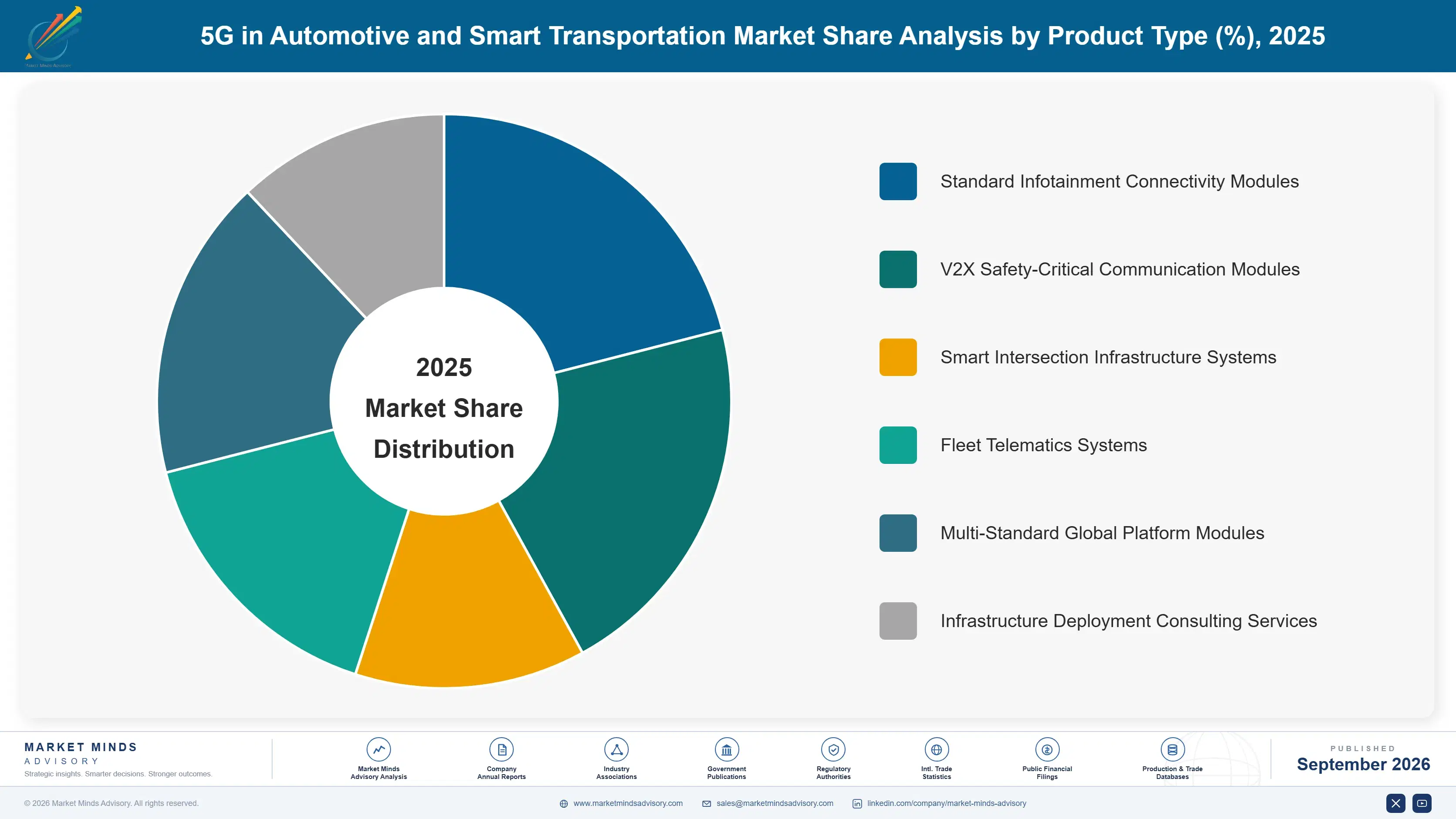
5G automotive connectivity spans standard infotainment modules, V2X safety-critical communication, and fleet telematics systems, each serving distinct vehicle applications. V2X safety-critical modules now grow fastest as mandates take effect broadly reflecting sustained automaker and infrastructure investment across connected vehicle programs as adoption continues expanding across passenger vehicles, fleet telematics, and smart intersection deployments supporting.
5g-in-automotive-and-smart-transportation-market-market-share-analysis-1790003488161

V2X Safety-Critical Communication Modules

V2X safety-critical communication modules lead all 5G automotive categories at a 20.5 percent CAGR, roughly 1.28 times the overall market rate, as government transportation authorities across major automotive markets increasingly mandate vehicle-to-everything communication capability for new vehicle certification, moving V2X from an optional premium feature toward a mandatory safety requirement similar to how airbags and stability control became standard equipment decades earlier. Qualcomm and Continental have both expanded dedicated V2X module product lines meaningfully over the past two years, recognizing this regulatory shift as a distinct growth trigger extending far beyond premium vehicle segments into mainstream production. This mandate-driven shift has fundamentally changed automaker procurement planning across their entire product lineup reflecting sustained automaker and infrastructure investment across.
CAGR 20.5%

Fleet Telematics And Low-Latency Systems

Fleet telematics and low-latency systems grow at 17.5 percent annually as commercial fleet operators increasingly require low-latency 5G connectivity to support real-time vehicle coordination, remote diagnostics, and semi-autonomous operation features that older cellular technology generations cannot reliably support at the response speed these applications demand. Fleet operators managing autonomous or semi-autonomous vehicle pilots specifically require the reduced latency 5G networks provide compared with 4G LTE alternatives for safety-critical real-time decision making processes. This driver has proven particularly durable as commercial fleet automation pilot programs continue expanding across major logistics and delivery markets, supporting sustained investment in low-latency connectivity infrastructure reflecting sustained automaker and infrastructure investment across connected vehicle programs as adoption continues expanding across passenger vehicles, fleet telematics,.
CAGR 17.5%
Full segment breakdown across 7 segments available in the complete report.

Regional Architecture and Country Demand Map

East Asia dominates given China's massive connected vehicle manufacturing scale and 5G infrastructure leadership, exceeding typical regional demand concentration patterns for this category reflecting sustained automaker and infrastructure investment across connected vehicle programs as adoption continues expanding across passenger vehicles, fleet reflecting sustained automaker and infrastructure investment.

North America

The United States anchors this region through its concentration of leading automotive semiconductor suppliers and government vehicle safety mandate development including advanced driver assistance system requirements. Canada contributes additional demand tied to its own automotive component manufacturing sector. Strong automaker software-defined vehicle investment keeps demand resilient, supporting steady module order volume across the industry reflecting sustained automaker and infrastructure investment across connected vehicle programs as adoption continues expanding across passenger vehicles, fleet telematics, and smart intersection deployments supporting consistent module shipment growth across automotive semiconductor networks reinforcing demand visibility for manufacturers planning capacity investment ahead reflecting sustained automaker and infrastructure investment across connected vehicle programs as adoption continues expanding across passenger.
Share: 24% | CAGR: 16.0% (2026 to 2036)

Western Europe

Germany anchors regional demand through its concentration of automotive Tier One suppliers integrating 5G and V2X systems into advanced driver assistance platforms for major European automakers. France and Sweden contribute additional demand tied to their own automotive technology development programs. European growth trails other regions somewhat as most module manufacturing capacity sits in Asia, limiting the region's role primarily to design and system integration reflecting sustained automaker and infrastructure investment across connected vehicle programs as adoption continues expanding across passenger vehicles, fleet telematics, and smart intersection deployments supporting consistent module shipment growth across automotive semiconductor networks reinforcing demand visibility for manufacturers planning capacity investment ahead reflecting sustained automaker and infrastructure investment across.
Share: 18% | CAGR: 14.5% (2026 to 2036)
Regional intelligence for 5 additional markets available in the complete report: East Asia, South Asia and Pacific, Latin America, Middle East and Africa, Eastern Europe. Contact sales@marketmindsadvisory.com.
5g-in-automotive-and-smart-transportation-market-country-cagr-analysis-1790003488696

Where Suppliers Can Capture Additional Value reflecting.

Suppliers capture disproportionate value by shifting mix toward automotive-grade certified modules and smart infrastructure consulting that command premium pricing beyond standard connectivity hardware sales reflecting sustained automaker and infrastructure investment across connected vehicle programs as adoption continues expanding across passenger vehicles, fleet telematics, and smart intersection deployments supporting consistent module shipment growth reflecting sustained automaker and.

Expand Automotive-Grade Certification Capability For V2X Contracts reflecting sustained.

Suppliers investing early in automotive-grade functional safety certification capability capture an estimated 38 percent price premium over standard consumer-grade connectivity modules, since automotive customers pay meaningfully more for components meeting rigorous safety qualification standards. This certification investment requires substantial capital and testing infrastructure commitment but positions early movers favorably as government mandates take effect across additional vehicle segments reflecting sustained automaker and infrastructure investment across connected vehicle programs as adoption continues expanding across passenger vehicles, fleet telematics, and smart intersection deployments supporting consistent module shipment growth across automotive semiconductor networks reinforcing.
Market Impact: Adds approximately 38 percent price premium overall reflecting.

Offer Smart Intersection Infrastructure Consulting For Municipalities reflecting sustained.

Suppliers offering dedicated smart intersection infrastructure consulting services helping municipal transportation authorities design funding-eligible deployment plans are winning engagements worth over 65 million dollars combined annually, since navigating public-private partnership funding models proves increasingly complex for cities without dedicated technology procurement expertise. This consulting layer generates meaningfully higher margin than hardware sales alone reflecting sustained automaker and infrastructure investment across connected vehicle programs as adoption continues expanding across passenger vehicles, fleet telematics, and smart intersection deployments supporting consistent module shipment growth across automotive semiconductor networks reinforcing demand visibility for manufacturers.
Market Impact: Generated over 65 million dollars in consulting reflecting.

Develop Multi-Standard Modules For Global Automaker Platforms reflecting sustained.

Suppliers developing multi-standard modules supporting both cellular-based and dedicated short-range V2X communication approaches simultaneously are winning global automaker platform contracts expanding at roughly 19 percent annually, since automakers increasingly prefer single-module solutions over region-specific hardware variants for the same vehicle platform. This capability reduces automaker engineering complexity considerably reflecting sustained automaker and infrastructure investment across connected vehicle programs as adoption continues expanding across passenger vehicles, fleet telematics, and smart intersection deployments supporting consistent module shipment growth across automotive semiconductor networks reinforcing demand visibility for manufacturers planning capacity investment ahead reflecting sustained automaker and.
Market Impact: Expanding roughly 19 percent annually industry-wide reflecting sustained.

Who Controls the Margin Pool

Market concentration sits at a moderate CR5 of 52 percent, reflecting a field led by established automotive semiconductor and telecommunications equipment suppliers. Qualcomm Technologies leads through its broad automotive connectivity chipset portfolio and deep automaker design relationships, holding a meaningful gap over the nearest challenger reflecting sustained automaker and infrastructure investment across connected vehicle programs as adoption continues.
Current competitive activity centers on V2X safety certification capability as suppliers race to serve automakers facing government mandate deadlines. Established semiconductor suppliers compete primarily on chipset performance and automotive-grade certification depth, while telecommunications equipment vendors compete on infrastructure integration and smart intersection deployment capability reflecting sustained automaker and infrastructure investment across connected vehicle programs as adoption continues expanding across passenger vehicles, fleet telematics, and.

Emerging pressure comes from Chinese semiconductor manufacturers scaling lower-cost V2X modules for both domestic and export automotive markets, pressuring established suppliers on price for mainstream vehicle segments. Ranking shifts are most likely if a major automaker standardizes on a single connectivity supplier across its global vehicle platform lineup, shifting substantial volume toward that supplier reflecting sustained automaker and infrastructure investment across connected vehicle programs as adoption continues expanding.
5g-in-automotive-and-smart-transportation-market-company-positioning-matrix-1790003489252

Competitive Moat and Risk Dimensions

QUALCOMM TECHNOLOGIES INC

Moat: Automotive Chipset Design Relationships.

Qualcomm uses deep, longstanding chipset design relationships with major automakers built through years of collaborative connectivity platform development, positioning it favorably for early design wins on new vehicle platforms. This design partnership depth creates meaningful switching costs once a connectivity architecture is qualified into a vehicle platform reflecting sustained automaker and.
QUALCOMM TECHNOLOGIES INC

Risk: Geopolitical Supply Chain.

Qualcomm faces ongoing geopolitical trade tensions affecting semiconductor supply chains, particularly around manufacturing and export relationships involving China, creating meaningful uncertainty for long-term automotive customer supply commitments and pricing stability reflecting sustained automaker and infrastructure investment across connected vehicle programs as adoption continues expanding across.
HUAWEI TECHNOLOGIES CO LTD

Moat: Chinese Automaker Manufacturing Scale.

Huawei holds deep, established relationships with major Chinese automakers scaling connected vehicle production at unprecedented volume, positioning it favorably as China's electric and connected vehicle market continues its rapid production scale expansion domestically and for export reflecting sustained automaker and infrastructure investment across connected vehicle.
HUAWEI TECHNOLOGIES CO LTD

Risk: Western Market Access.

Huawei faces growing restrictions in Western markets over national security concerns related to Chinese telecommunications and automotive technology, constraining its addressable market despite strong technical and cost competitiveness in domestic and allied markets reflecting sustained automaker and infrastructure investment across connected vehicle programs as reflecting sustained automaker.

Players Tracked

Prominent Players

Qualcomm Technologies Inc
Huawei Technologies Co Ltd
Continental AG
Harman International
Ericsson AB

Other Key Players

Nokia Corporation
NXP Semiconductors N.V.
Infineon Technologies AG
Robert Bosch GmbH
Denso Corporation
Autotalks Ltd
Commsignia Inc
ZTE Corporation
Aptiv PLC
Marvell Technology Inc
Rohde & Schwarz GmbH
Cohda Wireless Pty Ltd
Kapsch TrafficCom AG
Siemens Mobility GmbH
Telit Cinterion S.p.A.

Recent Developments

APRIL 2026

Qualcomm Technologies Inc: Product Launch

Qualcomm launched a new automotive-grade V2X chipset supporting both cellular and dedicated short-range communication standards simultaneously, expanding its addressable market as automakers seek single-module solutions for global vehicle platforms reflecting sustained automaker and infrastructure investment across connected vehicle programs as adoption continues expanding across reflecting sustained automaker.
Signal: Signals suppliers racing to develop multi-standard modules for global automaker platforms reflecting sustained automaker reflecting sustained automaker.
SEPTEMBER 2025

Huawei Technologies Co Ltd: Capacity Expansion

Huawei announced an organic capacity expansion of its automotive connectivity module manufacturing in China, aiming to support growing domestic electric vehicle production as connected vehicle mandates take effect across additional provinces reflecting sustained automaker and infrastructure investment across connected vehicle programs as adoption continues reflecting sustained automaker.
Signal: Signals manufacturers scaling ahead of expected Chinese connected vehicle mandate expansion reflecting sustained automaker reflecting sustained automaker.
JANUARY 2026

Continental AG: Strategic Partnership

Continental entered a partnership agreement with a major municipal transportation authority to deploy smart intersection infrastructure supporting vehicle-to-infrastructure communication, expanding its presence in the growing smart transportation category reflecting sustained automaker and infrastructure investment across connected vehicle programs as adoption continues expanding across passenger reflecting sustained automaker.
Signal: Signals suppliers securing municipal infrastructure contracts amid expanding smart city investment reflecting sustained automaker reflecting sustained automaker.

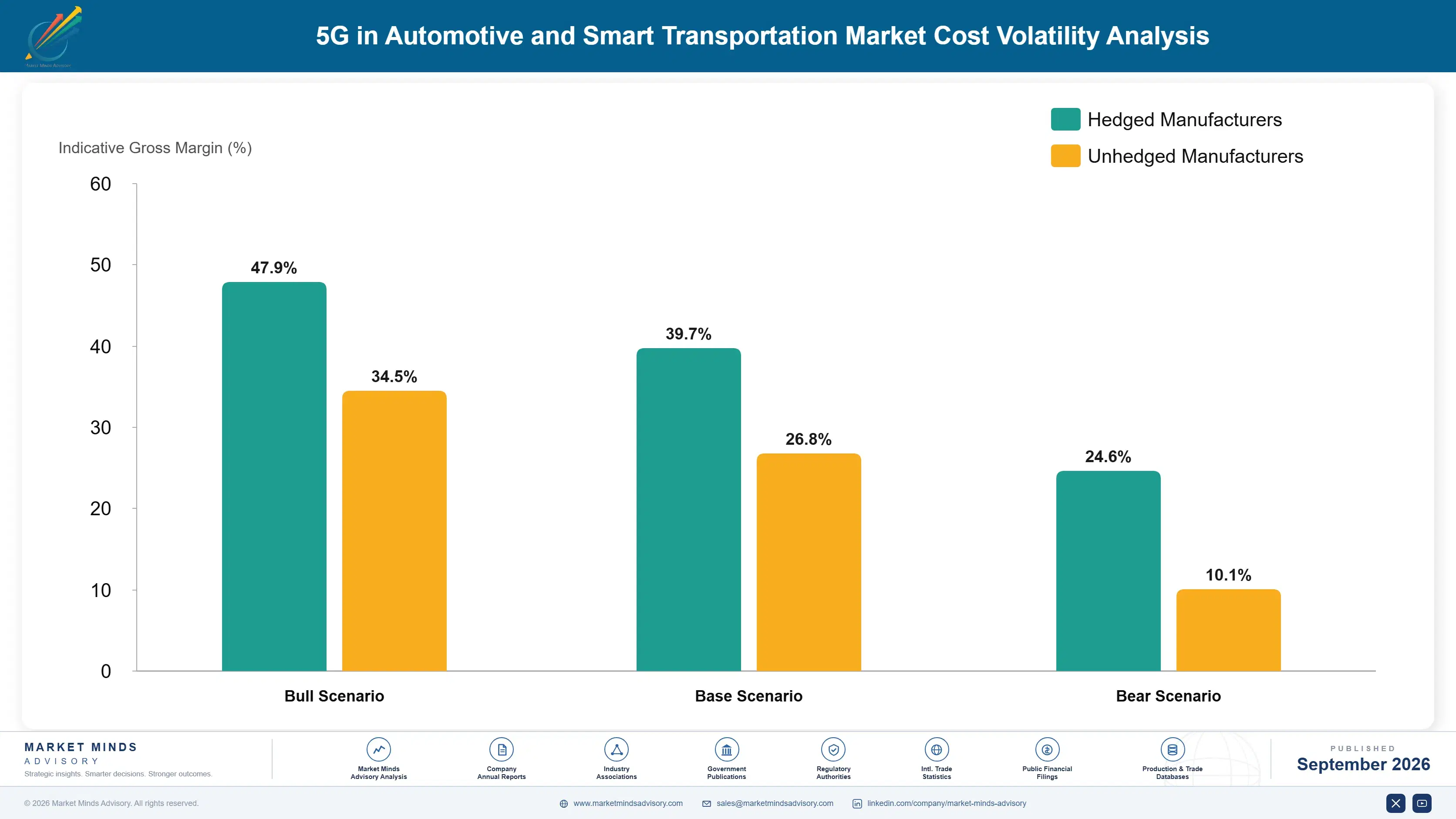
Semiconductor And Antenna Cost Exposure reflecting.

Semiconductor chipsets and antenna components represent the largest cost input for 5G automotive module manufacturing, running an estimated 45 to 50 percent of device bill of materials, sourced predominantly from Taiwanese and South Korean semiconductor foundries. Automotive-grade packaging and thermal management components add a smaller but meaningful additional share reflecting sustained automaker and infrastructure investment across connected vehicle programs as.
Semiconductor chipset pricing spiked notably during 2021 and 2022 amid the broader global chip shortage, delaying connected vehicle production for several automakers, according to company annual report disclosures from major automotive semiconductor suppliers. Manufacturers with long-term foundry capacity agreements weathered the disruption considerably better than those relying on spot market purchasing reflecting sustained automaker and infrastructure investment across connected vehicle programs as adoption continues expanding across passenger vehicles, fleet telematics, and smart.

Smaller suppliers face a meaningful competitive disadvantage since they lack the volume commitments needed to secure priority chipset allocation from constrained foundries, unlike Qualcomm and Huawei which negotiate dedicated capacity reservations at scale. This exposure varies by geography, with Chinese suppliers benefiting from proximity to domestic foundry capacity that reduces logistics lead time reflecting sustained automaker and infrastructure investment across connected vehicle programs as adoption continues expanding across.
5g-in-automotive-and-smart-transportation-market-cost-volatility-analysis-1790003489447

Secure Multi-Year Foundry Capacity Agreements Early reflecting sustained.

Leading suppliers increasingly lock in multi-year semiconductor foundry capacity agreements with guaranteed volume commitments well ahead of product launch windows, reducing exposure to spot market price spikes. This requires substantial upfront capital commitment but insulates production schedules from allocation shortfalls during periods of constrained industry-wide chip supply reflecting sustained automaker and infrastructure investment across connected vehicle.

Standardize Module Designs Across Multiple Product Tiers reflecting.

Suppliers are standardizing chipset and antenna designs across multiple product tiers to increase purchasing volume with foundry partners, reducing per-unit cost through economies of scale. This standardization adds engineering coordination overhead but provides meaningful cost advantage when negotiating annual wafer supply contracts reflecting sustained automaker and infrastructure investment across connected vehicle programs as adoption continues expanding.

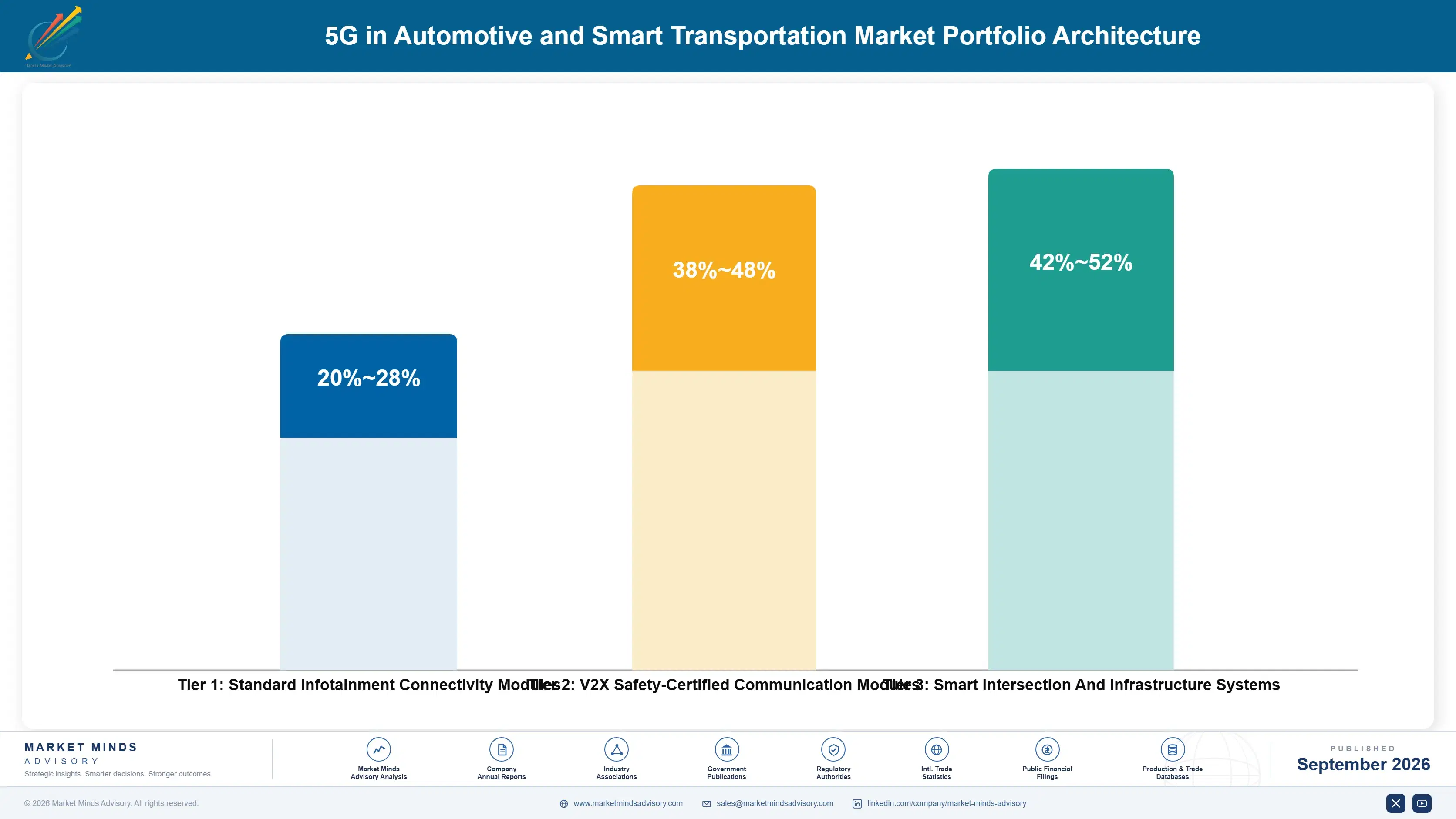
Portfolio Architecture for Margin Defence

Portfolio economics split between commodity-adjacent standard infotainment connectivity modules carrying moderate margins and premium V2X safety-certified or smart infrastructure systems commanding substantially higher gross margins tied to certification depth. Volume plays chase unit shipment scale while premium plays extract value through certification and consulting layered atop hardware reflecting sustained automaker and infrastructure investment across connected vehicle programs as adoption continues expanding across.
The tension between chasing infotainment volume and defending premium V2X positioning defines strategic choices across the supplier landscape. Suppliers pursuing mainstream vehicle accounts must accept moderate unit margins in exchange for order scale, while safety-certified and infrastructure specialists sacrifice volume for durable premium per-unit economics tied to certification exclusivity reflecting sustained automaker and infrastructure investment across connected vehicle programs as adoption continues expanding across passenger.

High-value margin pools concentrate in V2X safety certification, smart infrastructure consulting, and multi-standard module development rather than in standard infotainment connectivity itself, reinforcing why suppliers increasingly treat the module as a platform for higher-margin technical value-add reflecting sustained automaker and infrastructure investment across connected vehicle programs as adoption continues expanding across passenger vehicles, fleet telematics, and smart intersection.

Standard Infotainment Connectivity Modules

Mass-market 5G connectivity modules sold at accessible price points for mainstream vehicle infotainment, prioritizing unit shipment volume over margin capture reflecting sustained automaker and infrastructure investment across connected vehicle programs.
Gross Margin: 20-28%

V2X Safety-Certified Communication Modules

Automotive-grade certified modules meeting rigorous functional safety standards, sold to automakers requiring mandate-compliant vehicle certification reflecting sustained automaker and infrastructure investment across connected vehicle programs as adoption continues reflecting sustained.
Gross Margin: 38-48%

Smart Intersection And Infrastructure Systems

Vehicle-to-infrastructure communication systems and municipal deployment consulting representing the fastest-growing and highest strategic priority portion of revenue mix reflecting sustained automaker and infrastructure investment across connected vehicle programs as adoption.
Gross Margin: 42-52%
5g-in-automotive-and-smart-transportation-market-portfolio-architecture-1790003489946

High-value Sub-segments and Strategic Watch-out

Smart Intersection Infrastructure Consulting

Small today but expanding rapidly as municipalities seek deployment guidance, generating durable margin as public-private partnership funding models continue expanding reflecting sustained automaker and infrastructure investment across connected vehicle programs as adoption continues expanding across passenger vehicles, fleet telematics, and smart intersection deployments supporting reflecting sustained.
Gross Margin: 45-55%

V2X Safety-Certified Communication Modules

A substantial and rapidly expanding segment as government mandates take effect, generating durable multi-year supply contract revenue tied to vehicle production reflecting sustained automaker and infrastructure investment across connected vehicle programs as adoption continues expanding across passenger vehicles, fleet telematics, and smart intersection deployments reflecting sustained.
Gross Margin: 38-48%

Standard Infotainment Connectivity Modules

The largest volume segment today, anchored by broad mainstream vehicle adoption, though margin per unit remains comparatively thin relative to V2X and infrastructure segments reflecting sustained automaker and infrastructure investment across connected vehicle programs as adoption continues expanding across passenger vehicles, fleet telematics, and reflecting sustained.
Gross Margin: 20-28%

Legacy 4G LTE-Only Connectivity Modules

A strategic watch-out segment given accelerating automaker migration toward 5G-based connectivity. Suppliers still supporting legacy 4G-only modules must plan an orderly transition reflecting sustained automaker and infrastructure investment across connected vehicle programs as adoption continues expanding across passenger vehicles, fleet telematics, and smart intersection reflecting sustained.
Gross Margin: 12-20%

Recurring Certification Revenue Beyond Modules reflecting.

Module sales alone rarely produce durable annuity economics since vehicle production cycles run several years between platform refreshes. Suppliers increasingly design certification consulting and infrastructure deployment agreements to generate revenue continuity across vehicle platform generations, a strategy borrowed from broader automotive supplier commercial models reflecting sustained automaker and infrastructure investment across connected vehicle programs as adoption continues expanding across passenger vehicles,.
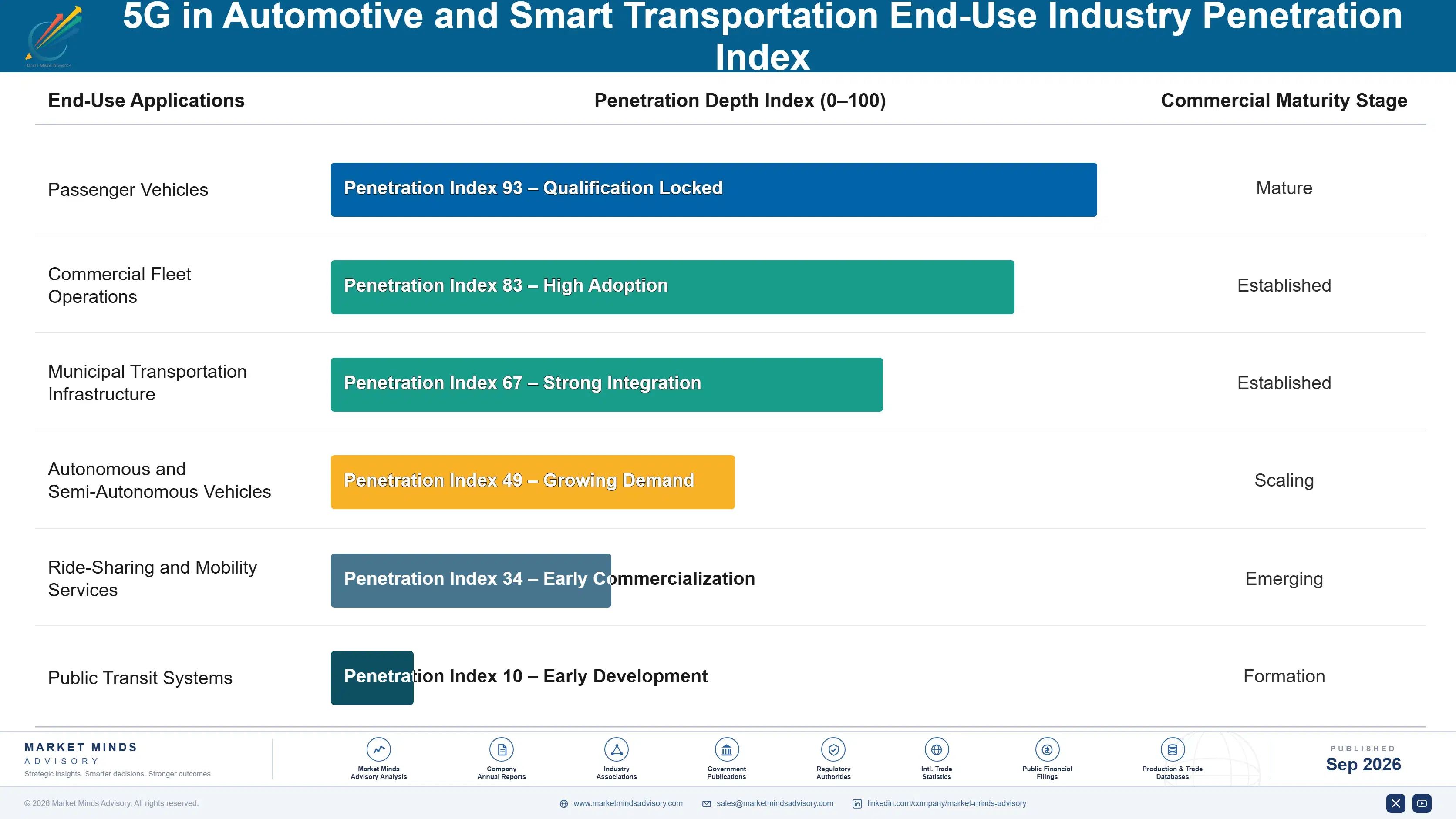
Adoption stickiness varies considerably by end-use vertical. Automakers show the deepest stickiness once a specific module is qualified and certified into a vehicle platform, since requalifying with a competing supplier requires extensive regulatory certification and testing across the platform lifecycle. Municipal transportation authorities show shallower stickiness, often multi-sourcing infrastructure equipment across several vendors depending on funding cycles reflecting sustained automaker and infrastructure investment across connected vehicle programs as.

Generational buyer shifts are also underway. Younger automotive engineering teams show markedly stronger interest in software-defined vehicle architecture than older cohorts, who historically favored hardware-fixed connectivity approaches. Procurement decision authority within automakers is simultaneously shifting from pure component cost negotiation toward broader connected vehicle platform partnership evaluation, changing how suppliers must position their value proposition reflecting sustained automaker and infrastructure investment across connected vehicle programs as adoption continues.
5g-in-automotive-and-smart-transportation-market-end-use-penetration-index-1790003490449

Where MMA Sees The Opportunity reflecting.

These are among the four positions where our research anticipates prominent divergence between winners and laggards over the coming forecast period. Each is grounded in the demand model, the regulatory perimeter, and the announced capacity pipeline.
01 / V2X CERTIFICATION INVESTMENT.

Build V2X Certification Capability Ahead Of Mandate Deadlines reflecting sustained.

Government transportation authorities are moving V2X from an optional premium feature toward a mandatory safety requirement, creating a predictable multi-year demand pipeline for certified suppliers. Suppliers that delay building automotive-grade certification capability risk losing qualification opportunities to competitors already embedded in automaker development programs years ahead of mandate deadlines. MMA views V2X certification investment as the single highest priority capital allocation decision for suppliers over the next three years reflecting sustained automaker and infrastructure investment across connected vehicle programs as adoption continues expanding across passenger vehicles,.
02 / MULTI-STANDARD MODULE DEVELOPMENT.

Develop Multi-Standard Modules To Win Global Automaker Platforms reflecting sustained.

Varying vehicle-to-everything communication standards across different countries complicate module design for automakers seeking to sell the same vehicle platform globally, creating a meaningful opportunity for suppliers offering unified multi-standard solutions. Suppliers that develop modules supporting both cellular and dedicated short-range approaches simultaneously will win global platform contracts more reliably than competitors offering only region-specific hardware. MMA views multi-standard development as more valuable than single-standard optimization reflecting sustained automaker and infrastructure investment across connected vehicle programs as adoption continues expanding across passenger vehicles, fleet telematics, and smart intersection.
03 / SMART INFRASTRUCTURE PARTNERSHIP STRATEGY.

Build Municipal Partnerships To Accelerate Infrastructure Deployment reflecting sustained automaker.

Municipal government budget constraints increasingly limit smart intersection infrastructure deployment pace, creating a meaningful gap between vehicle-side V2X capability and available infrastructure. Suppliers that build public-private partnership funding expertise will accelerate deployment more effectively than competitors waiting for municipal budgets to expand independently. MMA views infrastructure partnership development as essential for realizing the full commercial value of vehicle-side V2X investment already underway reflecting sustained automaker and infrastructure investment across connected vehicle programs as adoption continues expanding across passenger vehicles, fleet telematics, and smart intersection deployments supporting consistent.
04 / GEOPOLITICAL SUPPLY DIVERSIFICATION STRATEGY.

Diversify Manufacturing Footprint Against Geopolitical Trade Risk reflecting sustained automaker.

Ongoing geopolitical trade tensions affecting semiconductor supply chains create meaningful uncertainty for suppliers dependent on single-region manufacturing and export relationships, particularly those involving China-based production or Western market access restrictions. Suppliers that diversify manufacturing footprint across multiple geopolitical blocs reduce concentration risk considerably compared with those dependent on any single region. MMA views geopolitical diversification as an increasingly essential strategic consideration for suppliers reflecting sustained automaker and infrastructure investment across connected vehicle programs as adoption continues expanding across passenger vehicles, fleet telematics, and smart intersection deployments supporting.

Engagement Snapshot From the Field

A live engagement with an industry participant carrying material or product regulatory and market exposure ahead of a defining policy shift, showing how our research translates into a defensible multi-year portfolio strategy.
MARKET MINDS ADVISORY · CLIENT ENGAGEMENT SUMMARY
5G in Automotive and Smart Transportation Producer Strategic Portfolio Review and Transition Roadmap 2026·Investment Scenario on 5G in Automotive and Smart Transportation Exposure Evaluation 2025-26
CLIENT PROFILE
The client is a municipal transportation authority overseeing traffic infrastructure across a major metropolitan area, evaluating smart intersection vendors for a pilot vehicle-to-infrastructure communication deployment ahead of a broader citywide rollout decision reflecting sustained automaker and infrastructure investment across connected vehicle programs as adoption continues expanding across passenger vehicles, fleet telematics, reflecting sustained automaker and infrastructure investment across.
STRATEGIC CHALLENGE
The client needed to select a vendor capable of delivering measurable safety and traffic efficiency improvements while navigating limited municipal budget and competing infrastructure investment priorities reflecting sustained automaker and infrastructure investment across connected vehicle programs as adoption continues expanding across passenger vehicles, fleet telematics, and smart intersection deployments supporting.
MMA APPROACH
MMA combined its primary municipal survey data with expert interviews across transportation engineers and competing smart infrastructure vendors to benchmark deployment cost, safety outcomes, and funding model approaches across comparable metropolitan pilot programs reflecting sustained automaker and infrastructure investment across connected vehicle programs as adoption continues expanding across passenger vehicles,.
KEY FINDINGS
  1. Pilot intersections equipped with vehicle-to-infrastructure communication showed measurably reduced collision rates compared with unequipped intersections reflecting sustained automaker and infrastructure investment reflecting sustained automaker.
  2. Public-private partnership funding models significantly reduced the municipal budget burden compared with fully public financing reflecting sustained automaker and infrastructure reflecting sustained automaker and.
  3. Traffic signal timing optimization based on connected vehicle data meaningfully improved intersection throughput during peak hours reflecting sustained automaker and infrastructure reflecting sustained automaker.
  4. Phased deployment starting with highest-collision intersections maximized safety impact per dollar of infrastructure investment reflecting sustained automaker and infrastructure investment reflecting sustained automaker and.
CLIENT PROFILE
The client is a municipal transportation authority overseeing traffic infrastructure across a major metropolitan area, evaluating smart intersection vendors for a pilot vehicle-to-infrastructure communication deployment ahead of a broader citywide rollout decision reflecting sustained automaker and infrastructure investment across connected vehicle programs as adoption continues expanding across passenger vehicles, fleet telematics, reflecting sustained automaker and infrastructure investment across.
STRATEGIC CHALLENGE
The client needed to select a vendor capable of delivering measurable safety and traffic efficiency improvements while navigating limited municipal budget and competing infrastructure investment priorities reflecting sustained automaker and infrastructure investment across connected vehicle programs as adoption continues expanding across passenger vehicles, fleet telematics, and smart intersection deployments supporting.
MMA APPROACH
MMA combined its primary municipal survey data with expert interviews across transportation engineers and competing smart infrastructure vendors to benchmark deployment cost, safety outcomes, and funding model approaches across comparable metropolitan pilot programs reflecting sustained automaker and infrastructure investment across connected vehicle programs as adoption continues expanding across passenger vehicles,.
KEY FINDINGS
  1. Pilot intersections equipped with vehicle-to-infrastructure communication showed measurably reduced collision rates compared with unequipped intersections reflecting sustained automaker and infrastructure investment reflecting sustained automaker.
  2. Public-private partnership funding models significantly reduced the municipal budget burden compared with fully public financing reflecting sustained automaker and infrastructure reflecting sustained automaker and.
  3. Traffic signal timing optimization based on connected vehicle data meaningfully improved intersection throughput during peak hours reflecting sustained automaker and infrastructure reflecting sustained automaker.
  4. Phased deployment starting with highest-collision intersections maximized safety impact per dollar of infrastructure investment reflecting sustained automaker and infrastructure investment reflecting sustained automaker and.
RECOMMENDED STRATEGY
Phase 1: Phase one: deploy smart intersection technology at the highest-collision intersections identified through traffic safety data analysis reflecting sustained automaker and. Phase 2: Phase two: pursue public-private partnership funding to expand deployment without straining municipal budget constraints reflecting sustained automaker and infrastructure investment across. Phase 3: Phase three: expand citywide based on pilot safety outcomes and funding model effectiveness demonstrated during initial rollout reflecting sustained automaker.
OUTCOME
The client deployed smart intersection technology at its highest-collision locations, reporting a 22 percent reduction in collision rates within two quarters (client-reported, unverified by MMA), and subsequently secured public-private partnership funding for citywide expansion reflecting sustained automaker and infrastructure investment across connected vehicle programs as adoption continues expanding across passenger.

Frequently Asked Questions

Foundational context covering the market sizes, CAGR, scope, country, region and competition that inform every finding below. This section is provided to cover basics and most often pre-purchase conversations, answered from the MMA Primary Research Dataset.

What is the current size of the 5G in Automotive and Smart Transportation Market?

The global 5G in automotive and smart transportation market is valued at 4.4 billion dollars in 2025, the base year for this report's forecast period.

How large will the 5G in Automotive and Smart Transportation Market be by 2036?

MMA projects the market will reach approximately 22.5 billion dollars by 2036, driven by V2X safety mandates and smart intersection deployment reflecting sustained automaker reflecting sustained.

What is the CAGR for the 5G in Automotive and Smart Transportation Market 2026 to 2036?

The market is forecast to grow at a compound annual growth rate of 16.0 percent between 2026 and 2036 under MMA's base case scenario reflecting sustained.

Which segment is growing fastest?

V2X safety-critical communication modules lead at a 20.5 percent CAGR, roughly 1.28 times the overall market rate, driven by government mandates reflecting sustained automaker and.

Who are the major companies in the 5G in Automotive and Smart Transportation Market?

Qualcomm Technologies, Huawei Technologies, Continental, Harman International, and Ericsson hold leading positions globally reflecting sustained automaker and infrastructure investment across connected vehicle reflecting sustained automaker and.

Which country is growing fastest?

China leads at an 18.0 percent CAGR, supported by its massive connected vehicle manufacturing base and aggressive 5G infrastructure buildout reflecting sustained automaker and reflecting sustained.

Report Segmentation Architecture

The full report scope spans multiple orthogonal segmentation dimensions, with cross-tabulated demand data provided for each dimension pair. Coverage extends further to regional breakdowns, trend trajectories, and the competitive detail needed to support segment-level decision-making.

By Product Type

  • Standard Infotainment Connectivity Modules
  • V2X Safety-Critical Communication Modules
  • Smart Intersection Infrastructure Systems
  • Fleet Telematics Systems
  • Multi-Standard Global Platform Modules
  • Infrastructure Deployment Consulting Services

By End-Use Industry

  • Passenger Vehicles
  • Commercial Fleet Operations
  • Municipal Transportation Infrastructure
  • Autonomous and Semi-Autonomous Vehicles
  • Ride-Sharing and Mobility Services
  • Public Transit Systems

By Commercial Dimension

  • Direct Automaker Supply
  • Tier One Automotive Contract
  • Municipal Government Procurement
  • Infrastructure Consulting Services

By Region

  • North America
  • Western Europe
  • East Asia
  • South Asia and Pacific
  • Latin America
  • Middle East and Africa
  • Eastern Europe

Scope, Methodology, and Coverage

Every figure in this report is reproducible from documented input assumptions. The scope below maps the historical period, the forecast horizon, the segmentation dimensions, and the countries covered, alongside the underlying primary and qualitative methodology.
Historical Period
2020 to 2025
Forecast Period
2026 to 2036
Base Year
2025 (USD billions; MMA Primary Research Dataset, September 2026)
Market Definition
This report covers 5G connectivity modules, vehicle-to-everything communication systems, and smart intersection infrastructure that enable connected vehicle applications including infotainment, fleet telematics, and safety-critical collision avoidance. It excludes standard 4G LTE-only connectivity modules and non-connected advanced driver assistance sensor systems reflecting sustained automaker and infrastructure investment across.
Quantitative Units
USD billions, module unit shipments where cited
Segmentation Dimensions
Product Type, End-Use Industry, Commercial Dimension, Region
Regions Covered
North America, Western Europe, East Asia, South Asia and Pacific, Latin America, Middle East and Africa, Eastern Europe
Countries Covered
China, United States, Germany, Japan, South Korea, India, Brazil, United Kingdom, and 30 additional countries
Key Companies Profiled
20
Quantitative Methodology
Primary survey, n=3,800 respondents, Q4 2025, six countries; demand-side model with trade association cross-validation
Qualitative Methodology
47 expert interviews, Q4 2025; applied to validate demand model assumptions, identify emerging dynamics, and assess competitive positioning
Report Format
PDF and XLSX data workbook (Word format preview document)
Publisher
Market Minds Advisory
Report Code
MMA-2026-AUT-114
Published
September 2026
Contact
sales@marketmindsadvisory.com | www.marketmindsadvisory.com

Purchase the full 5G in Automotive and Smart Transportation Market Report (2026 to 2036).

The full report provides comprehensive coverage of the global 5G in automotive and smart transportation market across all segments, regions, and competitive dynamics outlined in this summary. It includes detailed supplier profiles, pricing benchmarks, and quantified segment-level forecasts through 2036. These findings draw on MMA's primary survey of 3,800 respondents and 47 expert interviews conducted in the fourth quarter of 2025. Subscribers receive quarterly data updates tracking regulatory mandate developments and competitive positioning shifts as the market evolves. Regional appendices break out country-level detail across thirty nine markets covered in this study.
Segment-level revenue forecasts through 2036 reflecting sustained.
Twenty supplier competitive profiles and benchmarking reflecting.
Country-level market sizing across 39 countries reflecting.
Quarterly data updates through subscription access reflecting.
Primary survey data across six countries reflecting.
Expert interview transcripts and analyst commentary reflecting.

Built For The People Who Decide

From boardroom strategy to bench-side execution, this report is read cover-to-cover by leaders shaping the next decade of their industry, turning demand scenarios, market dynamics and valuation benchmarks into decisions.
CXOs/ Presidents/ VPs/ Managers
M&A and Corporate Development
Strategy Teams and R&D Heads
Procurement and Product Directors
Regulatory and Compliance Leaders
Investor Relations and Equity Analysts