Market Minds Advisory
3D Printing Photopolymers Market

3D Printing Photopolymers Market: Dental and Engineering Applications Reshape a Resin Chemistry Category

Point-of-care dental printing and engineering-grade prototyping are pulling photopolymer resin demand toward specialized formulations faster than Stratasys and Covestro can requalify chemistry for dental clinics and manufacturers alike across the industry.

Lead Analyst

Alice Ballenger

Published

September 2026

Make Smarter Decisions with Customized Research Insights

Request a free sample report and evaluate market opportunities, growth trends, and competitive dynamics relevant to your business needs.

2025 MARKET VALUE$1.8BMarket Size 2025
2036 FORECAST VALUE$4.8BBase Case , 2026 to 2036
CAGR 2026 TO 20369.4 %Bull 10.6% / Bear 8.1%
INCREMENTAL OPPORTUNITY$2.9BNet 10- year value creation
EXPANSION MULTIPLE2.46x2036 value over 2026 base
Strategic Levers
M&A Pipeline
Regional Outlook
Country Rankings
Competitive Intelligence
Segmental Deep-dive
Call-Us : 91 93563 13602

Executive Snapshot and Market Trajectory

Photopolymer resin demand is shifting from general-purpose prototyping toward dental, medical, and engineering-grade formulations, and resin chemists are racing to qualify new chemistry across competing printer platforms faster than most buyers expected two years ago. Buyers face few genuine alternatives given how few competitors match that scale.
Standard general-purpose resins remain the largest category by volume, but dental and medical formulations are growing fastest as point-of-care digital dentistry and clear aligner production both scale globally. North America and Western Europe together anchor the deepest concentration of resin chemistry development, reflecting decades of polymer science investment at Stratasys, 3D Systems, and the European specialty chemicals majors. Buyers increasingly weigh both certification depth and platform compatibility when selecting a resin supplier each year.
Stratasys and Covestro set formulation and platform-compatibility benchmarks that smaller specialty resin makers struggle to match across a full application portfolio. Tightening dental and medical device certification requirements and rapidly evolving engineering-grade resin chemistry are both reshaping which formulators can keep pace with printer manufacturer and end-user qualification timelines each year. Buyers increasingly diversify across multiple qualified suppliers rather than depend on any single formulator for critical application volume.
Market Definition
The 3D printing photopolymers market covers UV and light-curable liquid resins formulated for stereolithography, digital light processing, and material jetting additive manufacturing processes, including standard, engineering, dental, medical, and elastomeric formulations. It excludes the 3D printers themselves, thermoplastic filaments and powders used in other additive manufacturing processes, and post-processing equipment.
Base Year Value
$1.8B in 2025 (MMA Primary Research Dataset, August 2026)
Forecast Period
2026 to 2036, eleven discrete annual values
CAGR
9.4% base case. Bull 10.6%. Bear 8.1%.
Fastest Growth Segment
Dental and Medical Photopolymer Resins: 14.2% CAGR
Fastest Growth Country
South Korea: 12.4% CAGR
Fastest Growth Region
South Asia and Pacific: 11.4% CAGR
Largest Region
North America: 27% of 2025 global value
Market Leaders
Stratasys Ltd., 3D Systems Corporation, Formlabs Inc., Carbon Inc., Covestro AG. Source: MMA Analysis based on company annual reports and primary research, July 2026.
Primary Survey
n=3,800 procurement and R&D decision-makers, Q4 2025, six countries
Methodology
Demand-side build-up, cross-validated against public data, 47 expert interviews

3D Printing Photopolymers Market Forecast Scenarios

3d-printing-photopolymers-market-size-forecast-scenario-1787303621835
Photopolymer resin demand grew steadily across 2020 to 2025 as desktop and industrial printer adoption both expanded, though periodic printer hardware shortages briefly constrained resin volume growth during component supply disruptions. The market grew at an estimated 8.4% historical CAGR across the period, reflecting that mix of steady printer adoption and periodic hardware-driven demand constraints across major producing regions each year.
The base case assumes dental and medical resin certification continues expanding through 2030, engineering-grade formulations move from prototyping into end-use production parts by 2028, and formulators add incremental specialty resin capacity to meet both established and emerging demand pools. Together these three commercial mechanisms support a 9.4% forecast CAGR, with standard general-purpose resins remaining the volume anchor even as dental and engineering formulations narrow the value gap each year overall.
The bull case centers on dental and medical resin adoption reaching full clinical standardization well ahead of current 2028 timelines. The bear case centers on a renewed printer hardware investment slowdown, whether from capital spending pullback or reduced manufacturing activity, which would strand incremental resin capacity investment across formulators worldwide for several years across the industry.

Specialty Applications Meet a Maturing Resin Category

Photopolymer resins sit at the intersection of specialty chemistry and printer engineering, since a formulation must cure predictably on a specific printer's light source and optical system while meeting the mechanical, biocompatibility, or aesthetic requirements of its end application. That dual requirement has kept the formulator base concentrated among companies with genuine photochemistry expertise rather than simple resin blending. Buyers rarely switch suppliers mid-program as a result.
MARKET CONCENTRATION (CR5)48%Top five formulators hold a fragmented plurality overall
AVERAGE SELLING PRICE$165 per literReflects resin chemistry, certification, and cure profile level
TOP PRODUCING COUNTRY SHAREUnited States, 24%Largest single national base for formulation capacity today
CAPACITY UTILIZATION RATE74%Formulators expanding ahead of confirmed near-term demand growth
TRADE INTENSITY58% cross-borderMost shipped volume crosses a border before end use
PHOTOINITIATOR COST SHARE44% of COGSLargest single cost line in formulation overall today
Commercially, the market splits between a mature general-purpose and engineering resin base sold through printer manufacturer and distributor channels, and a smaller but faster-growing dental and medical tier sold on regulatory certification rather than mechanical performance alone. Elastomeric and ceramic-filled resins round out demand with application-specific purchasing tied to footwear, jewelry, and investment casting workflows. Pricing differs meaningfully across each tier described.
Over the next decade, application-specific certification will matter more than general mechanical performance alone, since most established formulators already meet baseline strength and accuracy requirements for standard prototyping work. The formulators that can add incremental dental and engineering-grade certification fastest stand to capture a widening share of a market that clinical and industrial end-use adoption is reshaping simultaneously, across every major producing geography today.
"Nobody buys a liter of resin for its own sake. They are buying whatever certification or performance spec lets that resin escape the prototyping bin and go into a real product or a real mouth."
Director, Additive Manufacturing Materials Practice · MMA Chemicals & Materials

Market Trends

Point-of-Care Dental Resin Adoption Accelerates Rapidly

Dental practices and orthodontic labs are increasingly adopting in-office 3D printing for clear aligners, surgical guides, and temporary crowns, driving demand for biocompatible photopolymer resins certified to dental device regulatory standards. Formlabs and 3D Systems have both expanded dental-certified resin portfolios since 2023, targeting practices that want same-day digital workflows rather than outsourcing production to centralized dental laboratories. Formulators that clear biocompatibility certification for a specific dental application are capturing recurring resin consumable revenue that uncertified competitors cannot access, a qualification gap widening as more practices standardize around in-office digital dentistry.
Market Impact: Adds demand at 100% of practices

Engineering-Grade Resin End-Use Production Rapidly Expands

Manufacturers are increasingly qualifying photopolymer resins for end-use production parts rather than prototyping alone, driven by engineering-grade formulations that now match injection-molded thermoplastic performance in temperature resistance and mechanical strength for select applications. Carbon and Stratasys have both expanded engineering resin portfolios targeting automotive, industrial, and consumer product manufacturers evaluating additive manufacturing for low-volume production runs. Formulators that qualify resins for specific end-use production programs are capturing recurring consumable revenue that prototyping-only resin sales cannot match, a shift accelerating as manufacturers gain confidence in long-term part durability data. Adoption continues expanding across the industry.
Market Impact: Closes 90% of performance gap

Market Opportunities and Growth Drivers

Digital Dentistry Clinical Adoption Expansion Continues

Dental practices worldwide are continuing to adopt digital scanning and in-office 3D printing workflows, driven by both patient demand for faster treatment timelines and practice economics that favor same-day clear aligner and surgical guide production over outsourced laboratory work. Each dental practice that adopts in-office printing becomes a recurring resin consumable customer, meaning clinical adoption translates almost directly into resin demand growth without the substitution flexibility buyers have in less regulated categories. Formulators are responding by expanding dental sales and clinical support teams to capture this recurring consumable relationship ahead of qualification competition from rival resin makers.
Market Impact: Limits use to 1 platform

Engineering-Grade Formulation Performance Improvements Rapidly Accelerate

Resin chemists have continued improving engineering-grade photopolymer formulations to match injection-molded thermoplastic performance in temperature resistance, impact strength, and long-term durability, closing a performance gap that historically confined photopolymer resins to prototyping applications alone. Manufacturers evaluating additive manufacturing for low-volume production runs increasingly specify these engineering-grade formulations once qualification testing confirms comparable part lifetime to conventional manufacturing methods. Formulators including Carbon and Stratasys have both disclosed engineering resin roadmaps targeting automotive and industrial end-use production, reflecting sustained confidence that performance parity will keep expanding the addressable production application base across the region.
Market Impact: Requires 12 to 18 month certificati

Market Restraints and Challenges

Printer Platform Compatibility Fragmentation Limits Growth

Photopolymer resins must be formulated and validated for a specific printer's light source wavelength, optical system, and build chemistry, meaning a formulation qualified for one manufacturer's platform typically cannot be sold for use on a competitor's printer without separate reformulation and validation. That fragmentation forces formulators to choose which printer platforms to prioritize rather than developing one universal formulation, slowing the pace at which any resin innovation reaches the installed printer base. Formulators are responding by prioritizing partnerships with the largest-installed-base printer manufacturers first, though this approach concentrates commercial risk if a printer manufacturer's market share declines unexpectedly.
Market Impact: Expands certified lines across 20+

Regulatory Certification Cost and Timeline Burden

Dental and medical photopolymer resins require biocompatibility and regulatory certification testing that can take twelve to eighteen months and involves upfront cost before a formulation can be legally marketed for clinical use, a burden other resins do not carry. That certification timeline discourages smaller formulators from entering dental and medical applications even when chemistry performs adequately, concentrating this higher-margin segment among better-capitalized competitors. Formulators are responding by pursuing certification in phases, starting with lower-risk applications before pursuing demanding surgical or implantable certifications, though this approach still requires years of investment before full application coverage is achieved.
Market Impact: Matches injection-molded strength w
3 additional market trends, 4 additional growth drivers, and 3 additional restraints and challenges are covered in the full report. Contact sales@marketmindsadvisory.com to access the complete intelligence.

Segment CAGR and Growth Architecture

Photopolymer resins segment by chemistry and application, the classification formulators and printer manufacturers use to set certification pathway, cure profile, and platform compatibility, since standard, dental, and engineering buyers each negotiate under distinct commercial and technical terms. Formulators price each category differently depending on certification depth and platform compatibility required each year across the industry.
3d-printing-photopolymers-market-market-share-analysis-1787303622372

Dental and Medical Photopolymer Resins

Dental and medical photopolymer resins are the fastest-growing segment as dental practices and orthodontic labs increasingly adopt in-office 3D printing for clear aligners, surgical guides, and temporary crowns requiring biocompatible, regulatory-certified formulations. Formlabs and 3D Systems have expanded dental-certified resin portfolios since 2023, targeting practices that want same-day digital workflows rather than outsourcing production to centralized laboratories. Formulators that clear biocompatibility certification for a dental application are capturing recurring resin consumable revenue that uncertified competitors cannot access, a qualification advantage that compounds as more practices standardize around in-office digital dentistry workflows. If dental adoption continues expanding at pace, this segment could approach a share of total category value within the next decade, a trajectory no other category currently matches.
CAGR 14.2%

Engineering and High-Performance Photopolymer Resins

Engineering and high-performance photopolymer resins are the second-fastest-growing segment as manufacturers increasingly qualify photopolymer resins for end-use production parts rather than prototyping alone, driven by formulations that now match injection-molded thermoplastic performance in temperature resistance and mechanical strength for select applications. Carbon and Stratasys have both expanded engineering resin portfolios targeting automotive, industrial, and consumer product manufacturers evaluating additive manufacturing for low-volume production runs where tooling costs make conventional manufacturing uneconomical. This segment carries meaningfully higher per-liter value than standard general-purpose resins given the formulation complexity and performance validation required. Formulators with early end-use production qualification experience are positioning to capture disproportionate share as manufacturer confidence in long-term part durability continues building across the industry.
CAGR 9.8%
Full segment breakdown across 6 segments available in the complete report.

Regional Architecture and Country Demand Map

Photopolymer resin formulation concentrates in North America and Western Europe given decades of accumulated polymer chemistry investment, while East Asia grows fastest as dental and manufacturing adoption both scale rapidly. South Asia and Pacific follows closely given similar dental and manufacturing adoption trends across the region.

North America

The United States accounts for the large majority of North America's photopolymer resin demand, anchored by Stratasys, 3D Systems, Formlabs, and Carbon's combined formulation and printer manufacturing base concentrated across the country's additive manufacturing industry corridors. Dental and medical resin adoption across US dental practices and orthodontic labs represents a significant and growing demand driver, since in-office digital dentistry workflows require ongoing certified resin consumable purchasing. Canada contributes a smaller but steady share tied to its own manufacturing and dental technology sectors. Mexico's contribution remains modest but is growing as North American manufacturing supply chains increasingly specify additive manufacturing for prototyping and low-volume production, particularly across automotive and consumer goods programs nationwide.
Share: 27% | CAGR: 9.8% (2026 to 2036)

Western Europe

Germany, the Netherlands, and France anchor Western Europe's photopolymer resin demand, reflecting Covestro's, DSM's legacy specialty chemicals base, and BASF's Forward AM resin operations concentrated across the region's chemical engineering corridor. Rising engineering-grade resin adoption across German automotive and industrial manufacturing is a primary near-term demand driver, since manufacturers increasingly specify additive manufacturing for low-volume tooling and end-use parts. The United Kingdom contributes a distinct demand pool through DWS Systems and Photocentric's specialty resin manufacturing base. Growth here trails East Asia and North America given an already-mature formulation base and a customer mix weighted toward established engineering applications rather than new dental adoption. Manufacturers serving this market operate at meaningful scale despite trailing East Asian growth rates.
Share: 23% | CAGR: 7.8% (2026 to 2036)
Regional intelligence for 5 additional markets available in the complete report: East Asia, South Asia and Pacific, Latin America, Middle East and Africa, Eastern Europe. Contact sales@marketmindsadvisory.com.
3d-printing-photopolymers-market-country-cagr-analysis-1787303622903

Where Resin Formulators Are Capturing Margin

Four commercial moves separate photopolymer resin formulators capturing outsized margin from those competing purely on delivered liter price, each tied to certification depth, printer platform partnership, or end-use qualification that shields volume from commodity price competition across the industry each year. Each move requires a different mix of capital investment and multi-year commercial commitment before it meaningfully improves margin.

Dental and Medical Certification Investment Growth Program

Formulators investing in biocompatibility and regulatory certification testing for dental and medical applications are capturing recurring resin consumable revenue that uncertified competitors cannot access as more dental practices standardize around in-office digital workflows. Certifying a dental-grade formulation typically costs $3 million to $8 million in biocompatibility, mechanical, and clinical validation testing against regulatory requirements. Formulators without dental certification increasingly lose recurring consumable relationships to better-certified competitors as clinical adoption accelerates across the industry. Formulators without such investment risk permanent exclusion from recurring clinical consumable revenue industry-wide across every major regional market.
Market Impact: Costs $3 to $8 million per new cert

Printer Manufacturer Platform Partnership Growth Program

Formulators securing formal partnerships with major printer manufacturers, gaining validated compatibility status across a large installed printer base, are capturing distribution reach that independent resin makers selling through secondary channels cannot match. Establishing this kind of embedded platform partnership typically costs $2 million to $5 million in joint validation testing and co-marketing investment per major printer manufacturer relationship. Formulators without these partnerships increasingly compete purely on price against validated resins carrying the printer manufacturer's own endorsement. Formulators without validated status increasingly cede distribution reach to better-positioned rivals across most regional markets.
Market Impact: Costs $2 to $5 million per new part

Engineering End-Use Qualification Growth Strategy Program

Formulators developing engineering-grade resins qualified for end-use production parts, rather than prototyping alone, are capturing recurring consumable revenue tied to ongoing manufacturing programs rather than one-time prototyping purchases. Qualifying an engineering-grade formulation for a specific end-use production program typically costs $1 million to $4 million in mechanical, thermal, and long-term durability testing. Formulators without end-use qualification increasingly miss production program specification opportunities to competitors with proven long-term part performance data. Formulators without this qualification increasingly lose production program bids to better-prepared rivals investing in durability testing across the region each year.
Market Impact: Costs $1 to $4 million per new qual

Long-Term Distributor Supply Agreement Growth Program

Formulators securing multi-year supply agreements with major additive manufacturing distributors, guaranteeing defined volume and priority allocation, are capturing premium pricing that protects against spot-market competition from smaller regional formulators without comparable production scale. These agreements typically carry a 4 to 10% price premium over transactional purchasing, reflecting the value distributors place on guaranteed formulation supply and consistent quality across large order volumes. Formulators able to demonstrate reliable quality and delivery increasingly win renewal negotiations over smaller competitors lacking comparable track records. Formulators without such agreements compete purely on price when distributor volume is scarce.
Market Impact: Commands 4 to 10% premium over spot

Who Controls the Margin Pool

The top five formulators hold an estimated 48% of global photopolymer resin shipment volume, a fragmented plurality reflecting the range of specialized chemistry niches that smaller formulators can still profitably serve. Stratasys and Covestro lead on formulation breadth and printer platform relationships, while a second tier of formulators competes on niche technical performance in categories like elastomeric and ceramic-filled resins that do not require a full portfolio.
Current competitive activity centers on three fronts. Dental and medical certification investment is opening a new front for formulators willing to commit testing capital ahead of further clinical adoption. Engineering end-use qualification is becoming important as manufacturers push suppliers to prove long-term production part performance. And formulators are pursuing direct printer manufacturer partnerships to secure validated platform compatibility.

Emerging pressure comes from smaller specialty formulators moving into dental and engineering certification as they partner with established printer manufacturers, though matching Stratasys or Covestro's full application portfolio breadth remains years away for most. If these challengers close that certification gap, expect share to shift within specific application niches first, before any pressure reaches the largest incumbents given how deeply embedded existing printer manufacturer and distributor relationships are across the industry.
3d-printing-photopolymers-market-company-positioning-matrix-1787303623428

Competitive Moat and Risk Dimensions

STRATASYS LTD.

Moat: Broad Industrial Printer Installed Base

Stratasys holds one of the largest installed bases of industrial and professional 3D printers globally, giving its formulated resins a captive consumable market that independent resin makers selling into competing platforms cannot replicate. That installed base took decades to build and generates recurring resin revenue regardless of new printer sales pace.
STRATASYS LTD.

Risk: Hardware-Chemistry Bundling Margin Pressure

Stratasys faces growing pressure from open-material printer platforms that let customers use third-party resins, potentially eroding the captive consumable relationship that has historically anchored its resin margins across its installed printer base. That exposure compounds as more printer manufacturers adopt open-material policies to compete for hardware sales.
COVESTRO AG

Moat: Polymer Chemistry Manufacturing Scale

Covestro's broader polymer chemistry manufacturing scale, inherited through its acquisition of DSM's resins business, gives it raw material cost and formulation research depth that dedicated photopolymer specialists cannot match. This scale lets Covestro invest in next-generation chemistry research that smaller competitors cannot fund independently, across most major formulation categories each year.
COVESTRO AG

Risk: Photopolymer Niche Within Bulk Chemicals

Covestro's photopolymer business represents a small fraction of its overall bulk polymer and coatings portfolio, meaning photopolymer-specific capacity investment competes internally against larger corporate priorities for capital allocation and management attention. That internal competition has occasionally left photopolymer investment slower than dedicated specialists would prefer.

Players Tracked

Prominent Players

Stratasys Ltd.
3D Systems Corporation
Formlabs Inc.
Carbon Inc.
Covestro AG

Other Key Players

BASF SE
Henkel AG & Co. KGaA
Arkema S.A.
Allnex Group
DWS Systems S.r.l.
Photocentric Ltd.
Nexa3D Inc.
Liqcreate B.V.
Desktop Metal Inc.
Siraya Tech
Prusa Research a.s.
Shenzhen Anycubic Technology Co. Ltd.
Phrozen Tech Co. Ltd.
Elegoo Inc.
Peopoly Ltd.

Recent Developments

APRIL 2025

Formlabs Expands Dental Resin Certification Portfolio

Formlabs commissioned additional biocompatibility testing capacity to certify new dental resin formulations for expanded clinical applications, meeting rising in-office digital dentistry demand. The expansion followed distributor commitments signed as more dental practices adopted in-office printing workflows. Similar expansions are expected across other qualified formulators serving nearby clinics.
Signal: Confirms formulators are pre-committing ce
OCTOBER 2024

Carbon Signs Multi-Year Engineering Resin Supply Agreement

Carbon secured a multi-year supply agreement with a major automotive manufacturer covering engineering-grade resin formulations for end-use production parts, guaranteeing defined volume through 2028. The agreement reflects manufacturers' broader push to lock in qualified resin supply ahead of expanded production programs. Similar agreements are expected across other qualified formulators.
Signal: Shows manufacturers prioritizing supply ce
JANUARY 2025

Covestro Announces Asia-Pacific Formulation Capacity Investment

Covestro announced incremental photopolymer resin formulation capacity investment at its Asia-Pacific facility to serve growing regional dental and manufacturing customers directly. The investment followed sustained regional demand growth as East Asian adoption accelerated across multiple applications. Industry analysts expect similar investments from competing formulators regionwide soon.
Signal: Signals formulation capacity is shifting t

Photoinitiator and Monomer Feedstock Cost Exposure

Photoinitiators and specialty monomers together account for roughly 44% of cost of goods sold in photopolymer resin formulation, sourced from a limited pool of qualified specialty chemical suppliers capable of meeting the purity and cure-performance tolerances resin formulation requires. Pigments and additive packages add a further meaningful share, concentrated among formulators maintaining both chemistry expertise and supplier relationships.
Photoinitiator and monomer prices spiked during 2021 and 2022 as specialty chemical supply chains tightened following broader disruption, with several formulators reporting input cost increases exceeding 26% in their 2022 annual reports before pricing stabilized through 2023. Industry supply chain reviews have flagged photoinitiator sourcing as photopolymer formulation's single most constrained input, more than monomers or pigments combined. Several formulators have publicly flagged this feedstock exposure as a leading operational risk heading into 2026.

Smaller specialty formulators without long-term photoinitiator supply agreements absorbed the 2021 and 2022 shortage hardest, losing contract bids to larger competitors including Stratasys and Covestro that had negotiated priority allocation years in advance. Formulators with secured feedstock supply weathered the shortage far better than those dependent on spot market purchasing, a cost advantage that persists most sharply across smaller specialty formulators today.
3d-printing-photopolymers-market-cost-volatility-analysis-1787303623625

Long-Term Photoinitiator Supply Agreements

Larger formulators are locking in multi-year photoinitiator and monomer supply agreements directly with qualified specialty chemical suppliers, guaranteeing predictable input costs ahead of demand increases rather than relying on spot market purchasing that has grown increasingly volatile since 2021. This approach adds cost certainty to production planning even when spot pricing swings sharply during periods of tight allocation.

Vertical Integration Into Monomer Production

Several formulators are investing in internal monomer production capability to reduce dependence on third-party suppliers, gaining pricing control and supply security that non-integrated competitors dependent on external sourcing cannot match during shortage periods. This integration also reduces exposure to spot market volatility that has repeatedly disadvantaged non-integrated competitors during past tightening cycles overall each time.

Application Portfolio Diversification Strategy

Formulators are pursuing dental, medical, and engineering qualification partly to diversify revenue beyond standard general-purpose resins most exposed to photoinitiator cost pass-through limitations under competitive distributor pricing pressure. This diversification strategy also spreads formulator revenue across a broader set of application categories, reducing dependence on any single feedstock or pricing cycle for volume consistently overall.

Portfolio Architecture for Margin Defence

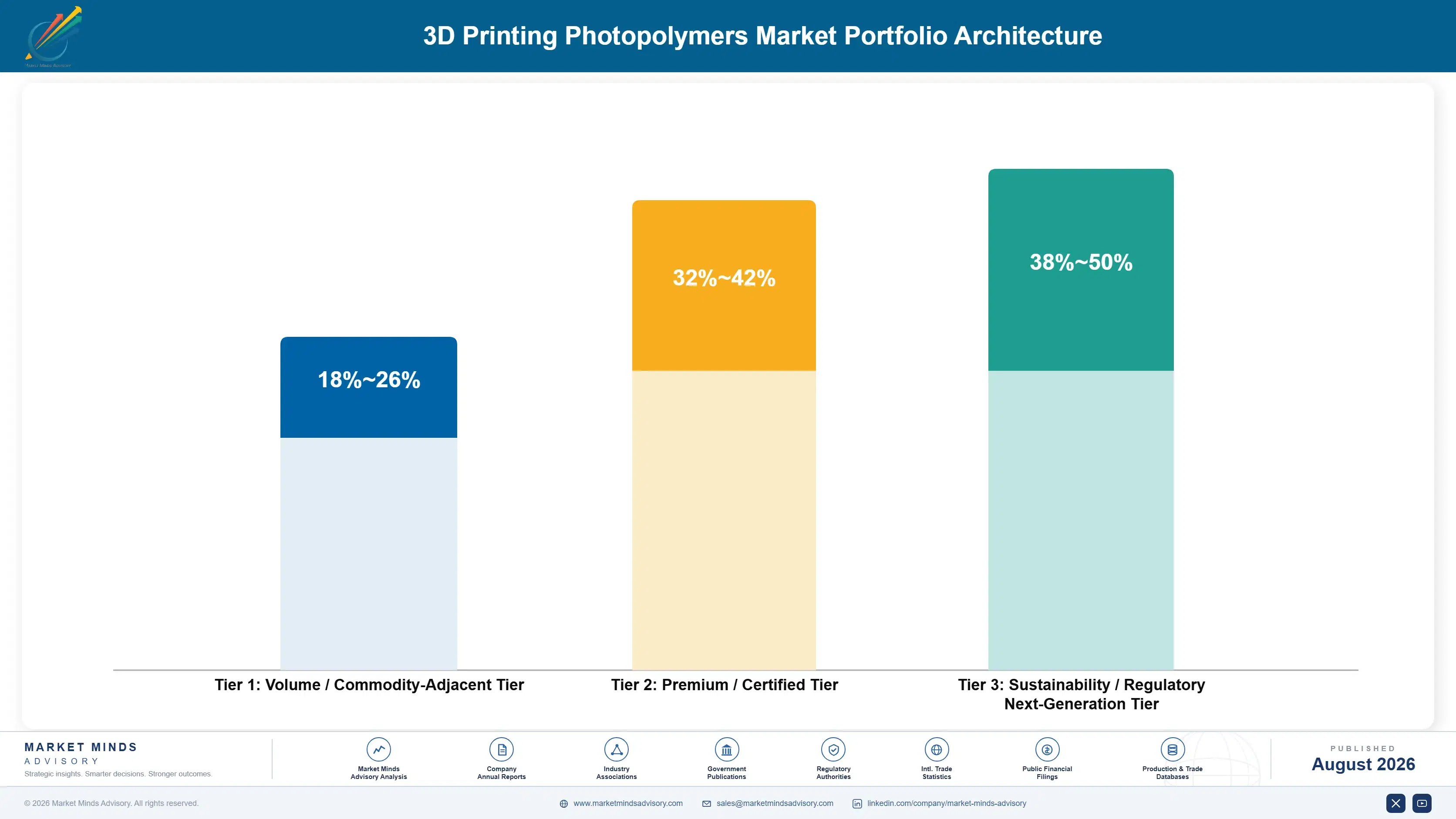
Photopolymer resin portfolios span three margin tiers, from commodity-adjacent standard general-purpose resins sold largely on price, through certified engineering and elastomeric formulations carrying application-specific premiums, toward a next-generation tier built around dental, medical, and advanced engineering formulations still gaining share. Gross margin widens at each tier as certification depth and formulation complexity increase across the industry. Buyers pay for certification depth,
The volume versus premium tension centers on production allocation. Formulators must choose between dedicating capacity to high-margin dental and engineering programs with growing but smaller volume, or serving standard resin demand that fills out production capacity across a typical year. Formulators without spare capacity favor higher-margin programs where competition remains thin. That decision shapes which formulators win the highest-margin accounts each year.

High-value margin pools concentrate in dental, medical, and engineering-grade formulation programs, where certification barriers and technical complexity keep competition thin and buyers pay a premium for regulatory compliance and proven performance. Standard general-purpose resins remain the volume anchor but carry the thinnest margins across the portfolio, leaving smaller formulators with fewer diversification options than larger competitors. Formulators that diversify across premium and volume tiers capture the widest margin spread today.

Volume / Commodity-Adjacent Tier

Standard general-purpose resins sold largely on price and platform availability without dental, medical, or engineering-grade certification premiums, across most prototyping buyer segments worldwide each year consistently overall today and beyond.
Gross Margin: 18%-26%

Premium / Certified Tier

Engineering and elastomeric formulations sold under distributor and manufacturer agreements carrying application-specific pricing power built through years of proven performance validation across major manufacturer accounts worldwide today and beyond consistently.
Gross Margin: 32%-42%

Sustainability / Regulatory / Next-Generation Tier

Dental, medical, and advanced engineering formulations in active regulatory qualification, commanding premium pricing against limited proven alternatives as clinical adoption expands across most major metropolitan markets nationwide today and beyond.
Gross Margin: 38%-50%
3d-printing-photopolymers-market-portfolio-architecture-1787303624127

Certification Depth Drives Recurring Purchasing

Photopolymer resin purchasing functions closer to an annuity than a transactional sale for dental and medical customers, since once a practice or manufacturer clears certification and workflow validation on a specific resin, that supplier relationship typically persists for years given the cost and clinical risk of requalifying an alternative formulation. Engineering and prototyping purchasing behaves somewhat differently, tracking individual project and production program cycles rather than fol
Adoption depth varies sharply by end-use vertical. Dental and medical customers show the deepest stickiness given regulatory certification requirements and clinical workflow validation, while hobbyist and prototyping buyers switch resins more readily since qualification barriers are far lower and price sensitivity plays a larger role in purchasing decisions. Pricing pressure also concentrates in these lower-tier accounts.

A generational shift is underway as manufacturers evaluating end-use production, who have no legacy relationship with prototyping-focused resin suppliers, evaluate formulators on long-term part durability data rather than decades-long supply relationships. That openness gives newer, engineering-focused formulators a rare opening to win share in a market where dental incumbency has otherwise been difficult to dislodge, across every major application category today.
3d-printing-photopolymers-market-end-use-penetration-index-1787303624619

Where Resin Formulators Should Focus Next

These are among the four positions where our research anticipates prominent divergence between winners and laggards over the coming forecast period. Each is grounded in the demand model, the regulatory perimeter, and the announced capacity pipeline.
01 / DENTAL CERTIFICATION STRATEGY

Expand clinical certification before adoption fully standardizes

Dental practices are increasingly requiring biocompatibility-certified resins for in-office printing, and formulators without certified product lines are losing recurring consumable relationships to better-certified competitors as this shift accelerates. Certification testing requires meaningful upfront investment but opens recurring revenue that prototyping-only resin sales cannot match. Formulators waiting until clinical adoption fully standardizes will find themselves racing to catch up against incumbents who invested years earlier, a gap that widens each quarter certification investment lags behind competitor programs already underway across the industry.
02 / ENGINEERING QUALIFICATION TIMING

Invest in end-use qualification before manufacturers commit elsewhere

Manufacturers evaluating additive manufacturing for production parts have not universally committed to a preferred resin supplier, leaving a genuine first-mover opportunity for formulators willing to fund qualification testing ahead of confirmed program adoption. Waiting for manufacturers to formally commit risks missing the qualification window entirely once a preferred supplier relationship forms. The capital required is meaningful but positions early movers to capture a category growing faster than standard general-purpose resins today, a window that will not stay open indefinitely once manufacturers standardize their preferred partner.
03 / PRINTER PLATFORM PARTNERSHIP STRATEGY

Secure validated compatibility across major printer platforms

Formulators with validated compatibility across major printer manufacturer platforms capture distribution reach that independent resin makers selling through secondary channels cannot match, an advantage that compounds with every new printer generation. Formulators relying solely on aftermarket compatibility remain persistently disadvantaged when printer manufacturers tighten material validation requirements. Building these partnerships now, ahead of the next major printer platform cycle, protects long-term market access against competitors already securing similar relationships, a pattern likely to repeat with each subsequent printer generation cycle.
04 / REGIONAL GROWTH ALLOCATION STRATEGY

Weight new investment toward East Asia given fastest regional growth

East Asia and South Asia and Pacific are both growing faster than North America and Western Europe as dental and manufacturing adoption accelerate across China, India, and neighboring markets. Formulators concentrating capacity expansion solely around legacy North American and European relationships risk ceding share in the regions where volume growth will be steepest through 2036. Early investment in Asian formulation and distribution capacity offers a meaningful head start over competitors still anchored entirely to legacy Western customer bases, a gap likely to widen further.

Engagement Snapshot From the Field

A live engagement with an industry participant carrying material or product regulatory and market exposure ahead of a defining policy shift, showing how our research translates into a defensible multi-year portfolio strategy.
MARKET MINDS ADVISORY · CLIENT ENGAGEMENT SUMMARY
3D Printing Photopolymers Producer Strategic Portfolio Review and Transition Roadmap 2026·Investment Scenario on 3D Printing Photopolymers Exposure Evaluation 2025-26
CLIENT PROFILE
The client is a regional dental service organization operating multiple practices across the southeastern United States, with annual resin and digital equipment procurement spend in the low tens of millions of dollars (client-reported, unverified by MMA). The client faced pressure to standardize in-office digital printing workflows across its practice network while managing resin certification and supplier consistency.
STRATEGIC CHALLENGE
The client needed to decide which resin formulator and printer platform combination to standardize across its practice network, given uncertainty over whether a single-supplier relationship would provide adequate application coverage across clear aligners, surgical guides, and temporary crowns, while balancing procurement cost against clinical performance requirements, while managing training timelines across a growing multi-practice network.
MMA APPROACH
MMA benchmarked three competing resin formulator and printer platform combinations against the client's full application requirements and modeled procurement cost scenarios against projected practice network growth, incorporating primary interview data from dental practices and formulators on certification scope and clinical performance. The analysis also benchmarked onboarding timelines across three peer dental service organizations pursuing similar standardization strategies.
KEY FINDINGS
  1. The client's fragmented multi-supplier approach across its practice network left it paying meaningfully more per liter than competitors standardized on a single validated formulator relationship.
  2. Standardizing on a single resin formulator with broad application certification reduced per-practice training burden while maintaining clinical performance across all three target application categories.
  3. Competitors that had already standardized on a single certified formulator were achieving faster new-practice onboarding timelines than the client's fragmented current approach allowed.
  4. Photoinitiator supply exposure at one of the client's smaller incumbent suppliers posed a greater near-term continuity risk than the clinical performance risk the client had originally prioritized in evaluation.
CLIENT PROFILE
The client is a regional dental service organization operating multiple practices across the southeastern United States, with annual resin and digital equipment procurement spend in the low tens of millions of dollars (client-reported, unverified by MMA). The client faced pressure to standardize in-office digital printing workflows across its practice network while managing resin certification and supplier consistency.
STRATEGIC CHALLENGE
The client needed to decide which resin formulator and printer platform combination to standardize across its practice network, given uncertainty over whether a single-supplier relationship would provide adequate application coverage across clear aligners, surgical guides, and temporary crowns, while balancing procurement cost against clinical performance requirements, while managing training timelines across a growing multi-practice network.
MMA APPROACH
MMA benchmarked three competing resin formulator and printer platform combinations against the client's full application requirements and modeled procurement cost scenarios against projected practice network growth, incorporating primary interview data from dental practices and formulators on certification scope and clinical performance. The analysis also benchmarked onboarding timelines across three peer dental service organizations pursuing similar standardization strategies.
KEY FINDINGS
  1. The client's fragmented multi-supplier approach across its practice network left it paying meaningfully more per liter than competitors standardized on a single validated formulator relationship.
  2. Standardizing on a single resin formulator with broad application certification reduced per-practice training burden while maintaining clinical performance across all three target application categories.
  3. Competitors that had already standardized on a single certified formulator were achieving faster new-practice onboarding timelines than the client's fragmented current approach allowed.
  4. Photoinitiator supply exposure at one of the client's smaller incumbent suppliers posed a greater near-term continuity risk than the clinical performance risk the client had originally prioritized in evaluation.
RECOMMENDED STRATEGY
Phase 1: Phase 1 (Months 1 to 4): Benchmark formulator certification breadth and standardize resin and printer platform selection network-wide and document results. Phase 2: Phase 2 (Months 5 to 9): Migrate existing practices to the standardized platform and consolidate resin procurement into a single supply agreement. Phase 3: Phase 3 (Months 10 to 14): Formalize a long-term supply agreement with volume-based pricing tied to practice network growth projections.
OUTCOME
Within fourteen months of implementation, the client standardized resin procurement across its practice network and consolidated supplier relationships from four formulators to one. Client-reported per-liter procurement costs declined by an estimated 16% over the following year, though this figure is client-reported and unverified by MMA.

Frequently Asked Questions

Foundational context covering the market sizes, CAGR, scope, country, region and competition that inform every finding below. This section is provided to cover basics and most often pre-purchase conversations, answered from the MMA Primary Research Dataset.

What is the current size of the 3D Printing Photopolymers Market?

The global 3D printing photopolymers market reached an estimated $1.8 billion in 2025. Standard general-purpose resins account for the largest share of that volume, reflecting broad prototyping and hobbyist demand.

How large will the 3D Printing Photopolymers Market be by 2036?

MMA forecasts the market will reach approximately $4.84 billion by 2036. That represents a 2.46x expansion over the 2026 base value across the ten-year forecast period.

What is the CAGR for the 3D Printing Photopolymers Market 2026 to 2036?

The base case forecast CAGR is 9.4%, with a bull case of 10.6% and a bear case of 8.1% depending on dental adoption and engineering qualification pace.

Which segment is growing fastest?

Dental and Medical Photopolymer Resins is growing fastest at a 14.2% CAGR, roughly 1.51 times the overall market rate, as in-office digital dentistry adoption accelerates.

Who are the major companies in the 3D Printing Photopolymers Market?

Stratasys, 3D Systems, Formlabs, Carbon, and Covestro lead the market. Together the top five hold an estimated 48% of global shipment volume across a fragmented supplier base.

Which country is growing fastest?

South Korea leads growth as its dental technology sector and manufacturing base both scale photopolymer resin adoption, growing at an estimated 12.4% CAGR through 2036.

Report Segmentation Architecture

The full report scope spans multiple orthogonal segmentation dimensions, with cross-tabulated demand data provided for each dimension pair. Coverage extends further to regional breakdowns, trend trajectories, and the competitive detail needed to support segment-level decision-making.

By Resin Chemistry and Application

  • Standard General-Purpose Resins
  • Engineering and High-Performance Resins
  • Dental and Medical Photopolymer Resins
  • Elastomeric and Flexible Resins
  • Ceramic-Filled Resins
  • Biocompatible and Bio-Based Resins

By End-Use Industry

  • Dental and Orthodontic Practices
  • Automotive and Industrial Manufacturing
  • Consumer Goods and Jewelry
  • Healthcare and Medical Devices
  • Prototyping and Education

By Commercial Dimension

  • Printer Manufacturer Direct Sales
  • Distributor and Reseller Channels
  • Long-Term Supply Agreements
  • Aftermarket and Third-Party Compatibility

By Region

  • North America
  • Western Europe
  • East Asia
  • South Asia and Pacific
  • Latin America
  • Middle East and Africa
  • Eastern Europe

Scope, Methodology, and Coverage

Every figure in this report is reproducible from documented input assumptions. The scope below maps the historical period, the forecast horizon, the segmentation dimensions, and the countries covered, alongside the underlying primary and qualitative methodology.
Historical Period
2020 to 2025
Forecast Period
2026 to 2036
Base Year
2025 (USD billions; MMA Primary Research Dataset, August 2026)
Market Definition
This report covers UV and light-curable liquid resins formulated for stereolithography, digital light processing, and material jetting additive manufacturing processes, including standard, engineering, dental, medical, and elastomeric formulations. It excludes the 3D printers themselves, thermoplastic filaments and powders used in other additive manufacturing processes, and post-processing equipment.
Quantitative Units
USD billions (current prices); liters of resin formulation shipped where disclosed
Segmentation Dimensions
By Resin Chemistry and Application; By End-Use Industry; By Commercial Dimension; By Region
Regions Covered
North America, Western Europe, East Asia, South Asia and Pacific, Latin America, Middle East and Africa, Eastern Europe
Countries Covered
USA, China, Germany, France, UK, Japan, South Korea, India, Australia, Canada, Brazil, Mexico, Indonesia, Vietnam, Thailand, Malaysia, UAE, Saudi Arabia, South Africa, Nigeria, Turkey, Poland, Netherlands, Italy, Spain, Sweden, Switzerland, Argentina, Colombia, Singapore, and additional markets relevant to this sector
Key Companies Profiled
Stratasys Ltd., 3D Systems Corporation, Formlabs Inc., Carbon Inc., Covestro AG, BASF SE, Henkel AG & Co. KGaA, Arkema S.A., Allnex Group, DWS Systems S.r.l., Photocentric Ltd., Nexa3D Inc., Liqcreate B.V., Desktop Metal Inc., Siraya Tech, Prusa Research a.s., Shenzhen Anycubic Technology Co. Ltd., Phrozen Tech Co. Ltd., Elegoo Inc., Peopoly Ltd.
Quantitative Methodology
Primary survey, n=3,800 respondents, Q4 2025, six countries; demand-side model with trade association cross-validation
Qualitative Methodology
47 expert interviews, Q4 2025; applied to validate demand model assumptions, identify emerging dynamics, and assess competitive positioning
Report Format
PDF and XLSX data workbook (Word format preview document)
Publisher
Market Minds Advisory
Report Code
MMA-2026-CHM-171
Published
August 2026
Contact
sales@marketmindsadvisory.com | www.marketmindsadvisory.com

Purchase the full 3D Printing Photopolymers Market Report (2026 to 2036).

The full report delivers an assessment of the global 3D printing photopolymers market across all six resin chemistry segments and seven world regions through 2036. It includes competitive profiling of twenty active formulators, primary survey data from procurement and clinical decision-makers, and a dedicated deep-dive on dental certification timelines. Buyers receive access to underlying segment and regional data tables alongside the full narrative analysis, supporting both supply planning and supplier evaluation decisions. The report also benchmarks revenue lever adoption and input cost exposure across the top twenty profiled companies, drawing on MMA's primary survey of 3,800 respondents and 47 expert interviews conducted in Q4 2025.
Twenty-company competitive profiling and margin benchmarking
Six-segment resin chemistry forecast data and tables
Seven-region demand and CAGR breakdown data
Dental certification timeline deep-dive overview analysis
Photoinitiator supply chain risk assessment overview
Primary interview data from procurement decision-makers

Built For The People Who Decide

From boardroom strategy to bench-side execution, this report is read cover-to-cover by leaders shaping the next decade of their industry, turning demand scenarios, market dynamics and valuation benchmarks into decisions.
CXOs/ Presidents/ VPs/ Managers
M&A and Corporate Development
Strategy Teams and R&D Heads
Procurement and Product Directors
Regulatory and Compliance Leaders
Investor Relations and Equity Analysts