Market Minds Advisory
3D Bio-Printing Market

3D Bio-Printing Market: Tissue Engineering and Preclinical Drug Testing

Pharmaceutical companies are adopting bioprinted tissue models to cut animal testing costs, while laser-assisted and vat photopolymerisation platforms push single-cell resolution beyond what extrusion-based printers built a decade ago can reach.

Lead Analyst

Alice Ballenger

Published

September 2026

Make Smarter Decisions with Customized Research Insights

Request a free sample report and evaluate market opportunities, growth trends, and competitive dynamics relevant to your business needs.

2025 MARKET VALUE$2.1BMarket Size 2025
2036 FORECAST VALUE$10.0BBase Case , 2026 to 2036
CAGR 2026 TO 203615.2 %Bull 16.6% / Bear 13.8%
INCREMENTAL OPPORTUNITY$7.5BNet 10- year value creation
EXPANSION MULTIPLE4.12x2036 value over 2026 base
Strategic Levers
M&A Pipeline
Regional Outlook
Country Rankings
Competitive Intelligence
Segmental Deep-dive
Call-Us : 91 93563 13602

Executive Snapshot and Market Trajectory

Pharmaceutical research budgets are shifting meaningfully toward bioprinted tissue models as regulators signal growing openness to non-animal preclinical testing pathways, and that shift is reshaping which bioprinting platforms attract serious commercial adoption budgets right now across the industry. Momentum looks durable across most major research budgets.
Laser-assisted and vat photopolymerisation platforms are pulling ahead of the extrusion-based systems that dominated the market's first commercial decade, concentrated heavily in North American pharmaceutical and academic research budgets, while China and Japan's growing biotech investment base is absorbing a disproportionate share of new bioprinter installations across Asia-Pacific research institutions this decade, reshaping which vendors capture the fastest-growing regional demand pools. Regional vendors are increasingly competing against established Western platform leaders on price and support.
Five companies hold just over a third of category revenue, leaving this a genuinely fragmented and fast-evolving field where research-grade specialists and platform generalists compete hard on print resolution, cell viability, and bioink compatibility across nearly every customer segment tracked. Regulatory clarity around tissue model validation is becoming the defining commercial differentiator industry-wide, reshaping purchasing decisions at every major pharmaceutical company. Buyers confirm this shift is accelerating.
Market Definition
The 3D bio-printing market covers hardware platforms, bioinks, and associated software used to fabricate three-dimensional tissue constructs, organoids, and cellular scaffolds for research, drug testing, and regenerative medicine applications. It excludes conventional additive manufacturing of non-biological medical devices, implant hardware printed from inert metals or polymers, and general-purpose 3D printers not designed for living cell deposition.
Base Year Value
$2.1B in 2025 (MMA Primary Research Dataset, August 2026)
Forecast Period
2026 to 2036, eleven discrete annual values
CAGR
15.2% base case. Bull 16.6%. Bear 13.8%.
Fastest Growth Segment
Laser-Assisted Bioprinting: 19.5% CAGR
Fastest Growth Country
Australia: 17.8% CAGR
Fastest Growth Region
South Asia and Pacific: 17.2% CAGR
Largest Region
North America: 30% of 2025 global value
Market Leaders
CELLINK (BICO Group), Organovo Holdings, 3D Systems, Aspect Biosystems, and EnvisionTEC. Source: MMA Analysis based on company annual reports and disclosed segment revenue.
Primary Survey
n=3,800 procurement and R&D decision-makers, Q4 2025, six countries
Methodology
Demand-side build-up, cross-validated against public data, 47 expert interviews

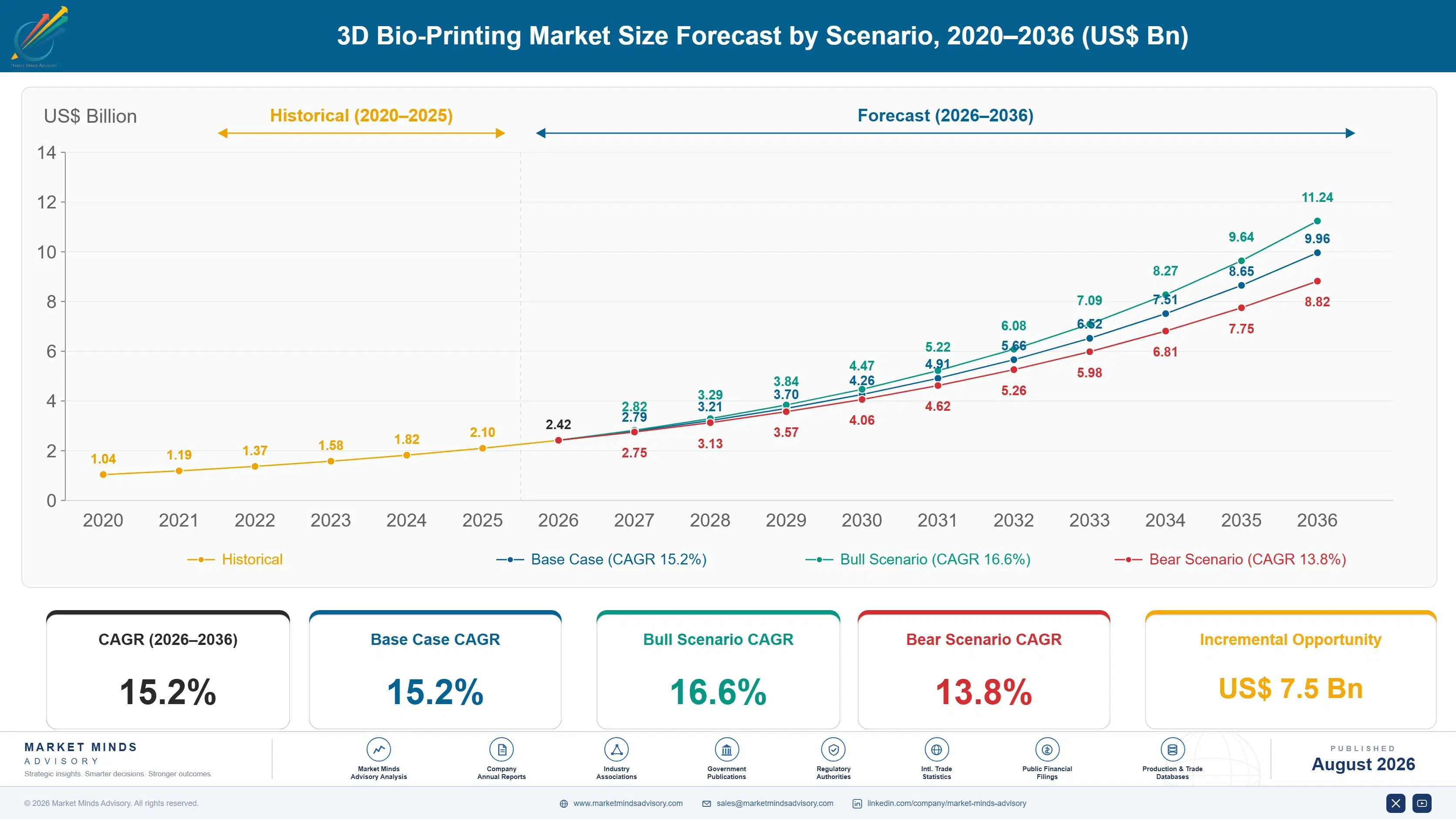
3D Bio-Printing Market Forecast Scenarios

3d-bio-printing-market-size-size-forecast-scenario-1787303566380
Between 2020 and 2025 the market grew at roughly 13.9% a year, a pace held back early by pandemic-era laboratory disruption before accelerating sharply as deferred pharmaceutical research budgets resumed and academic bioprinting programmes expanded across several major research universities during the recovery period that followed shortly afterward across most major research economies tracked. across most major research economies tracked closely.
The base case assumes 15.2% annual growth through 2036, driven by three commercial mechanisms operating together across the industry: regulatory openness to non-animal preclinical testing pathways expanding pharmaceutical adoption budgets meaningfully, laser-assisted and vat photopolymerisation platforms opening research applications extrusion-based systems could never reliably serve, and falling bioink costs broadening access beyond the best-funded academic and pharmaceutical laboratories worldwide. Contract research service expansion adds a fourth complementary growth channel worth tracking closely across the forecast period.
A bull case near 16.7% follows if the FDA's Modernization Act guidance accelerates formal validation pathways for bioprinted tissue models faster than currently expected by most industry observers. A bear case near 13.6% follows instead if research funding tightens across major academic and pharmaceutical budgets, slowing capital equipment purchases industry-wide during the forecast period ahead.

Preclinical Adoption and Resolution Competition

Three forces converge on bioprinting adoption decisions this decade: growing regulatory openness to non-animal preclinical testing pathways, intensifying competition between print resolution and cell viability across rival technology platforms, and falling bioink costs that are broadening access beyond the best-funded pharmaceutical and academic laboratories that once dominated the buyer base almost entirely. Vendors that read this shift early are already ahead of slower-moving rivals across the
MARKET CONCENTRATIONCR5 34%share held by top five companies by disclosed revenue
AVERAGE SELLING PRICE$15,000-$450,000range spans desktop research units to industrial platforms
TOP PRODUCING COUNTRYUSA, 27% shareof global bioprinter installation base by unit count
ADOPTION RATE41%share of major pharmaceutical firms using bioprinted models
BIOINK COST SHARE22%share of total system cost attributable to consumable bioinks
PRINT RESOLUTION10-50 micronstypical achievable print resolution across leading current platforms
Commercial character has shifted from single-unit research equipment sales toward multi-year platform partnerships bundling hardware, proprietary bioink supply, and technical validation support into a single vendor relationship. Pharmaceutical buyers increasingly select a bioprinting partner during early drug discovery programme design rather than at equipment tender, giving platform vendors with strong validation data a durable adoption advantage over pure hardware competitors. This shift is most visible among pharmaceutical customers building multi-year research programme commitments.
Over the next decade, regulatory validation pathways, resolution improvements, and bioink cost declines will keep separating platform vendors with genuine pharmaceutical traction from research-only specialists still selling primarily into academic laboratories where budgets remain comparatively constrained and adoption cycles considerably slower than in commercial drug development settings. Validation-first vendors are shaping category norms broadly.
"Bioprinting used to be judged purely on how fine a line the nozzle could lay down. Now pharmaceutical buyers ask about validation data first and resolution second, and that ordering change is rewriting which companies win contracts."
Director, Life Sciences Tools Practice · MMA Medical Devices and Life Sciences T

Market Trends

Pharmaceutical Adoption of Bioprinted Models for Preclinical Testing

Major pharmaceutical companies are incorporating bioprinted liver, kidney, and tumour tissue models into early-stage drug toxicity screening programmes, responding to regulatory signals including the FDA Modernization Act that explicitly opened pathways for non-animal testing methods in specific preclinical contexts. Bioprinted models offer a meaningful cost and speed advantage over traditional animal studies for early screening, letting research teams eliminate clearly unviable drug candidates before committing to more expensive downstream testing phases. Several large pharmaceutical firms have established dedicated bioprinting laboratories over the past two years to build internal validation datasets ahead of formal acceptance criteria.
Market Impact: Drives 9 pct pharma spend

Laser-Assisted and Vat Photopolymerisation Platforms Gain Resolution Advantage

Laser-assisted bioprinting and vat photopolymerisation platforms are winning specification on complex tissue applications requiring single-cell placement precision that extrusion-based nozzle systems, the technology that dominated the market's first commercial decade, simply cannot achieve reliably at comparable speed. Research teams building vascularised tissue constructs and organoid models increasingly specify these higher-resolution platforms despite their meaningfully higher capital cost, valuing precision over the lower price point older extrusion technology still offers. Three of the five largest companies expanded these product lines between 2023 and 2025, and order data shows adoption arriving well ahead of manufacturer projections.
Market Impact: Adds 7 percent new-buyer segment gr

Market Opportunities and Growth Drivers

FDA Modernization Act Opens Non-Animal Testing Pathways

The FDA Modernization Act 2.0 formally removed the longstanding requirement that new drugs undergo animal testing before human trials in specific circumstances, explicitly naming bioprinted and organoid-based models among the acceptable alternative methods pharmaceutical companies may now submit for regulatory consideration during preclinical review. This regulatory shift has accelerated pharmaceutical investment in internal bioprinting capability considerably faster than industry forecasters had projected, since companies want validated internal datasets ready well before broader acceptance criteria are finalised. European Medicines Agency officials have signalled parallel interest in similar alternative testing frameworks. reinforcing the global regulatory direction now shaping investment plans.
Market Impact: Delays 14 percent of adoption decis

Falling Bioink Costs Broaden Access Beyond Elite Laboratories

Bioink production costs have declined steadily as manufacturing scale increases and more suppliers enter the market with standardised, off-the-shelf formulations rather than the custom-formulated bioinks that once required dedicated in-house expertise most smaller laboratories simply could not justify budgeting for. This cost decline is broadening bioprinting access beyond the best-funded pharmaceutical companies and top-tier research universities that dominated early adoption, opening the technology to mid-sized biotech firms and regional academic institutions previously priced out of meaningful participation. Suppliers report standardised bioink sales volume growing considerably faster than custom orders. reflecting broader first-time adoption.
Market Impact: Limits 16 pct of runs

Market Restraints and Challenges

Regulatory Validation Pathways Remain Incomplete for Most Applications

While the FDA has opened the door to non-animal testing methods in specific circumstances, comprehensive validation standards for bioprinted tissue models across most drug categories remain genuinely incomplete, leaving pharmaceutical companies uncertain how much regulatory weight bioprinted data will ultimately carry in formal submissions. The root cause is that validation science itself is still developing alongside the underlying bioprinting technology, meaning regulators cannot finalise standards for a still-evolving field without risking premature codification of soon-superseded methods. Companies are mitigating this by building parallel bioprinted and traditional datasets during the transition period.
Market Impact: Adds 12 percent pharmaceutical adop

Cell Sourcing and Viability Consistency Challenges Persist

Maintaining consistent cell viability and function across bioprinted constructs remains a genuine technical challenge, particularly for complex multi-cell-type tissue models where different cell populations require carefully balanced printing conditions that vary considerably by application. The root cause is biological variability itself, since living cells respond to printing stress and post-print culture conditions in ways that are inherently harder to standardise than inert materials conventional additive manufacturing typically works with. Platform vendors are mitigating this by developing gentler printing mechanisms and standardised protocols that reduce cell stress. though full consistency across diverse cell types remains an active area of ongoing development.
Market Impact: Lifts high-resolution platform shar
3 additional market trends, 4 additional growth drivers, and 2 additional restraints and challenges are covered in the full report. Contact sales@marketmindsadvisory.com to access the complete intelligence.

Segment CAGR and Growth Architecture

Segmentation follows bioprinting technology, the dimension that determines achievable resolution, cell viability outcomes, and which research or clinical application a given platform can reliably serve without significant compromise, since technology choice matters more than any other single factor considered carefully by most current buyers evaluating platforms today. Regulatory pathway compatibility depends heavily on this same underlying choice.
3d-bio-printing-market-size-market-share-analysis-1787303566909

Laser-Assisted Bioprinting

Laser-assisted bioprinting is pulling ahead because its nozzle-free deposition mechanism achieves single-cell placement precision that extrusion and inkjet systems cannot reliably match, making it the platform of choice for research teams building vascularised tissue constructs and complex organoid models. Pharmaceutical and academic researchers building the most demanding tissue models increasingly specify laser-assisted platforms despite their considerably higher capital cost, valuing precision over the lower price point extrusion technology still offers to budget-constrained laboratories. Growth concentrates in well-funded pharmaceutical and top-tier academic research budgets first, where precision requirements justify the premium cost. Companies including CELLINK and 3D Systems have expanded laser-assisted product lines to meet this fast-rising demand. Order data confirms this growth rate consistently outpaces every other technology category tracked.
CAGR 19.5%

Vat Photopolymerisation Bioprinting

Vat photopolymerisation bioprinting is the second-fastest category, favoured wherever researchers need high-resolution scaffold and organoid structures produced considerably faster than laser-assisted systems can achieve, though with somewhat less single-cell precision than the category leader offers. The light-based curing mechanism allows researchers to build complex three-dimensional scaffold geometries in a fraction of the time extrusion-based systems require, a genuine advantage for high-throughput drug screening requiring many replicate constructs produced quickly. Growth concentrates in pharmaceutical drug screening applications first, where throughput matters as much as resolution for statistically meaningful results, and manufacturers are scaling production to reach mid-sized biotech buyers previously priced out. Distributor order data shows this segment's growth rate consistently exceeding standard extrusion sales across most major research markets tracked.
CAGR 18.2%
Full segment breakdown across 6 segments available in the complete report.

Regional Architecture and Country Demand Map

North America leads on pharmaceutical adoption budgets and regulatory clarity, while South Asia and Pacific grows fastest as Australian and regional biotech investment expands rapidly. East Asia's growing biotech sector is closing the gap on installed base quickly. Western Europe and East Asia both show steady, well-funded institutional growth.

North America

The FDA Modernization Act's explicit acceptance of non-animal testing methods is the dominant demand mechanism here, driving pharmaceutical companies across the United States to build internal bioprinting capability well ahead of formal regulatory acceptance criteria being finalised across additional drug categories. Organovo and 3D Systems, both headquartered domestically, supply a meaningful share of pharmaceutical-grade platforms directly to the region's dense concentration of major drug developers. Academic research funding through the National Institutes of Health continues supporting university bioprinting programmes at a scale unmatched elsewhere globally, sustaining a steady pipeline of new researchers entering the commercial workforce. Growth here outpaces most developed markets given the sheer concentration of pharmaceutical research spending and regulatory clarity driving early adoption decisions across the industry.
Share: 30% | CAGR: 15.9% (2026 to 2036)

Western Europe

Academic and pharmaceutical research collaboration is the dominant demand mechanism across Germany, France, and Switzerland, where CELLINK's parent company BICO Group and specialist firms including Poietis and RegenHU supply a large share of regional demand directly from local production and research facilities. The European Medicines Agency's signalled interest in alternative testing frameworks is reinforcing pharmaceutical investment in bioprinting capability, though formal regulatory acceptance criteria remain somewhat behind the explicit pathway the FDA has already established domestically. Growth trails North America slightly because research funding, while substantial, is distributed across more countries with somewhat less concentrated pharmaceutical research spending than the US market shows, moderating the pace of aggregate regional adoption despite strong underlying research quality.
Share: 24% | CAGR: 13.6% (2026 to 2036)
Regional intelligence for 5 additional markets available in the complete report: East Asia, South Asia and Pacific, Latin America, Middle East and Africa, Eastern Europe. Contact sales@marketmindsadvisory.com.
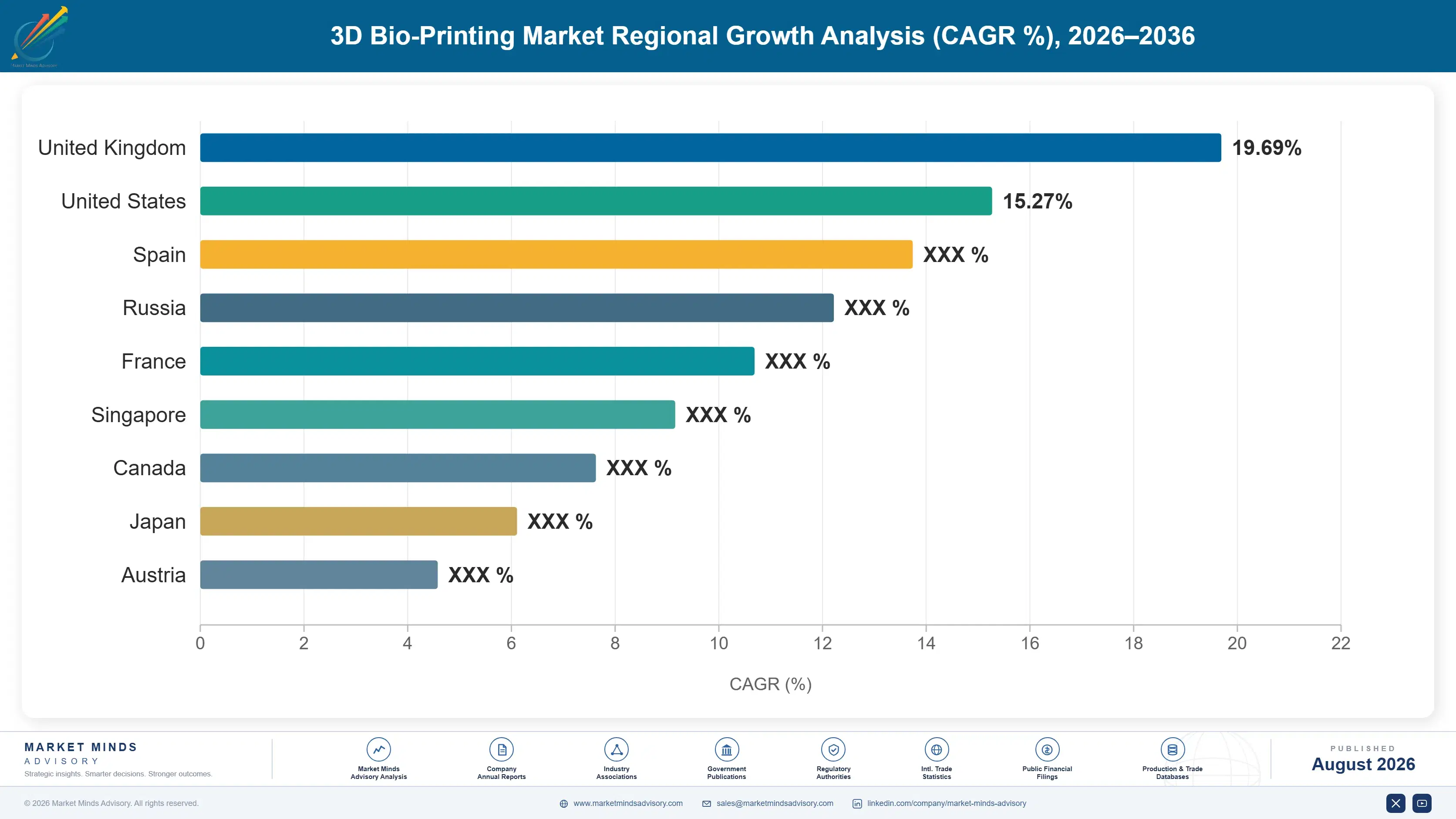
3d-bio-printing-market-size-country-cagr-analysis-1787303567419

Validation Data, Bioink Subscriptions, and Licensing

Companies are shifting revenue toward recurring bioink supply, validation data services, and technology licensing, capturing more value per customer relationship rather than competing purely on the upfront price of bioprinting hardware sold through traditional capital equipment purchasing cycles, a shift reshaping category economics broadly. across most vendor and customer relationships tracked. across the wider vendor community.

Recurring Proprietary Bioink Supply Subscription Programme

Platform vendors including CELLINK now bundle proprietary bioink subscriptions directly into hardware sales, guaranteeing consistent formulation supply on a recurring schedule rather than requiring customers to reorder consumables ad hoc from potentially inconsistent third-party sources. This converts a single equipment sale into a recurring revenue stream worth roughly 20% of the original hardware price annually, while giving customers formulation consistency that improves experimental reproducibility across research programmes. Vendors report subscription attach rates above 45% on new platform sales, with attach rates highest among pharmaceutical customers running high-volume screening programmes requiring predictable bioink supply.
Market Impact: Adds roughly 20 percent recurring r

Regulatory Validation Data Licensing for Pharmaceutical Partners

Companies with established pharmaceutical partnerships are licensing validated tissue model datasets and protocols to additional pharmaceutical customers building internal regulatory submission strategies, capturing revenue from accumulated validation expertise rather than only from hardware and consumables sales made independently. This addresses a genuine commercial need, since building validation datasets from scratch requires years of investment most companies cannot justify duplicating internally when licensed data already exists elsewhere. Companies report licensing revenue growing roughly 26% faster than hardware revenue across the past two years. This shift has proven durable even as competitive pressure has intensified across the wider industry.
Market Impact: Grows licensing revenue by roughly

Technical Training and Protocol Certification Programmes

Vendors are introducing paid technical training and protocol certification programmes that help customer laboratory staff achieve consistent, reproducible results faster than self-directed learning alone would allow, closing a support gap that previously went entirely uncompensated despite requiring substantial vendor technical staff time. Certification programmes typically run several weeks and combine hands-on training with ongoing technical support access, and customer feedback suggests this materially reduces time-to-productive-use for new laboratory installations. Vendors report certified laboratories showing platform utilisation roughly 24% higher than uncertified customers. This utilisation gain has held steady across two full years since programmes first launched broadly.
Market Impact: Lifts platform utilisation rate by

Contract Research Services Using Proprietary Platforms

Rather than only selling hardware, several companies now offer contract bioprinting research services using their own proprietary platforms, letting smaller pharmaceutical and biotech customers access advanced bioprinting capability without capital equipment investment they cannot yet justify internally. This lever extends addressable market to customers who would otherwise remain locked out of the category entirely due to upfront cost barriers, while building additional validation data and case studies that strengthen the vendor's broader commercial positioning. Companies offering contract services report this channel now contributing roughly 15% of total company revenue within just a few years of launch.
Market Impact: Contributes roughly 15 percent of t

Who Controls the Margin Pool

Five companies hold a combined 34% of revenue on a consistent company-disclosed segment revenue basis, a genuinely fragmented concentration level that leaves considerable room for research-grade specialists and platform generalists competing hard on print resolution and validation data rather than attempting to out-scale category leaders directly on manufacturing volume alone. No single company commands anything close to majority share of the category globally.
Current competitive activity centres on three fronts at once: laser-assisted and vat photopolymerisation platform development racing to capture resolution-sensitive pharmaceutical demand, regulatory validation data accumulation aimed at winning pharmaceutical partnership agreements ahead of competitors, and bioink subscription and licensing model expansion targeting recurring revenue growth across an expanding installed base of customers worldwide. Each front requires meaningfully different capital and technical capability investment from companies.

Pressure is building steadily from Chinese and South Korean platform manufacturers moving up the value chain from research-grade hardware toward pharmaceutical-validated systems, a shift that could compress pricing meaningfully for mid-tier Western competitors as regional manufacturing scale increasingly rivals established global suppliers on both cost and delivery lead time for large institutional research contracts. Established Western vendors are watching this shift closely and adjusting strategy accordingly across every major market.
3d-bio-printing-market-size-company-positioning-matrix-1787303567941

Competitive Moat and Risk Dimensions

CELLINK (BICO GROUP AB)

Moat: Broad installed base

CELLINK's installed base across academic and pharmaceutical laboratories worldwide, combined with its broad proprietary bioink product portfolio, gives it recurring consumables revenue and customer familiarity that smaller specialist competitors find genuinely difficult to replicate quickly across comparable geographic and application breadth today. That advantage took years to build.
CELLINK (BICO GROUP AB)

Risk: Broader portfolio dilutes specialisation

CELLINK's strategy of covering multiple bioprinting technologies simultaneously leaves it more exposed than focused specialists to losing ground on any single technology's cutting edge, particularly as laser-assisted and vat photopolymerisation specialists increasingly out-innovate broader platform companies on pure resolution performance metrics. Smaller specialists are exploiting this gap already.
ORGANOVO HOLDINGS INC.

Moat: Deep pharmaceutical validation relationships

Organovo's early and sustained focus on pharmaceutical-grade tissue models has built validation relationships and accumulated regulatory submission experience that newer entrants cannot replicate quickly, giving it a genuine trust advantage among large pharmaceutical customers evaluating which bioprinting partner to build long-term programmes around today. Competitors cannot shortcut this trust.
ORGANOVO HOLDINGS INC.

Risk: Narrower technology and hardware breadth

Organovo's more focused pharmaceutical positioning leaves it with narrower hardware technology breadth than diversified competitors like CELLINK, creating exposure if pharmaceutical customers increasingly want a single vendor covering multiple printing technologies rather than working with several specialist providers separately. This gap is widening as CELLINK expands further.

Players Tracked

Prominent Players

CELLINK (BICO Group AB)
Organovo Holdings Inc.
3D Systems Corporation
Aspect Biosystems Ltd.
EnvisionTEC (Desktop Metal)

Other Key Players

RegenHU SA
Poietis SAS
Advanced Solutions Life Sciences
Cellbricks GmbH
Rokit Healthcare Inc.
TeVido BioDevices
Prellis Biologics Inc.
Readily3D SA
Inventia Life Science
Regenovo Biotechnology Co. Ltd.
FluidForm Inc.
UPM Biomedicals
Allevi Inc.
Nano3D Biosciences Inc.
Cyfuse Biomedical K.K.

Recent Developments

FEBRUARY 2025

CELLINK launches next-generation laser-assisted bioprinting platform

CELLINK introduced a new laser-assisted bioprinting platform targeting pharmaceutical customers building complex vascularised tissue models, offering single-cell placement precision the company's existing extrusion-based product line could not previously achieve at comparable throughput. Early distributor feedback has been strongly positive across several major pharmaceutical accounts. for high-volume screening use.
Signal: Signals established generalists are racing
OCTOBER 2024

Organovo signs multi-year validation partnership with major pharmaceutical company

Organovo signed a multi-year research partnership agreement with a top-ten global pharmaceutical company to build validated liver toxicity tissue models for internal drug screening use, deepening the kind of long-term validation relationship that increasingly determines competitive positioning in pharmaceutical bioprinting adoption decisions made across the industry.
Signal: Confirms pharmaceutical partnerships are b
MAY 2025

3D Systems acquires a vat photopolymerisation bioprinting specialist

3D Systems completed an acquisition of a smaller vat photopolymerisation bioprinting specialist, expanding its technology portfolio to compete more directly against laser-assisted platform leaders in high-throughput pharmaceutical drug screening applications where resolution and speed both matter considerably. Analysts expect further consolidation of this kind. across the wider category soon.
Signal: Shows established players prioritising acq

Bioink Feedstock and Precision Optics

Specialty biopolymer and hydrogel feedstock accounts for roughly 26% of unit cost of goods sold for proprietary bioink formulations, sourced primarily from specialty chemical suppliers in the United States and Western Europe, while precision optics and laser components for high-resolution platforms add another 21%, sourced from a concentrated group of specialised optical component manufacturers. across the wider supply chain.
Supply constraints on medical-grade hyaluronic acid and collagen feedstock during 2023 tightened bioink production costs across several manufacturers, and industry commentary from company annual reports noted bioink formulation among the categories most exposed to feedstock supply concentration given the limited number of qualified medical-grade biopolymer suppliers currently serving this specialised and rapidly growing market segment. Rates have since stabilised, but the episode reshaped supplier qualification practices industry-wide going forward.

Larger companies with diversified feedstock sourcing agreements absorbed the supply tightening more smoothly than smaller specialists dependent on single suppliers, giving them a durable cost and continuity advantage during the disruption period that followed shortly afterward. Newer entrants without established supplier relationships remain the most exposed to any future feedstock tightening of this kind affecting the broader bioink manufacturing supply chain.
3d-bio-printing-market-size-cost-volatility-analysis-1787303568135

Diversified Medical-Grade Biopolymer Sourcing Agreements

Larger manufacturers are qualifying multiple medical-grade biopolymer suppliers across different geographies rather than depending on a single source, reducing exposure to the kind of feedstock supply tightening that squeezed smaller competitors hardest during the 2023 disruption period, according to several company annual reports reviewed. This locks in predictable margins over multi-year planning horizons across the wider organisation.

In-House Precision Optics Component Development

Several larger platform manufacturers are bringing precision optics component development partially in-house rather than depending entirely on external specialised suppliers, reducing exposure to the concentrated optical component supply base that has occasionally constrained high-resolution platform production schedules across the wider industry recently. This diversification spans production facilities across several countries and component suppliers. across the wider supply chain.

Synthetic Biopolymer Alternative Qualification

Bioink manufacturers are qualifying synthetic and recombinant biopolymer alternatives to natural collagen and hyaluronic acid sources, reducing dependence on feedstock supply chains that face inherent natural sourcing constraints difficult to scale as quickly as growing market demand requires across several major producing regions currently. This flexibility has already paid off during one recent period of elevated pricing.

Portfolio Architecture for Margin Defence

The portfolio splits into three tiers running from entry-level extrusion-based research platforms sold largely on price, through validated pharmaceutical-grade systems carrying regulatory submission track records and proprietary bioink compatibility, up to next-generation laser-assisted and vat photopolymerisation platforms aimed at customers pursuing the highest achievable resolution and cell viability outcomes available. Margins widen as validation depth and resolution capability increase acro
Entry-level tier platforms still account for the largest unit shipment count overall but generate the thinnest margins of the three tiers by a wide margin, while validated pharmaceutical-grade systems, though a smaller share of total units sold, generate a disproportionate share of category profit as pharmaceutical customers pay up for validation track record and technical support reliability. This dynamic mirrors patterns seen across many other premiumising scientific instrument categories in recent years.

The highest-value pools concentrate in pharmaceutical drug screening applications pursuing regulatory-grade validation data, where requirements run strictest and buyers stay least price-sensitive, followed closely by academic research institutions building next-generation tissue engineering programmes that increasingly extend well beyond pure drug-screening use cases into genuine regenerative medicine research. Vendors with strong pharmaceutical partnerships capture a disproportionate share of this premium value pool.

Volume / Commodity-Adjacent Tier

Entry-level extrusion-based research platforms sold largely on price into smaller academic laboratories carrying minimal validation track record attached to the initial hardware purchase decision. Margins stay thin here across nearly every regional market this year.
Gross Margin: 24-30%

Premium / Certified Tier

Validated pharmaceutical-grade systems carrying regulatory submission track records, sold into pharmaceutical customers requiring documented reliability and dedicated technical support across their research programme. Margins improve meaningfully once validation credentials are attached to a system.
Gross Margin: 40-48%

Sustainability / Regulatory / Next-Generation Tier

Laser-assisted and vat photopolymerisation platforms sold into customers pursuing the highest achievable resolution and cell viability outcomes available anywhere in the market today. Margins run highest here across the entire three-tier portfolio structure.
Gross Margin: 50-60%
3d-bio-printing-market-size-portfolio-architecture-1787303568639

Validation Renewal and Research Programme Scaling

Demand behaves less like a one-time equipment purchase and increasingly like a recurring research programme investment, since pharmaceutical customers building internal validation datasets require ongoing bioink supply, technical support, and periodic platform upgrades as their internal drug screening programmes mature and expand across additional therapeutic categories. This repurchase pattern rewards consistent validation quality over one-time promotional pricing considerably. Vendors that pri
Adoption depth varies sharply by buyer type: pharmaceutical companies building regulatory submission strategies standardise on validated platforms across an entire research programme for consistency and reproducibility, while academic laboratories still often specify equipment opportunistically based on individual grant funding and principal investigator preference rather than pursuing institution-wide consistency deliberately. Vendors increasingly tailor commercial strategy around these two distinct buyer purchasing behaviours.

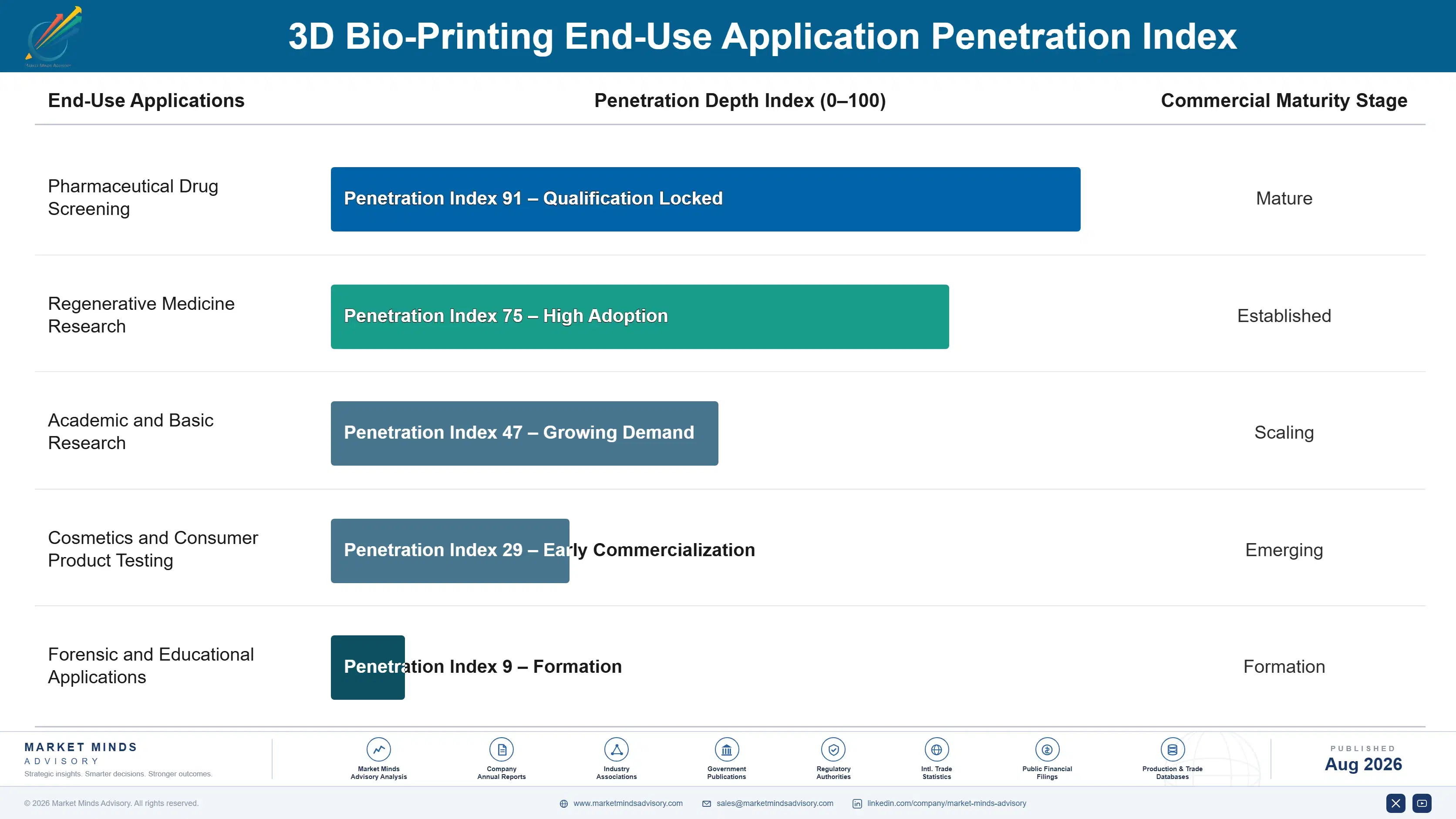
A generational shift is underway in the buyer profile itself, as younger pharmaceutical research scientists trained during graduate programmes that already incorporated bioprinting coursework increasingly champion internal adoption decisions previously left entirely to senior scientists more accustomed to traditional animal testing methods and considerably more skeptical of newer alternative approaches. Companies investing in scientific publication and conference visibility are capturing this shift fastest.
3d-bio-printing-market-size-end-use-penetration-index-1787303569129

Where Adoption Advantage Concentrates Next

These are among the four positions where our research anticipates prominent divergence between winners and laggards over the coming forecast period. Each is grounded in the demand model, the regulatory perimeter, and the announced capacity pipeline.
01 / VALIDATION DATA STRATEGY

Regulatory validation datasets beat resolution specs on pharma deals

Pharmaceutical companies building internal drug screening programmes increasingly select a bioprinting partner based on accumulated validation data and regulatory submission track record rather than raw resolution specifications alone, since regulatory acceptance risk now outweighs pure technical performance in most purchasing decisions made today. Companies that under-invested in validation partnerships are losing pharmaceutical contracts even where their hardware technically outperforms validation-focused competitors on paper. This dynamic will keep favouring Organovo and other validation-first companies over the next several forecast years ahead.
02 / RESOLUTION TECHNOLOGY RACE

Laser-assisted platforms will keep pulling ahead on complex tissue work

Laser-assisted bioprinting's adoption curve is arriving faster than manufacturers originally projected, but further mid-market penetration depends on continued cost declines that only production scale and component standardisation can deliver across the wider optical component supply chain over time. Competitors without meaningful laser-assisted capacity are ceding this fast-growing category entirely to companies who invested early in the underlying technology and formulation research. Expect laser-assisted revenue to keep growing meaningfully faster than extrusion-based sales through the remainder of the forecast period ahead.
03 / BIOINK SUBSCRIPTION ECONOMICS

Recurring bioink revenue will increasingly outweigh hardware sales

Companies building recurring bioink subscription relationships are capturing considerably more predictable revenue than pure hardware sales alone can provide, a pattern that mirrors recurring revenue transitions seen across many other scientific instrument categories in recent years across adjacent markets. Competitors still selling equipment as one-time transactions are ceding this durable margin pool entirely to subscription-focused rivals who moved earlier. Expect bioink and consumables revenue to grow meaningfully faster than hardware revenue through the back half of the current forecast period ahead.
04 / REGIONAL MANUFACTURING SHIFT

Chinese and Korean manufacturers will keep compressing mid-tier pricing

Chinese and South Korean platform manufacturers moving up the value chain toward pharmaceutical-validated systems represent a genuine competitive threat to mid-tier Western hardware companies that lack strong validation partnerships or proprietary bioink portfolios to differentiate themselves against lower-cost regional alternatives entering the market. This pressure will intensify as regional manufacturing scale and technical capability continue closing the gap with established global suppliers over time. Expect pricing compression to hit mid-tier competitors hardest across the current forecast period ahead of them.

Engagement Snapshot From the Field

A live engagement with an industry participant carrying material or product regulatory and market exposure ahead of a defining policy shift, showing how our research translates into a defensible multi-year portfolio strategy.
MARKET MINDS ADVISORY · CLIENT ENGAGEMENT SUMMARY
3D Bio-Printing Producer Strategic Portfolio Review and Transition Roadmap 2026·Investment Scenario on 3D Bio-Printing Exposure Evaluation 2025-26
CLIENT PROFILE
The client is a mid-sized pharmaceutical company with an active oncology and metabolic disease drug development pipeline, generating annual research and development spending of approximately $310 million (client-reported, unverified by MMA). Leadership sought to reduce reliance on traditional animal testing for early-stage compound screening following growing internal pressure around both cost and development timeline concerns across the pipeline.
STRATEGIC CHALLENGE
The client lacked internal bioprinting expertise and was uncertain which technology platform and vendor partnership would best support building a credible internal validation dataset within a reasonable timeline, while also navigating still-evolving regulatory guidance around how much weight bioprinted data would ultimately carry in formal submissions to regulators reviewing the pipeline.
MMA APPROACH
MMA's team evaluated leading bioprinting platform vendors against the client's specific therapeutic focus areas and existing laboratory infrastructure, modelling the total cost and timeline of building internal validation capability against partnering with an established vendor offering contract research services instead. The analysis incorporated regulatory trend data and comparable pharmaceutical company adoption timelines to inform the recommended approach.
KEY FINDINGS
  1. A hybrid approach combining an initial contract research partnership with parallel internal capability building offered the fastest path to a credible validation dataset within the client's target timeline.
  2. Laser-assisted platforms best matched the client's oncology tissue model requirements, based on published resolution and cell viability performance data reviewed during the evaluation phase.
  3. Building full internal capability alone would have taken an estimated eighteen months longer than the hybrid approach, based on comparable pharmaceutical company adoption timelines gathered during the engagement.
  4. Partnering with a vendor holding existing pharmaceutical validation relationships reduced projected regulatory submission risk considerably compared to building an entirely unproven internal validation approach from scratch.
CLIENT PROFILE
The client is a mid-sized pharmaceutical company with an active oncology and metabolic disease drug development pipeline, generating annual research and development spending of approximately $310 million (client-reported, unverified by MMA). Leadership sought to reduce reliance on traditional animal testing for early-stage compound screening following growing internal pressure around both cost and development timeline concerns across the pipeline.
STRATEGIC CHALLENGE
The client lacked internal bioprinting expertise and was uncertain which technology platform and vendor partnership would best support building a credible internal validation dataset within a reasonable timeline, while also navigating still-evolving regulatory guidance around how much weight bioprinted data would ultimately carry in formal submissions to regulators reviewing the pipeline.
MMA APPROACH
MMA's team evaluated leading bioprinting platform vendors against the client's specific therapeutic focus areas and existing laboratory infrastructure, modelling the total cost and timeline of building internal validation capability against partnering with an established vendor offering contract research services instead. The analysis incorporated regulatory trend data and comparable pharmaceutical company adoption timelines to inform the recommended approach.
KEY FINDINGS
  1. A hybrid approach combining an initial contract research partnership with parallel internal capability building offered the fastest path to a credible validation dataset within the client's target timeline.
  2. Laser-assisted platforms best matched the client's oncology tissue model requirements, based on published resolution and cell viability performance data reviewed during the evaluation phase.
  3. Building full internal capability alone would have taken an estimated eighteen months longer than the hybrid approach, based on comparable pharmaceutical company adoption timelines gathered during the engagement.
  4. Partnering with a vendor holding existing pharmaceutical validation relationships reduced projected regulatory submission risk considerably compared to building an entirely unproven internal validation approach from scratch.
RECOMMENDED STRATEGY
Phase 1: Phase 1 (Months 1-6): Launch a contract research partnership with an established vendor to begin generating validation data immediately for priority compounds. Phase 2: Phase 2 (Months 7-14): Build internal laser-assisted bioprinting capability in parallel, training staff through the vendor's technical certification programme fully. Phase 3: Phase 3 (Months 15-20): Transition fully to internal capability while maintaining the contract research relationship for overflow capacity and specialised applications.
OUTCOME
The client generated its first credible internal validation dataset within eight months, faster than the eighteen-month internal-only timeline originally estimated, and reported (client-reported, unverified by MMA) a 30% reduction in early-stage animal testing costs across the affected compound pipeline within the first year following implementation.

Frequently Asked Questions

Foundational context covering the market sizes, CAGR, scope, country, region and competition that inform every finding below. This section is provided to cover basics and most often pre-purchase conversations, answered from the MMA Primary Research Dataset.

What is the current size of the 3D Bio-Printing Market?

The global 3D bio-printing market reached an estimated $2.1 billion in 2025, based on MMA's primary research dataset and company-disclosed segment revenue across the five largest companies tracked worldwide.

How large will the 3D Bio-Printing Market be by 2036?

The market is projected to reach approximately $9.96 billion by 2036, roughly 4.12 times its 2026 value under MMA's base-case forecast scenario for the coming decade.

What is the CAGR for the 3D Bio-Printing Market 2026 to 2036?

The base-case compound annual growth rate is 15.2%, with a bull case near 16.6% and a bear case near 13.8% depending on regulatory validation pathway progress and research funding conditions.

Which segment is growing fastest?

Laser-assisted bioprinting is the fastest-growing segment at a 19.5% CAGR, roughly 1.28 times the overall market rate, driven by single-cell placement precision demand from pharmaceutical customers.

Who are the major companies in the 3D Bio-Printing Market?

CELLINK, Organovo Holdings, 3D Systems, Aspect Biosystems, and EnvisionTEC are the five largest companies by disclosed segment revenue, together holding a combined 34% share of the global market today.

Which country is growing fastest?

Australia is the fastest-growing major market at an estimated 17.8% CAGR, driven primarily by well-funded biotech research programmes and strong government research grant support nationally.

Report Segmentation Architecture

The full report scope spans multiple orthogonal segmentation dimensions, with cross-tabulated demand data provided for each dimension pair. Coverage extends further to regional breakdowns, trend trajectories, and the competitive detail needed to support segment-level decision-making.

By Bioprinting Technology

  • Extrusion-Based Bioprinting
  • Inkjet (Droplet) Bioprinting
  • Laser-Assisted Bioprinting
  • Vat Photopolymerisation Bioprinting
  • Magnetic Levitation / Scaffold-Free Bioprinting
  • Acoustic Droplet Ejection Bioprinting

By End-Use Application

  • Pharmaceutical Drug Screening
  • Regenerative Medicine Research
  • Academic and Basic Research
  • Cosmetics and Consumer Product Testing
  • Forensic and Educational Applications

By Commercial Dimension

  • Direct Hardware Sales
  • Bioink Subscription Supply
  • Contract Bioprinting Research Services
  • Technology Licensing

By Region

  • North America
  • Western Europe
  • East Asia
  • South Asia and Pacific
  • Latin America
  • Middle East and Africa
  • Eastern Europe

Scope, Methodology, and Coverage

Every figure in this report is reproducible from documented input assumptions. The scope below maps the historical period, the forecast horizon, the segmentation dimensions, and the countries covered, alongside the underlying primary and qualitative methodology.
Historical Period
2020 to 2025
Forecast Period
2026 to 2036
Base Year
2025 (USD billions; MMA Primary Research Dataset, August 2026)
Market Definition
The 3D bio-printing market covers hardware platforms, bioinks, and associated software used to fabricate three-dimensional tissue constructs, organoids, and cellular scaffolds for research, drug testing, and regenerative medicine applications. Conventional additive manufacturing of non-biological medical devices, implant hardware printed from inert metals or polymers, and general-purpose 3D printers not designed for living cell deposition are excluded from this scope.
Quantitative Units
USD billions (current prices); installed unit base where disclosed
Segmentation Dimensions
By Bioprinting Technology; By End-Use Application; By Commercial Dimension; By Region
Regions Covered
North America, Western Europe, East Asia, South Asia and Pacific, Latin America, Middle East and Africa, Eastern Europe
Countries Covered
USA, China, Germany, France, UK, Japan, South Korea, India, Australia, Canada, Brazil, Mexico, Indonesia, Vietnam, Thailand, Malaysia, UAE, Saudi Arabia, South Africa, Nigeria, Turkey, Poland, Netherlands, Italy, Spain, Sweden, Switzerland, Argentina, Colombia, Singapore, and additional markets relevant to this sector
Key Companies Profiled
CELLINK (BICO Group AB), Organovo Holdings Inc., 3D Systems Corporation, Aspect Biosystems Ltd., EnvisionTEC (Desktop Metal), RegenHU SA, Poietis SAS, Advanced Solutions Life Sciences, Cellbricks GmbH, Rokit Healthcare Inc., TeVido BioDevices, Prellis Biologics Inc., Readily3D SA, Inventia Life Science, Regenovo Biotechnology Co. Ltd., FluidForm Inc., UPM Biomedicals, Allevi Inc., Nano3D Biosciences Inc., Cyfuse Biomedical K.K.
Quantitative Methodology
Primary survey, n=3,800 respondents, Q4 2025, six countries; demand-side model with trade association cross-validation
Qualitative Methodology
47 expert interviews, Q4 2025; applied to validate demand model assumptions, identify emerging dynamics, and assess competitive positioning
Report Format
PDF and XLSX data workbook (Word format preview document)
Publisher
Market Minds Advisory
Report Code
MMA-2026-MED-131
Published
August 2026
Contact
sales@marketmindsadvisory.com | www.marketmindsadvisory.com

Purchase the full 3D Bio-Printing Market Report (2026 to 2036).

The full 3D Bio-Printing Market report delivers detailed segmentation by printing technology, end-use application, and commercial channel across all seven world regions through 2036. It includes company-level competitive profiles for all twenty companies profiled, covering technology portfolios, validation partnerships, and licensing activity underway. Regional chapters detail country-level regulatory timelines, research funding patterns, and adoption trends for each of the seven regions covered in the report. A dedicated input cost chapter tracks bioink feedstock and optical component exposure alongside mitigation strategies used by leading companies today.
Full seven-region data tables and CAGR breakdowns
Twenty-company competitive profiles and moat analysis
Regulatory validation pathway tracker included here
Input cost exposure and mitigation playbook detailed
Segment-level growth and margin forecasts provided
Editable data appendix in spreadsheet format

Built For The People Who Decide

From boardroom strategy to bench-side execution, this report is read cover-to-cover by leaders shaping the next decade of their industry, turning demand scenarios, market dynamics and valuation benchmarks into decisions.
CXOs/ Presidents/ VPs/ Managers
M&A and Corporate Development
Strategy Teams and R&D Heads
Procurement and Product Directors
Regulatory and Compliance Leaders
Investor Relations and Equity Analysts