

Market Minds Advisory
2-Iodophenol Market

2-Iodophenol Market: Iodinated Building Blocks Across Pharmaceutical and Agrochemical Synthesis, 2026 to 2036

Elemental iodine is 58% of what this intermediate costs to make, and its price has more than tripled since 2020, which turns a synthesis question into a procurement one for everybody involved.

Lead Analyst

Bilal Shaikh

Published

September 2026

Make Smarter Decisions with Customized Research Insights

Request a free sample report and evaluate market opportunities, growth trends, and competitive dynamics relevant to your business needs.

2025 MARKET VALUE$0.1BMarket Size 2025
2036 FORECAST VALUE$0.2BBase Case , 2026 to 2036
CAGR 2026 TO 20367.6 %Bull 8.9% / Bear 6.4%
INCREMENTAL OPPORTUNITY$0.1BNet 10- year value creation
EXPANSION MULTIPLE2.08x2036 value over 2026 base
Strategic Levers
M&A Pipeline
Regional Outlook
Country Rankings
Competitive Intelligence
Segmental Deep-dive
Call-Us : 91 93563 13602

Executive Snapshot and Market Trajectory

This is a small molecule with a large commodity problem sitting inside it. Elemental iodine accounts for 58% of what 2-iodophenol costs to produce, and iodine pricing has more than tripled since 2020 on constrained Chilean and Japanese supply, which has changed the commercial character of the whole intermediate entirely.
Growth concentrates in pharmaceutical intermediate grade, expanding at 11.4%, where the ortho-iodo phenol structure serves as a starting point for palladium-catalysed heterocycle construction that medicinal chemists reach for repeatedly when building benzofuran and indole scaffolds. East Asia holds 32% of value, above the band this report applies elsewhere, because Chinese fine chemical manufacture supplies iodinated intermediates at a scale and cost position Western producers gave up contesting years ago.
The supplier base is concentrated for a fine chemical, with the top five holding 52% of volume supplied, because iodine access rather than synthetic capability limits who can participate seriously. Competition runs on purity consistency, iodine recovery and regulatory documentation rather than on synthesis route, which has been in the literature for a century. Iodine supply, rather than anything a producer does in its own plant, is what decides margins in any given year.
Market Definition
The market comprises 2-iodophenol supplied as a chemical intermediate and reagent, spanning pharmaceutical intermediate grade, custom synthesis and contract manufactured grade, research and analytical grade, agrochemical intermediate grade, and technical and dye intermediate grade. Sizing captures product revenue at realised delivered price across pharmaceutical and agrochemical synthesis, contrast agent manufacture, specialty dye production, and research and analytical supply. Other iodophenol isomers, iodinated aromatic intermediates outside this compound, elemental iodine and iodide salts sold as raw material, finished active pharmaceutical ingredients and contract research services fall outside scope.
Base Year Value
$0.1B in 2025 (MMA Primary Research Dataset, August 2026)
Forecast Period
2026 to 2036, eleven discrete annual values
CAGR
7.6% base case. Bull 8.9%. Bear 6.4%.
Fastest Growth Segment
Pharmaceutical Intermediate Grade: 11.4% CAGR
Fastest Growth Country
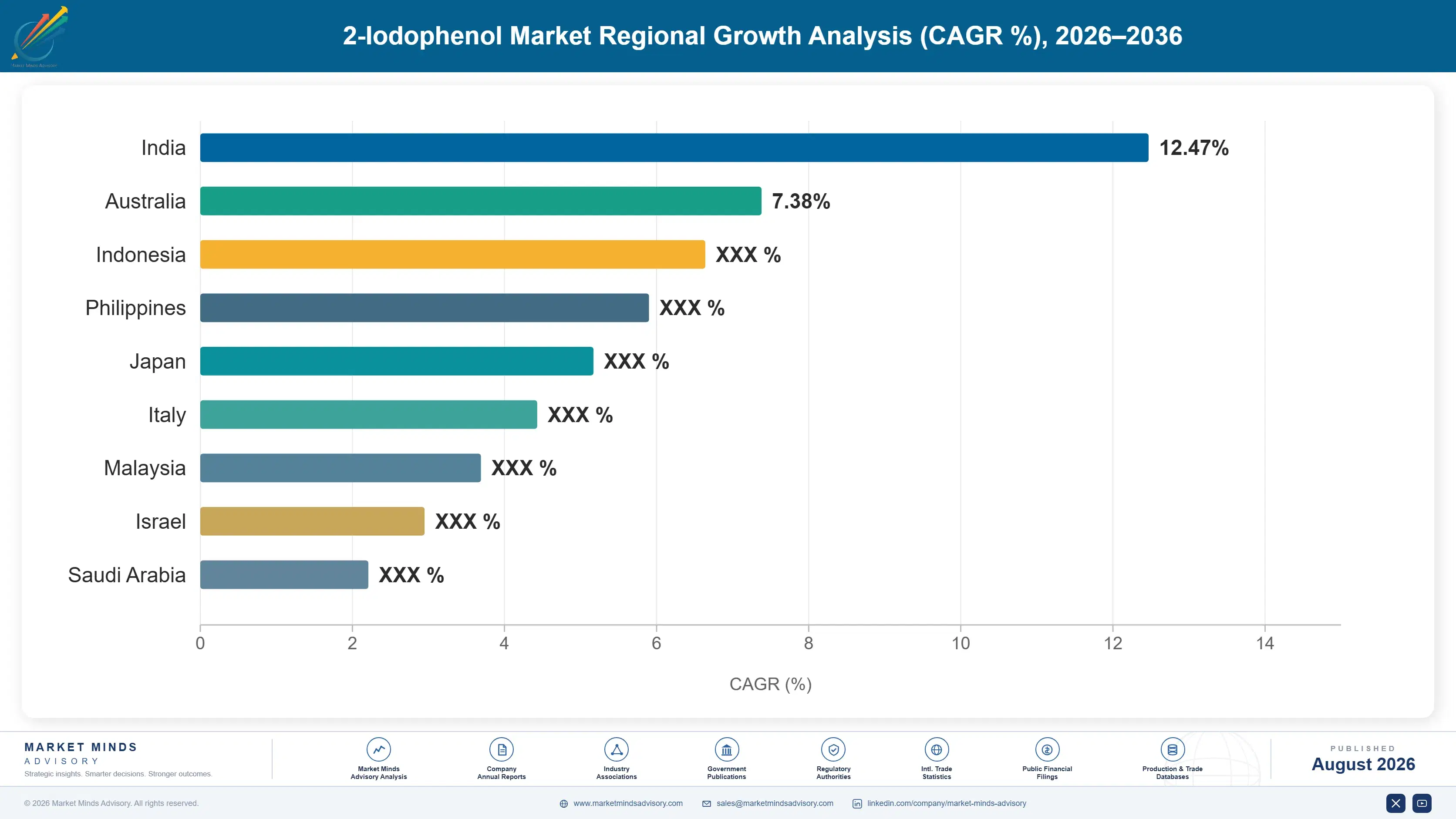
India: 10.4% CAGR
Fastest Growth Region
South Asia and Pacific: 9.8% CAGR
Largest Region
East Asia: 32% of 2025 global value
Market Leaders
Iofina, Ajay-SQM Group, Deepwater Chemicals, Godo Shigen, Nippoh Chemicals. Source: MMA Analysis based on company annual reports.
Primary Survey
n=3,800 procurement and R&D decision-makers, Q4 2025, six countries
Methodology
Demand-side build-up, cross-validated against public data, 47 expert interviews

2-Iodophenol Market Forecast Scenarios

2-iodophenol-market-trends-size-forecast-scenario-1787310621456
Growth of 6.2% across 2020 to 2025 says more about iodine pricing than about how much material anybody consumed. Iodine rose from roughly twenty dollars per kilogram to well above sixty across the window as Chilean nitrate operations constrained output and Japanese brine production stayed flat, and every iodinated intermediate repriced accordingly. Underlying volume grew considerably more slowly than the revenue figures alone would suggest.
The base case at 7.6% rests on three mechanisms. Small molecule drug discovery continues favouring heterocyclic scaffolds that palladium-catalysed coupling from ortho-iodo phenols reaches efficiently, and iodine leaves considerably faster than bromine in those particular reactions. Contract manufacturing of pharmaceutical intermediates keeps migrating toward Indian and Chinese producers with the iodine handling capability required. And contrast agent and diagnostic manufacture keeps growing steadily with imaging volumes across every developed health system.
The bull case at 8.9% turns on iodine pricing holding at elevated levels, which raises the value of every kilogram sold whatever happens to underlying demand. The bear case at 6.4% turns on substitution. Medicinal chemists switch to bromo analogues when iodine pricing makes the reactivity advantage uneconomic, and sustained high iodine costs accelerate exactly that decision across discovery and development programmes.

What Determines Iodophenol Intermediate Value

The synthesis is not the business. Direct iodination of phenol has been published for over a century, the chemistry is taught in undergraduate courses, and any competent fine chemical plant can run it. What separates producers is that iodine represents 58% of the cost, that recovering it from spent reaction streams at 78% or better takes real process work, and that pharmaceutical customers demand 99.5% assay with impurity profiles documented to a standard research suppliers never contemplate.
TOP FIVE SHARE52%Concentration of iodinated intermediate volume across the largest suppliers
IODINE COST SHARE58%Elemental iodine share of finished intermediate production cost
PHARMACEUTICAL PURITY SPECIFICATION99.5%Assay required before pharmaceutical customers will qualify supply
TYPICAL BATCH SCALE250 kilogramsCampaign batch size for pharmaceutical intermediate production runs
PROCESS IODINE RECOVERY78%Share of iodine recovered from reaction streams and recycled
CUSTOMER QUALIFICATION CYCLE11 monthsTime from sample supply to commercial supply agreement signature
Iodine access decides participation. Global supply comes overwhelmingly from Chilean caliche operations and Japanese brine fields, with a small and growing contribution from produced water recovery in North America, and it has been tight enough since 2020 to price out anybody buying spot. Producers with contracted supply or their own recovery operate on a different cost base entirely.
Qualification behaves as it does anywhere in pharmaceutical supply. Customers take around 11 months from first sample to a commercial agreement, testing impurity profiles against their own downstream chemistry, and having qualified a supplier they change reluctantly because the regulatory filing names it. That barrier is what allows a producer to earn something beyond an iodine pass-through margin.
"Everybody quotes this molecule on a dollars per kilogram basis and almost nobody asks what iodine assumption sits underneath the number. I have watched customers accept a quote in March and discover in September that the supplier had priced iodine at a level nobody could still buy it at, which is a conversation neither party enjoys."
Director, Fine Chemicals and Pharmaceutical Intermediates Practice · MMA Chemica

Market Trends

Iodine Pricing Reshapes Intermediate Commercial Structure

Elemental iodine moved from roughly twenty dollars per kilogram to well above sixty between 2020 and 2025, driven by constrained Chilean caliche output and flat Japanese brine production against demand from contrast agents, polarising film and animal feed. Iodine now represents 58% of intermediate production cost, against a much smaller share historically. That shift has forced producers to introduce metal pass-through pricing, forced customers to hedge or contract forward, and pushed several smaller synthesisers out of the business altogether rather than absorb it. Nothing about that pressure has eased since.
Market Impact: Covers 4,200 development compounds

Palladium Coupling Chemistry Sustains Iodo Reagent Demand

Medicinal chemists building benzofuran, benzoxazole and indole scaffolds reach for the ortho-iodo phenols because iodine is a better leaving group than bromine in palladium-catalysed cyclisation, giving faster reactions at appreciably lower catalyst loading. Roughly 34% of published heterocycle syntheses using halophenol starting materials specify the iodo compound rather than a cheaper halide. That preference survives cost pressure comfortably at discovery scale, where quantities are small, and it weakens considerably at manufacturing scale, where the bromo analogue frequently wins on economics alone. Discovery quantities are small enough that price barely registers as a consideration.
Market Impact: Reaches 61% contract production

Market Opportunities and Growth Drivers

Small Molecule Discovery Favours Heterocyclic Scaffold Construction

Pharmaceutical discovery has concentrated heavily on heterocyclic chemistry, where nitrogen and oxygen containing ring systems dominate the structures reaching clinical development, and ortho-substituted iodophenols are efficient entry points into several of those ring systems. Around 4,200 compounds in active preclinical and clinical development contain benzofuran or related scaffolds accessible from this starting material. Discovery quantities are small and the price sensitivity correspondingly low, which makes this comfortably the most reliably profitable demand available anywhere in the market. Programme attrition means most qualifications generate little, and the survivors generate a great deal.
Market Impact: Iodine is 58% of cost

Contract Manufacturing Migrates Toward Iodine Handling Capability

Pharmaceutical companies have been outsourcing intermediate manufacture steadily for years, and iodination chemistry requires corrosion-resistant equipment, iodine recovery capability and waste handling that most general fine chemical plants simply do not have. Roughly 61% of pharmaceutical intermediate volume is now produced under contract rather than in-house. Producers who invested early in dedicated iodination capability capture a disproportionate share of that migration, since a customer moving a synthetic step outward wants a plant that already runs the chemistry rather than one proposing to learn it on their programme. Qualification depth compounds that advantage.
Market Impact: Recovery sits at 78% typical

Market Restraints and Challenges

Iodine Supply Concentration Caps Everybody's Cost Position

Elemental iodine comes overwhelmingly from Chilean caliche operations and Japanese brine fields, and the root cause is geological rather than commercial, since economically recoverable iodine deposits are genuinely rare almost everywhere. Commercially this means a producer without contracted supply buys at spot into a market where two countries set the price, and at 58% of production cost that determines profitability more or less entirely. Participants are responding with multi-year iodine supply agreements, investment in process recovery well beyond the 78% currently typical, and recovery from customer iodine-bearing waste streams under toll arrangements.
Market Impact: Iodine reaches 58% of cost

Bromo Analogue Substitution Erodes Manufacturing Scale Demand

The reactivity advantage that iodine offers in coupling chemistry is real and frequently not worth paying for once a synthesis reaches commercial scale, where bromine costs a fraction as much and reaction conditions can be adjusted to compensate. The root cause is simply the price differential, which widened very sharply after 2020. Commercially this caps the segment at development quantities for many programmes. Mitigation runs through process chemistry support demonstrating total cost advantage, iodine recovery services that reduce net consumption, and pricing that reflects recovered rather than virgin iodine content.
Market Impact: Specified in 34% of syntheses
3 additional market trends, 4 additional growth drivers, and 2 additional restraints and challenges are covered in the full report. Contact sales@marketmindsadvisory.com to access the complete intelligence.

Segment CAGR and Growth Architecture

Segmentation follows purity grade and supply relationship, which is the dimension determining documentation burden, qualification requirement, batch scale and realised price per kilogram together. End-use application maps closely onto grade rather than cutting across it, and synthesis route is effectively uniform across producers, so neither of those belongs anywhere in the primary hierarchy here.
2-iodophenol-market-trends-market-share-analysis-1787310622008

Pharmaceutical Intermediate Grade

Growing at 11.4%, exactly 1.50 times the market rate, and the only grade where a producer earns genuine specification pricing rather than an iodine pass-through margin. Pharmaceutical customers require assay above 99.5%, documented impurity profiles, residual solvent control and manufacturing records that stand up to regulatory inspection, none of which ordinary research grade supply involves at all. Qualification runs around eleven months and the supplier is then named in regulatory filings, which makes these positions unusually durable once they are properly established. Batch campaigns run at a few hundred kilograms rather than at tonne scale, so this is a genuinely high-value, low-volume business that rewards documentation discipline far above manufacturing scale.
CAGR 11.4%

Custom Synthesis and Contract Manufactured Grade

Expanding at 9.2% as pharmaceutical and agrochemical companies push intermediate manufacture outward to producers who already run iodination chemistry, since the corrosion-resistant equipment, recovery systems and waste handling involved are genuinely awkward to install for one product. Roughly 61% of all pharmaceutical intermediate volume now comes through contract arrangements. Relationships here run deeper than a supply agreement, frequently covering process development, scale-up and regulatory support alongside material, which makes them considerably harder for a competitor to displace on price. Margins here reflect the service content rather than the molecule itself, which is why they survive competitors quoting lower on material alone. Process knowledge accumulated across campaigns compounds the position further.
CAGR 9.2%
Full segment breakdown across 5 segments available in the complete report.

Regional Architecture and Country Demand Map

Regional value follows fine chemical manufacturing capability and iodine access together, which sit in quite different places from one another. Iodine comes from Chile and Japan, the chemistry is increasingly run in China and India, and the pharmaceutical customers specifying it sit mostly somewhere else again entirely.

East Asia

Thirty-two percent of value sits here, above the band this report applies to global markets. Note: the deviation is genuine, since Chinese fine chemical manufacture supplies iodinated intermediates at a scale and cost position that Western producers largely stopped contesting some years ago. Chinese producers operate dedicated iodination capability with recovery systems, and they serve both domestic pharmaceutical manufacture and substantial export demand. Japanese producers hold a quite different position, sitting on domestic brine iodine supply that gives them a raw material advantage nobody else in the region has. Korean demand is modest and almost entirely pharmaceutical in character. Growth of 8.5% runs above the global rate on contract manufacturing migration.
Share: 32% | CAGR: 8.5% (2026 to 2036)

South Asia and Pacific

Twenty percent of value, above the usual band, reflecting Indian fine chemical manufacture that has become genuinely central to pharmaceutical intermediate supply worldwide. Note: the deviation follows real production geography rather than analytical judgement. Indian producers combine iodination capability, regulatory documentation experience built through decades of pharmaceutical supply, and cost positions that Western contract manufacturers cannot approach on anything resembling standard chemistry. Growth of 9.8% is comfortably the fastest of any region here. Australian involvement in this market is negligible outside research supply. The binding constraint on Indian expansion is iodine procurement rather than chemistry capability, since the country has no domestic elemental iodine production of any consequence at all.
Share: 20% | CAGR: 9.8% (2026 to 2036)
Regional intelligence for 5 additional markets available in the complete report: North America, Western Europe, Latin America, Middle East and Africa, Eastern Europe. Contact sales@marketmindsadvisory.com.
2-iodophenol-market-trends-country-cagr-analysis-1787310622540

Where Iodophenol Producers Can Earn More

Selling a published synthesis on price per kilogram against competitors buying the same iodine leaves a producer nothing worth defending at all. The margin genuinely available sits in iodine recovery, in pharmaceutical qualification, in the service content wrapped around custom synthesis, and in contract structures that stop the producer carrying a commodity position it cannot hedge.

Push Iodine Recovery Well Beyond Typical Process Yields

Iodine is 58% of production cost and typical process recovery from reaction streams sits around 78%, which means roughly a fifth of the most expensive input leaves the plant as waste. Producers investing in improved recovery, oxidative regeneration and stream segregation reach 90% or better and cut effective iodine consumption by roughly 15%, which drops almost entirely to margin. The engineering is well understood and the payback at current iodine pricing is measured in months rather than years. Most producers still treat recovery as an environmental obligation rather than as the cost programme it actually is.
Market Impact: Cuts effective iodine consumption b

Qualify Into Pharmaceutical Supply Chains Deliberately

Pharmaceutical grade requires assay above 99.5% with documented impurity profiles and inspection-ready records, and qualification takes around eleven months before a supplier is finally named in a regulatory filing. That barrier is exactly why the grade realises roughly 4 times research and technical grade pricing, and why it has held that through successive iodine cycles. The documentation work involved is bounded and the analytical investment modest against the price differential. Producers selling technical grade on price are competing in the one part of this market where absolutely nothing protects them from anybody.
Market Impact: Realises roughly 4 times technical

Sell Process Development Alongside The Molecule

Roughly 61% of all pharmaceutical intermediate volume now comes through contract arrangements, and customers moving a synthetic step outward want scale-up support, impurity characterisation and regulatory documentation rather than simply a drum of material. Producers supplying that service content alongside the material realise roughly 2.6 times the value of catalogue supply across comparable volumes, and the relationship survives price competition because any competitor would first have to repeat the whole development programme. It also generates exactly the process knowledge that improves iodine recovery on every subsequent campaign the plant runs.
Market Impact: Realises roughly 2.6 times catalogu

Price Iodine Through Rather Than Carrying The Position

Iodine at 58% of cost tripling within five years destroyed margin at every single producer quoting fixed prices, and several smaller synthesisers left the business over it entirely rather than continue. Pass-through clauses referenced to a published iodine benchmark protect roughly 80% of gross margin through a movement of that size, and customers accept them readily because they already track the metal price themselves. Producers resist because quoted prices become variable, which is presentation rather than economics and a very poor reason to hold a commodity position nobody can hedge.
Market Impact: Protects roughly 80% of gross margi

Who Controls the Margin Pool

Concentration is high for a fine chemical and it traces upstream. The top five participants hold 52% of iodinated intermediate volume supplied, the basis used throughout this section, and the gap between them reflects iodine access rather than any synthetic advantage, since the chemistry itself is published and entirely unremarkable. Iofina and Deepwater Chemicals approach this market from iodine production, while Ajay-SQM and the Japanese producers combine iodine supply with downstream derivati
Competition currently runs on three dimensions and synthesis capability is the least of them. Iodine cost position decides who can quote profitably at all. Pharmaceutical qualification decides who earns beyond a pass-through margin. Service content around custom synthesis decides who holds onto a customer once a competitor quotes lower on the molecule alone.

Pressure is building from two directions. Indian and Chinese contract manufacturers keep taking standard intermediate volume on cost positions Western producers cannot match. Bromo analogue substitution removes commercial scale demand whenever iodine pricing stays elevated for long. Rankings shift first across technical and research grades, where nothing whatever protects a supplier and buyers compare quotations directly on delivered price.
2-iodophenol-market-trends-company-positioning-matrix-1787310623086

Competitive Moat and Risk Dimensions

IOFINA

Moat: Produced water iodine recovery

Recovering iodine from oilfield produced water in Oklahoma gives a supply position independent of Chilean caliche and Japanese brine, which is the only genuinely new source developed in decades. Integration forward into iodine derivatives captures value across both stages and provides a cost base that any producer buying iodine at spot simply cannot approach in a tight market.
IOFINA

Risk: Oilfield activity dependence

Iodine recovery depends on produced water volumes from oil and gas operations that are drilled for entirely unrelated reasons, so feedstock availability follows drilling activity rather than iodine demand. A sustained downturn in regional drilling reduces the brine stream regardless of how valuable the iodine in it has become.
AJAY-SQM GROUP

Moat: Caliche supply and derivatives

Combining access to Chilean caliche iodine with downstream derivative manufacturing across several geographies creates a position that neither a pure iodine producer nor a pure fine chemical synthesiser can replicate. Scale in iodine chemistry spreads recovery and handling investment across a product range rather than concentrating it on any single molecule.
AJAY-SQM GROUP

Risk: Chilean concentration and regulation

Caliche operations concentrate in one country whose mining and water regulation has tightened considerably, and whose political environment around resource extraction has been unsettled for several years. Any constraint on Chilean output affects the supply base directly and immediately, and there is no comparable alternative deposit available to develop quickly.

Players Tracked

Prominent Players

Iofina
Ajay-SQM Group
Deepwater Chemicals
Godo Shigen
Nippoh Chemicals

Other Key Players

SQM
Nihon Tennen Gas Development
Calibre Chemicals
Shreeji Pharma International
Sisco Research Laboratories
TCI Chemicals
Merck KGaA
Thermo Fisher Scientific
Central Drug House
Otto Chemie
Loba Chemie
Shanghai Aladdin Biochemical
Toronto Research Chemicals
Combi-Blocks
Apollo Scientific

Recent Developments

MAY 2025

Iodine recovery capacity expanded at derivative producer

A producer of iodinated fine chemical intermediates commissioned substantially improved iodine recovery and regeneration capacity, targeting an effective consumption reduction across its entire iodinated product range after elemental iodine pricing sustained levels several times those prevailing before 2020 across an extended and unusually persistent period.
Signal: Recovery investment at these iodine prices
SEPTEMBER 2025

Pharmaceutical customer qualifies Indian intermediate supplier

A pharmaceutical manufacturer completed full qualification of an Indian contract producer for iodinated intermediate supply, following an extended review covering impurity profiles, manufacturing records and full regulatory documentation ahead of formally naming the supplier in regulatory filings for a development stage programme heading toward registration.
Signal: Qualification into a regulatory filing is
JANUARY 2025

Iodine supply agreement signed on multi-year indexed terms

A fine chemical producer concluded a multi-year elemental iodine supply agreement with an upstream producer on indexed rather than fixed terms, securing volume through a period of constrained availability while sharing the price exposure with its upstream supplier rather than absorbing all of it downstream.
Signal: Indexed iodine contracting is how downstre

What Sits Inside Intermediate Cost

Elemental iodine accounts for roughly 58% of production cost, purchased from a supply base concentrated in Chile and Japan with a small and growing contribution from North American produced water recovery. Phenol and related precursors add around 9%. Oxidants, solvents and process chemicals contribute about 14%, energy 6%, waste treatment and iodine-bearing effluent handling 8%, and overhead the remaining 5%.
Iodine pricing moved violently across the forecast history. Prices rose from roughly twenty dollars per kilogram in 2020 to well above sixty by 2024 as Chilean caliche output was constrained and Japanese brine production stayed flat against growing contrast agent demand. SQM Annual Report 2023 and Iofina Annual Report 2023 both documented the pricing environment and its effect on derivative economics, and several smaller synthesisers exited rather than absorb it.

The competitive disadvantage mechanism runs through iodine procurement rather than through synthesis efficiency. A producer buying iodine at spot competes against one holding contracted supply or recovering its own, and at 58% of cost that gap cannot be closed through operational improvement. Recovery rates compound it, since a plant achieving 90% recovery consumes considerably less virgin iodine than one at 78%. Small producers typically carry both disadvantages at once.
2-iodophenol-market-trends-cost-volatility-analysis-1787310623284

Contract iodine supply on multi-year indexed terms

Spot iodine purchasing offers no protection at all in a market where two countries set the price and availability has been constrained for years now. Multi-year agreements indexed to a published benchmark secure volume through tight periods and share price movement with the upstream supplier rather than concentrating all of it on the derivative producer downstream.

Invest in recovery and regeneration beyond typical yields

Typical process recovery sits around 78%, which means a fifth of the dominant cost input leaves the plant as waste that then requires treatment as well. Improved recovery, oxidative regeneration and careful stream segregation together reach 90% or better, and at current iodine pricing the engineering involved pays back in months rather than in years.

Offer customer waste stream iodine recovery under toll

Pharmaceutical customers running iodination chemistry downstream generate iodine-bearing waste that they must treat and dispose of anyway. Recovering that iodine under a toll arrangement supplies feedstock cheaply for the producer, solves a disposal problem that the customer already has on its hands, and it creates a commercial relationship that straightforward material supply never generates.

Portfolio Architecture for Margin Defence

Margin architecture separates by documentation rather than by chemistry, which is common in fine chemicals and unusually pronounced here because the synthesis is genuinely trivial. Technical and dye grade material earns an iodine pass-through margin and nothing more, since any plant can make it and buyers compare quotes directly. Value rises steeply with pharmaceutical qualification, service content and iodine recovery capability, none of which the molecule itself provides.
The volume versus premium tension is unusual because the volume tier barely exists. This is a small market in absolute terms, so nobody builds scale on technical grade, and the campaigns that matter run at a few hundred kilograms. Pharmaceutical and custom synthesis grades carry both the value and most of the volume worth having. A producer without qualification capability is not choosing the lower tier; it cannot reach the higher one.

High-value pools concentrate in three places. Pharmaceutical grade commands price because qualification takes eleven months and the supplier gets named in a filing. Custom synthesis with process development earns on service the customer cannot easily replicate. And iodine recovery capability earns on cost avoided rather than price charged, which is the least visible and most durable advantage available.

Volume / Commodity-Adjacent Tier

Technical and dye intermediate grade material supplied against basic specification into non-regulated applications, where any competent fine chemical plant can produce it and buyers compare quotations directly on delivered price alone.
Gross Margin: 14-22%

Premium / Certified Tier

Research, analytical and agrochemical intermediate grades with characterised impurity profiles and certificates of analysis. Documentation and consistency defend pricing here. Consistency reinforces it. The eight-point range reflects catalogue against contracted supply economics.
Gross Margin: 28-36%

Sustainability / Regulatory / Next-Generation Tier

Pharmaceutical intermediate grade and custom synthesis supplied with process development, scale-up support and regulatory documentation. Qualification barriers defend pricing strongly. The eleven-point range reflects material supply against full service engagement.
Gross Margin: 42-53%
2-iodophenol-market-trends-portfolio-architecture-1787310623786

High-value Sub-segments and Strategic Watch-out

Pharmaceutical grade qualified intermediate supply

High value and high growth together, because qualification runs around eleven months and it results in the supplier being named in a regulatory filing that nobody ever revisits casually. Realised pricing has held at roughly 4 times technical grade through every iodine cycle so far.
Gross Margin: 42-53%

Custom synthesis with process development content

Strong realised value on rapid growth, because roughly 61% of pharmaceutical intermediate volume now runs through contract arrangements and customers want scale-up and regulatory documentation support rather than drums of material. Competitors must repeat the whole development programme in order to displace an incumbent supplier.
Gross Margin: 36-48%

Technical and dye intermediate grade volume

The volume core in name only, given that this market has very little volume anywhere at all and technical grade earns an iodine pass-through margin at best. Necessary for plant loading between campaigns, but it funds nothing at all and attracts every low-cost competitor in the market.
Gross Margin: 14-22%

Iodine recovery and regeneration capability

The strategic watch-out, because iodine at 58% of cost against typical recovery of 78% means a fifth of the dominant input is simply being discarded as waste. Producers reaching 90% operate on a cost base that spot purchasers simply cannot approach under any market condition whatsoever.
Gross Margin: 30-46%

How Intermediate Demand Behaves

Demand is programme-locked and highly asymmetric in value. A pharmaceutical intermediate qualified into a development programme is consumed at quantities that scale with the programme's progress, from grams in discovery through to hundreds of kilograms in late development, and the supplier named in the filing supplies all of it. Most programmes fail, so most qualifications generate little revenue, and the few that reach commercial manufacture generate a great deal for a decade or more.
Stickiness varies enormously by grade. Research and catalogue supply is loosest, bought from whichever supplier lists the compound acceptably, with no relationship surviving the order. Agrochemical intermediate supply sits tighter, with specification and volume commitments in place already. Pharmaceutical grade is stickiest by a wide margin, where the supplier appears in a regulatory filing and changing means amending it, which nobody undertakes without a documented operational reason.

The buyer profile has shifted toward procurement and supply chain functions in a way that disadvantages purely technical suppliers. A decade ago process chemists selected intermediate suppliers on chemistry and service. Today supply chain resilience, second-source availability and iodine price exposure all feature alongside technical fit, which favours producers able to discuss commodity position credibly rather than only synthesis.
2-iodophenol-market-trends-end-use-penetration-index-1787310624278

Where We Land On This

These are among the four positions where our research anticipates prominent divergence between winners and laggards over the coming forecast period. Each is grounded in the demand model, the regulatory perimeter, and the announced capacity pipeline.
01 / IODINE RECOVERY INVESTMENT

Recover the iodine before optimising anything else

Elemental iodine represents 58% of production cost and typical process recovery sits near 78%, which means roughly a fifth of the dominant input walks out of the plant as waste that then costs money to treat. Producers investing in improved recovery, regeneration and stream segregation reach 90% or better and cut effective consumption by roughly 15%, dropping almost all of it to margin. At current iodine pricing the engineering pays back in months, and most producers still treat recovery as an environmental obligation.
02 / PHARMACEUTICAL GRADE QUALIFICATION

Qualify into filings rather than selling on catalogue

Pharmaceutical grade requires assay above 99.5% with documented impurity profiles and inspection-ready manufacturing records, and qualification runs around eleven months before the supplier is named in a regulatory filing that nobody revisits casually. That barrier is precisely why the grade realises roughly 4 times technical grade pricing and has held it through every iodine cycle so far. Producers selling technical grade on price alone are competing in the one part of this market where absolutely nothing protects them from anybody.
03 / SERVICE CONTENT DEVELOPMENT

Sell development capability, not drums of intermediate

Roughly 61% of pharmaceutical intermediate volume now runs through contract arrangements, and customers moving a synthetic step outward want scale-up support, impurity characterisation and regulatory documentation rather than a shipment of material. Producers supplying that service content realise roughly 2.6 times the value of catalogue supply on comparable volumes, and any competitor would first have to repeat the entire development programme in order to displace them. The process knowledge generated also improves iodine recovery on every subsequent campaign the plant runs.
04 / COMMODITY EXPOSURE REMOVAL

Pass iodine through instead of carrying the position

Iodine at 58% of cost tripling within five years destroyed margin at every producer quoting fixed prices, and several smaller synthesisers left the business altogether rather than continue absorbing it. Pass-through clauses referenced to a published benchmark protect roughly 80% of gross margin through a movement of that magnitude, and customers accept them readily enough because they already track the metal price themselves anyway. Producers resist mainly because quoted prices become variable, which is presentation rather than economics and a poor reason.

Engagement Snapshot From the Field

A live engagement with an industry participant carrying material or product regulatory and market exposure ahead of a defining policy shift, showing how our research translates into a defensible multi-year portfolio strategy.
MARKET MINDS ADVISORY · CLIENT ENGAGEMENT SUMMARY
2-Iodophenol Producer Strategic Portfolio Review and Transition Roadmap 2026·Investment Scenario on 2-Iodophenol Exposure Evaluation 2025-26
CLIENT PROFILE
A fine chemical producer operating multipurpose synthesis capacity across Western Europe and South Asia, supplying iodinated and brominated intermediates to pharmaceutical, agrochemical and research customers. Iodinated intermediate revenue approached EUR 42 million annually (client-reported, unverified by MMA), roughly two thirds of it in technical and research grades sold from catalogue at fixed annual prices with no pass-through provision.
STRATEGIC CHALLENGE
Margins had collapsed across three years and management attributed it to Asian competition, responding with cost reduction across both sites. Nobody had separated iodine price movement from competitive pricing pressure in the analysis. A proposed capacity expansion assumed catalogue volumes would recover once pricing stabilised, and pharmaceutical qualification had been discussed for years without ever being funded.
MMA APPROACH
MMA interviewed forty-seven pharmaceutical process chemists, procurement leads, iodine producers and competing synthesisers across five markets, establishing how intermediate suppliers are actually selected and qualified. We separated iodine cost movement from realised margin across four years, benchmarked the client's process recovery against competitors, and assessed the qualification requirements standing between the client and pharmaceutical grade supply.
KEY FINDINGS
  1. Margin collapse traced almost entirely to iodine pricing on fixed-price catalogue contracts rather than to any competitive pressure from Asian producers at all.
  2. Process iodine recovery ran at 71% against a competitor benchmark near 90%, and the difference alone exceeded the entire margin decline being investigated across the period.
  3. Pharmaceutical grade qualification required analytical and documentation work the client could complete within a year, against pricing several times its catalogue realisation (client-reported, unverified by MMA).
  4. Every pharmaceutical customer interviewed said they would evaluate a European qualified supplier for supply chain resilience, and none had ever been approached by the client.
CLIENT PROFILE
A fine chemical producer operating multipurpose synthesis capacity across Western Europe and South Asia, supplying iodinated and brominated intermediates to pharmaceutical, agrochemical and research customers. Iodinated intermediate revenue approached EUR 42 million annually (client-reported, unverified by MMA), roughly two thirds of it in technical and research grades sold from catalogue at fixed annual prices with no pass-through provision.
STRATEGIC CHALLENGE
Margins had collapsed across three years and management attributed it to Asian competition, responding with cost reduction across both sites. Nobody had separated iodine price movement from competitive pricing pressure in the analysis. A proposed capacity expansion assumed catalogue volumes would recover once pricing stabilised, and pharmaceutical qualification had been discussed for years without ever being funded.
MMA APPROACH
MMA interviewed forty-seven pharmaceutical process chemists, procurement leads, iodine producers and competing synthesisers across five markets, establishing how intermediate suppliers are actually selected and qualified. We separated iodine cost movement from realised margin across four years, benchmarked the client's process recovery against competitors, and assessed the qualification requirements standing between the client and pharmaceutical grade supply.
KEY FINDINGS
  1. Margin collapse traced almost entirely to iodine pricing on fixed-price catalogue contracts rather than to any competitive pressure from Asian producers at all.
  2. Process iodine recovery ran at 71% against a competitor benchmark near 90%, and the difference alone exceeded the entire margin decline being investigated across the period.
  3. Pharmaceutical grade qualification required analytical and documentation work the client could complete within a year, against pricing several times its catalogue realisation (client-reported, unverified by MMA).
  4. Every pharmaceutical customer interviewed said they would evaluate a European qualified supplier for supply chain resilience, and none had ever been approached by the client.
RECOMMENDED STRATEGY
Phase 1: Phase 1 (0 to 6 months): Halt the capacity expansion, convert catalogue pricing to iodine pass-through and begin recovery improvement engineering. Phase 2: Phase 2 (6 to 18 months): Complete pharmaceutical grade qualification and approach European pharmaceutical customers on supply chain resilience grounds. Phase 3: Phase 3 (18 to 36 months): Build custom synthesis and process development capability, targeting programmes at development stage rather than catalogue buyers.
OUTCOME
The client cancelled roughly EUR 9 million of planned capacity (client-reported, unverified by MMA) and moved catalogue pricing to iodine pass-through within two quarters. Process recovery reached benchmark within a year, the first pharmaceutical qualification completed at fourteen months, and two development stage programmes were secured before the engagement closed.

Frequently Asked Questions

Foundational context covering the market sizes, CAGR, scope, country, region and competition that inform every finding below. This section is provided to cover basics and most often pre-purchase conversations, answered from the MMA Primary Research Dataset.

What is the current size of the 2-Iodophenol Market?

The market reached USD 0.1 billion in 2025, measured as product revenue at realised delivered price across all grades. Pharmaceutical and custom synthesis grades account for most of that value.

How large will the 2-Iodophenol Market be by 2036?

MMA forecasts USD 0.23 billion by 2036, an expansion of 2.08 times the 2026 level. Incremental value across the forecast period reaches USD 0.12 billion.

What is the CAGR for the 2-Iodophenol Market 2026 to 2036?

The base case compound annual growth rate is 7.6%, with a bull case of 8.9% and a bear case of 6.4%. Iodine pricing and bromo analogue substitution separate those two scenarios.

Which segment is growing fastest?

Pharmaceutical intermediate grade grows fastest at 11.4%, exactly 1.50 times the overall market rate. Qualification into regulatory filings is what makes that segment genuinely defensible.

Who are the major companies in the 2-Iodophenol Market?

Iofina, Ajay-SQM Group, Deepwater Chemicals, Godo Shigen and Nippoh Chemicals lead, holding 52% of volume between them. Iodine access rather than synthetic capability explains that concentration.

Which country is growing fastest?

India grows fastest at 10.4%, where fine chemical producers combine iodination capability with regulatory documentation experience and cost positions Western contract manufacturers cannot match. Iodine procurement remains the constraint.

Report Segmentation Architecture

The full report scope spans multiple orthogonal segmentation dimensions, with cross-tabulated demand data provided for each dimension pair. Coverage extends further to regional breakdowns, trend trajectories, and the competitive detail needed to support segment-level decision-making.

By Purity Grade and Supply Relationship

  • Pharmaceutical Intermediate Grade
  • Custom Synthesis and Contract Manufactured Grade
  • Research and Analytical Grade
  • Agrochemical Intermediate Grade
  • Technical and Dye Intermediate Grade

By End-Use Industry

  • Pharmaceutical Synthesis and Development
  • Contrast Agent and Diagnostic Manufacture
  • Agrochemical Active Ingredient Synthesis
  • Specialty Dye and Pigment Production
  • Academic and Industrial Research

By Customer Type and Channel

  • Pharmaceutical Manufacturers
  • Contract Development and Manufacturing Organisations
  • Agrochemical Producers
  • Research Chemical Distributors
  • Specialty Chemical Traders

By Region

  • North America
  • Western Europe
  • East Asia
  • South Asia and Pacific
  • Latin America
  • Middle East and Africa
  • Eastern Europe

Scope, Methodology, and Coverage

Every figure in this report is reproducible from documented input assumptions. The scope below maps the historical period, the forecast horizon, the segmentation dimensions, and the countries covered, alongside the underlying primary and qualitative methodology.
Historical Period
2020 to 2025
Forecast Period
2026 to 2036
Base Year
2025 (USD billions; MMA Primary Research Dataset, August 2026)
Market Definition
The market comprises 2-iodophenol supplied as a chemical intermediate and reagent, spanning pharmaceutical intermediate grade, custom synthesis and contract manufactured grade, research and analytical grade, agrochemical intermediate grade, and technical and dye intermediate grade. Sizing captures product revenue at realised delivered price across pharmaceutical synthesis and development, contrast agent and diagnostic manufacture, agrochemical active ingredient synthesis, specialty dye production, and academic and industrial research supply, including material produced under contract manufacturing arrangements. Other iodophenol isomers, iodinated aromatic intermediates outside this compound, elemental iodine and iodide salts sold as raw material, finished active pharmaceutical ingredients and contract research services fall outside scope.
Quantitative Units
USD billions (current prices); product tonnes supplied annually; USD per kilogram at realised delivered price by grade
Segmentation Dimensions
By Purity Grade and Supply Relationship; By End-Use Industry; By Customer Type and Channel; By Region
Regions Covered
North America, Western Europe, East Asia, South Asia and Pacific, Latin America, Middle East and Africa, Eastern Europe
Countries Covered
USA, Canada, Mexico, Germany, Switzerland, Ireland, UK, France, Italy, Netherlands, Spain, Poland, Hungary, Czech Republic, Turkey, China, Japan, South Korea, Taiwan, India, Singapore, Australia, Brazil, Chile, Argentina, Israel, Saudi Arabia, UAE, South Africa, and additional markets relevant to this sector
Key Companies Profiled
Iofina, Ajay-SQM Group, Deepwater Chemicals, Godo Shigen, Nippoh Chemicals, SQM, Nihon Tennen Gas Development, Calibre Chemicals, Shreeji Pharma International, Sisco Research Laboratories, TCI Chemicals, Merck KGaA, Thermo Fisher Scientific, Central Drug House, Otto Chemie, Loba Chemie, Shanghai Aladdin Biochemical, Toronto Research Chemicals, Combi-Blocks, Apollo Scientific.
Quantitative Methodology
Primary survey, n=3,800 respondents, Q4 2025, six countries; demand-side model with trade association cross-validation
Qualitative Methodology
47 expert interviews, Q4 2025; applied to validate demand model assumptions, identify emerging dynamics, and assess competitive positioning
Report Format
PDF and XLSX data workbook (Word format preview document)
Publisher
Market Minds Advisory
Report Code
MMA-2026-CHM-508
Published
August 2026
Contact
sales@marketmindsadvisory.com | www.marketmindsadvisory.com

Purchase the full 2-Iodophenol Market Report (2026 to 2036).

The full report sizes the 2-iodophenol market across five purity grades, five end-use industries, five customer channels and seven regions, with annual forecasts to 2036 in revenue and tonnes supplied. It separates elemental iodine cost movement from realised producer margin across the forecast history, which is the analysis that establishes what has actually happened to profitability in this market. Twenty participants are assessed on a consistent iodinated intermediate volume basis, with iodine access and process recovery capability mapped separately from synthesis capacity. Pharmaceutical qualification positions are tracked programme by programme.
Five purity grades sized and forecast annually
Iodine cost movement separated from realised producer margin
Twenty participants on consistent intermediate volume supplied basis
Iodine access and recovery capability mapped separately
Pharmaceutical qualification positions tracked programme by programme
Bromo analogue substitution quantified by synthesis scale

Built For The People Who Decide

From boardroom strategy to bench-side execution, this report is read cover-to-cover by leaders shaping the next decade of their industry, turning demand scenarios, market dynamics and valuation benchmarks into decisions.
CXOs/ Presidents/ VPs/ Managers
M&A and Corporate Development
Strategy Teams and R&D Heads
Procurement and Product Directors
Regulatory and Compliance Leaders
Investor Relations and Equity Analysts