Market Minds Advisory
2-Hexyldecanol Market

2-Hexyldecanol Market: Branching as the Product, Silicone Displacement in Personal Care, and Capacity Nobody Is Building

European restrictions on cyclic silicones handed branched Guerbet alcohols a personal care opportunity that nobody planned for, and the condensation capacity that makes them has barely moved in a decade.

Lead Analyst

Bilal Shaikh

Published

September 2026

Make Smarter Decisions with Customized Research Insights

Request a free sample report and evaluate market opportunities, growth trends, and competitive dynamics relevant to your business needs.

2025 MARKET VALUE$0.2BMarket Size 2025
2036 FORECAST VALUE$0.4BBase Case , 2026 to 2036
CAGR 2026 TO 20366.7 %Bull 8.0% / Bear 5.4%
INCREMENTAL OPPORTUNITY$0.2BNet 10- year value creation
EXPANSION MULTIPLE1.95x2036 value over 2026 base
Strategic Levers
M&A Pipeline
Regional Outlook
Country Rankings
Competitive Intelligence
Segmental Deep-dive
Call-Us : 91 93563 13602

Executive Snapshot and Market Trajectory

The commercial property of 2-hexyldecanol is not its chain length but its branch. A sixteen-carbon alcohol branched at the second position stays liquid where a straight chain would solidify, spreads without greasiness, and resists oxidation, which is why formulators pay several times commodity alcohol pricing for it.
Commercial power sits with the handful of producers running Guerbet condensation at scale, and that list has barely changed. European restrictions on cyclic silicones in wash-off and now leave-on personal care have pushed formulators toward branched esters and alcohols as replacements, creating demand nobody planned capacity against. High-purity electronic grade grows fastest at 11.6%, roughly 1.73 times the market. East Asia holds 30% of value. Capacity is the constraint.
Concentration is high at roughly 68% for the top five, because Guerbet chemistry needs specific catalyst systems, distillation trains, and operating know-how rather than large capital. Regulation is doing the demand work here: European restriction of D4, D5, and D6 siloxanes under REACH keeps widening, Chinese cosmetic registration under CSAR requires ingredient dossiers, and palm-derived octanol carries certification expectations that petrochemical routes avoid entirely. Documentation now travels with the molecule everywhere it goes.
Market Definition
This report covers 2-hexyldecanol, the branched sixteen-carbon Guerbet alcohol produced by condensation of octanol, supplied across cosmetic and personal care, pharmaceutical and excipient, high-purity electronic, lubricant and metalworking, surfactant intermediate, and technical and industrial grades. Value is measured at producer level on a neat alcohol basis. Esters and ethoxylates derived from it, other Guerbet alcohols including 2-octyldodecanol, linear fatty alcohols, and finished formulated products fall outside scope.
Base Year Value
$0.2B in 2025 (MMA Primary Research Dataset, August 2026)
Forecast Period
2026 to 2036, eleven discrete annual values
CAGR
6.7% base case. Bull 8.0%. Bear 5.4%.
Fastest Growth Segment
High-Purity Electronic Grade: 11.6% CAGR
Fastest Growth Country
India: 9.4% CAGR
Fastest Growth Region
South Asia and Pacific: 8.8% CAGR
Largest Region
East Asia: 30% of 2025 global value
Market Leaders
Sasol, BASF, KH Neochem, Kokyu Alcohol Kogyo, Jarchem Industries. Source: MMA Analysis based on company annual reports.
Primary Survey
n=3,800 procurement and R&D decision-makers, Q4 2025, six countries
Methodology
Demand-side build-up, cross-validated against public data, 47 expert interviews

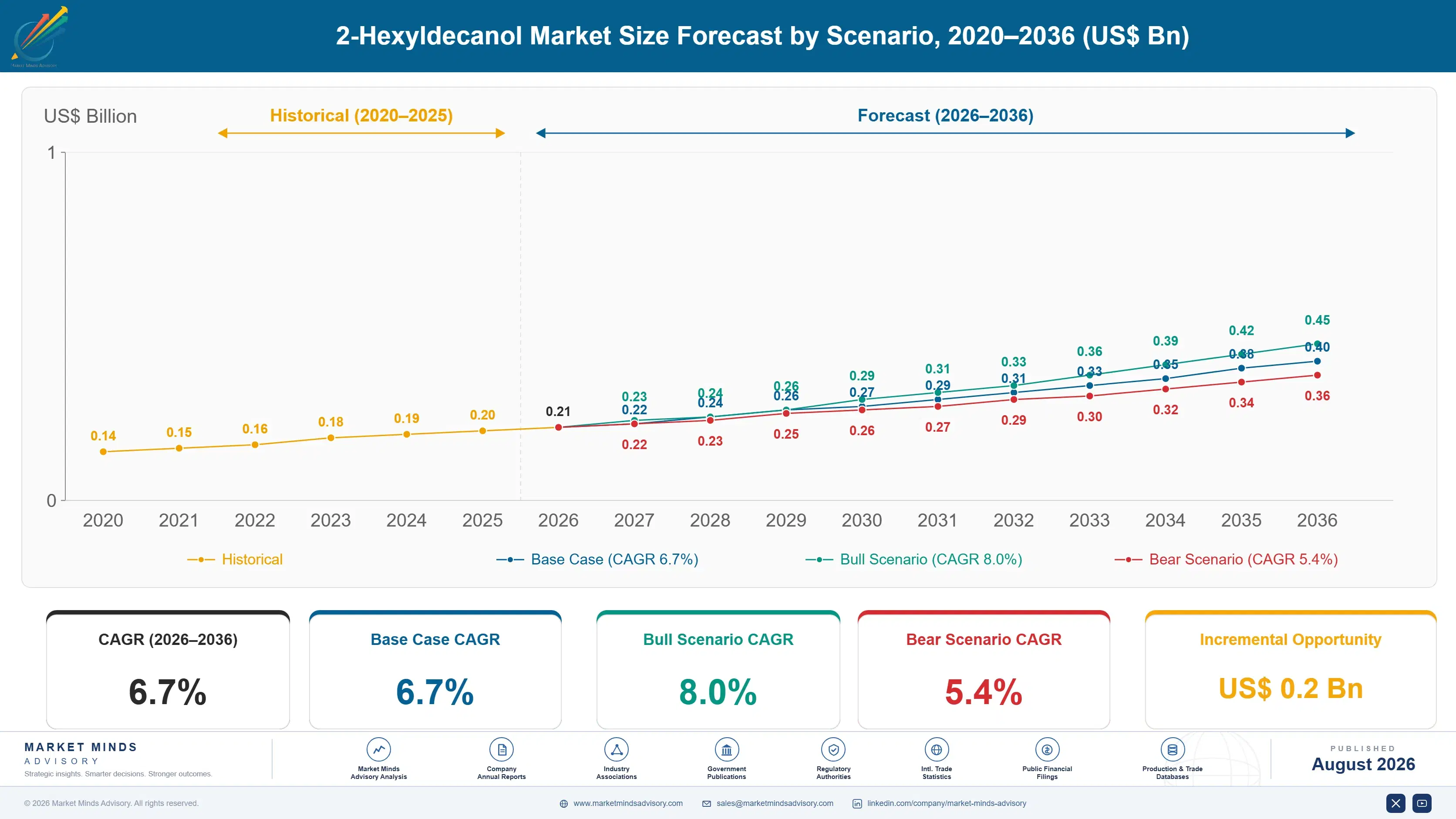
2-Hexyldecanol Market Forecast Scenarios

2-hexyldecanol-market-trends-size-forecast-scenario-1787463908986
The 2020 to 2025 period was shaped by feedstock volatility rather than by demand shifts. Palm kernel oil pricing swung violently through 2021 and 2022, and octanol followed it, which pushed producers using oleochemical routes into repeated price adjustments while petrochemical-route competitors held steadier. Personal care demand grew consistently throughout. The 5.6% historical growth reflects that feedstock pass-through as much as it reflects any change in tonnage actually shipped.
The 6.7% base case rests on three mechanisms. Silicone replacement in personal care keeps converting formulations toward branched alcohols and their esters, and European restriction is widening rather than settling. Semiconductor and electronics manufacturing keeps expanding high-purity demand at specifications and prices that cosmetic grades never approach. And lubricant formulators keep specifying Guerbet-derived base stocks for refrigeration and aviation applications where pour point and thermal stability matter more than cost.
The 8.0% bull case assumes European siloxane restriction extends decisively into leave-on personal care, forcing reformulation across a much larger product base. The 5.4% bear case reflects palm kernel volatility resuming alongside Chinese capacity entering the technical grade tier, compressing pricing from below while premium conversion proceeds slowly. Restriction scope decides which of those cases arrives.

Why Branching Beats Chain Length Here

Three forces govern this small market. Regulation comes first, because European restriction of cyclic siloxanes is creating demand no formulator sought and no producer forecast. Feedstock route comes second, since palm kernel octanol behaves differently in price and certification terms than petrochemical octanol. Capacity comes third, and it is the quiet constraint: Guerbet condensation trains have barely been added anywhere in a decade.
TOP-FIVE CONCENTRATION68%Share of global Guerbet alcohol supply held collectively
AVERAGE SELLING PRICE$6,240/tonneBlended price across cosmetic, industrial, and purified grades
COSMETIC APPLICATION SHARE44%Portion of volume consumed in personal care formulation
FEEDSTOCK COST SHARE51%Octanol input as proportion of total production cost
CAPACITY UTILISATION81%Average loading across condensation and distillation plant assets
TRADE INTENSITY62%Share of output crossing a border before final use
The commercial character resembles a licensed technology more than a chemical commodity. Guerbet condensation demands specific catalyst systems, careful distillation to separate the product from unreacted feedstock and heavier condensates, and operating experience that does not transfer from linear alcohol production. That combination has kept the producer list short and stable. Where a formulator qualifies a supplier, the specification travels into finished products across dozens of markets.
The next decade tests whether capacity responds to the demand regulation is creating. Utilisation already sits near 81%, which is high for a specialty chemical, and personal care conversion has barely begun on leave-on products. Producers have been reluctant to build against a demand signal driven by regulatory process. Whoever moves first on capacity captures a conversion window that will not stay open indefinitely.
"Nobody set out to build a market on a siloxane restriction. Formulators looking for a silicone replacement found a branched alcohol that had been sitting there for forty years, and the producers are now the constraint rather than the chemistry."
Director, Oleochemicals and Specialty Alcohols Practice · MMA Specialty Chemicals / Oleochemicals and Guerbet Alcohols Practice · August 2026

Market Trends

Siloxane Restriction Converts Personal Care Formulations Toward Branched Alcohols

European restriction of D4, D5, and D6 cyclic siloxanes under REACH has moved from wash-off products toward leave-on applications, and formulators replacing cyclopentasiloxane need something that spreads dryly, evaporates slowly, and does not feel greasy. Branched Guerbet alcohols and their esters deliver that sensory profile better than linear alternatives, which is why reformulation programmes across skin care, sun care, and colour cosmetics keep specifying them. The conversion is regulatory rather than consumer-driven, so it proceeds on legislative timetables. Demand created this way is unusually predictable once the restriction scope is settled.
Market Impact: Commands 4x commodity alcohol pricing
Electronic Grade Purity Requirements Create a Separate Business

Semiconductor and display manufacturing consume branched alcohols in cleaning, photoresist ancillary, and formulation applications where metal ion content is specified in parts per billion rather than parts per million. Meeting that requires dedicated distillation, filtration, and packaging lines plus analytical capability that cosmetic production does not need. Growth of 11.6% follows fabrication capacity expansion across Taiwan, Korea, China, Japan, and increasingly the United States. Pricing sits at several multiples of cosmetic grade for chemically identical material, and qualification cycles run long enough to deter opportunistic entry entirely. Very few branched alcohol producers have attempted this at all.
Market Impact: Supports 5.8% lubricant grade growth

Market Opportunities and Growth Drivers

Sensory Performance Justifies Premium Over Linear Alcohols

Branching at the second carbon position keeps the molecule liquid at room temperature, lowers pour point substantially, and produces a dry non-occlusive skin feel that straight-chain cetyl and stearyl alcohols cannot match at any concentration. Formulators developing lightweight moisturisers, sun care, and colour cosmetics specify it for exactly that property rather than for cost. The premium over commodity fatty alcohols runs several times, and it holds because no cheaper molecule delivers the same sensory result. Consumer testing consistently distinguishes the difference even when panellists cannot articulate why. Reformulating away from it usually costs a launch its positioning.
Market Impact: Runs capacity near 81% utilisation

Guerbet Ester Base Stocks Serve Demanding Lubricant Applications

Refrigeration compressors using hydrofluoroolefin refrigerants, aviation turbine oils, and metalworking fluids all require base stocks combining low pour point, high viscosity index, and thermal stability, and esters derived from branched alcohols deliver that combination reliably. Formulators specify them where mineral oils and linear esters fail on cold flow or oxidative life. Demand tracks refrigerant transitions and aviation fleet activity rather than any consumer trend, which gives it a different and useful cycle. Qualification into a lubricant specification is slow and the resulting position is correspondingly durable. Refrigerant transitions run on regulatory timetables rather than commercial ones.
Market Impact: Moves 51% of production cost

Market Restraints and Challenges

Guerbet Condensation Capacity Has Barely Expanded in a Decade

Utilisation across the producer base sits near 81%, which is high for any specialty chemical, and very little new condensation capacity has been commissioned anywhere since the last cycle. The root cause is commercial caution: producers hesitate to build against demand driven by regulatory process rather than by consumer pull, because restriction scope and timing both shift. Responses include debottlenecking existing trains, toll arrangements with linear alcohol producers holding suitable distillation assets, and allocating scarce output toward electronic and pharmaceutical grades that pay best when supply tightens. Nobody wants to be the first to commit capital here.
Market Impact: Converts 44% of cosmetic volume

Palm Kernel Feedstock Volatility Passes Straight Through

Octanol accounts for roughly 51% of production cost, and oleochemical-route octanol prices track palm kernel oil, which swung violently through 2021 and 2022 on Indonesian export policy and harvest outcomes. The root cause is that the branched alcohol carries no natural hedge and demand is too inelastic to absorb the movement through volume. Producers respond with dual-route sourcing across oleochemical and petrochemical octanol, with indexed pricing clauses in industrial contracts, and by concentrating on grades where customers accept pass-through without renegotiation. Indonesian export policy decisions move this market more than any customer does.
Market Impact: Prices 5x above cosmetic grade
3 additional market trends, 2 additional growth drivers, and 4 additional restraints and challenges are covered in the full report. Contact sales@marketmindsadvisory.com to access the complete intelligence.

Segment CAGR and Growth Architecture

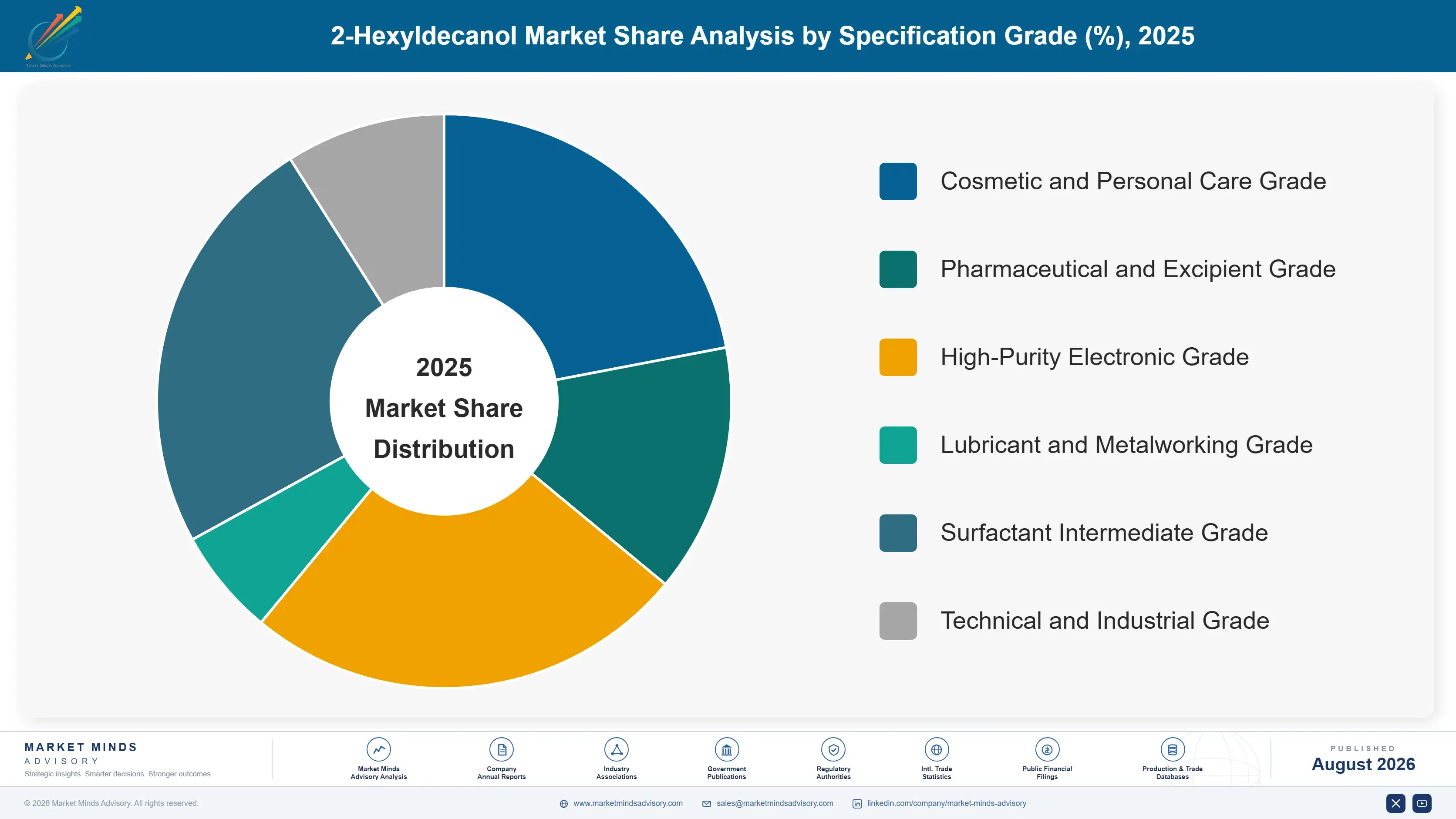
Segmentation follows specification grade, the single commercial logic that determines purity threshold, regulatory documentation, packaging requirement, and price per tonne. Grade decides which customers can use the material and what a producer must demonstrate before they will. Application industries and channel structures appear separately in the framework as commercial dimensions rather than parallel segments here.
2-hexyldecanol-market-trends-market-share-analysis-1787463909561

High-Purity Electronic Grade

Electronic grade is the same molecule with metal ions measured in parts per billion, and that difference sustains pricing several multiples above cosmetic supply. Growth of 11.6%, roughly 1.73 times the market, follows semiconductor and display fabrication capacity expanding across Taiwan, Korea, China, Japan, and increasingly the United States under domestic manufacturing programmes. Meeting the specification demands dedicated distillation, filtration, packaging in qualified containers, and analytical capability that no cosmetic production line possesses. Qualification with a fabrication customer typically runs eighteen months and is rarely revisited afterwards, which makes the segment both hard to enter and unusually durable once a supplier is inside it. Nobody enters this particular segment opportunistically or quickly.
CAGR 11.6%

Pharmaceutical and Excipient Grade

Topical and transdermal formulations use branched alcohols as penetration enhancers, solubilisers, and emollient carriers, and the grade requires pharmacopoeial documentation, residual solvent control, and manufacturing under quality systems that survive customer audit. Growth of 8.2% follows dermatological and transdermal product development rather than any change in the underlying chemistry. Once written into a drug master file or a marketing authorisation, the supplier becomes extremely difficult to displace, because changing an excipient source triggers regulatory variation work nobody undertakes for a price improvement. That combination of slow entry and near-permanent tenure makes it the most defensible position available to a mid-sized producer. Entry is slow and deliberate, which is exactly what makes it worth doing.
CAGR 8.2%
Full segment breakdown across 6 segments available in the complete report.

Regional Architecture and Country Demand Map

East Asia holds the largest share at 30%, combining Chinese and Korean personal care manufacturing with the region's semiconductor and display fabrication base. South Asia and Pacific grows fastest as Indian cosmetic and pharmaceutical formulation expands, while Western Europe drives regulatory conversion. North America is converting ahead of requirement.

North America

Personal care and pharmaceutical formulation carry most regional demand, with American and Canadian brand owners reformulating away from cyclic silicones ahead of any domestic requirement because global product harmonisation makes a single formula cheaper than two. Semiconductor fabrication expansion under domestic manufacturing programmes is creating high-purity demand that previously sat almost entirely in Asia, and qualification work is under way at several new sites. Lubricant formulators in Texas and the Midwest specify Guerbet ester base stocks for refrigeration and aviation applications. Supply is largely imported from European and Asian producers. Regional growth of 6.0% is carried by personal care conversion and emerging electronic demand together. Domestic condensation capacity remains effectively absent from the region.
Share: 24% | CAGR: 6.0% (2026 to 2036)

Western Europe

Regulation makes this region the source of the demand signal that the rest of the world is now following. Restriction of D4, D5, and D6 cyclic siloxanes under REACH began in wash-off products and has extended toward leave-on applications, forcing systematic reformulation across skin care, sun care, and colour cosmetics. German and French formulators have led the conversion and their specifications travel globally through multinational brand portfolios. Sasol and BASF both operate Guerbet capacity in the region, making it a production centre as well as a demand one. Growth of 5.1% is the slowest of any region and reflects a mature base where conversion is already well advanced. Specifications written here end up everywhere else.
Share: 22% | CAGR: 5.1% (2026 to 2036)
Regional intelligence for 5 additional markets available in the complete report: East Asia, South Asia and Pacific, Latin America, Middle East and Africa, Eastern Europe. Contact sales@marketmindsadvisory.com.
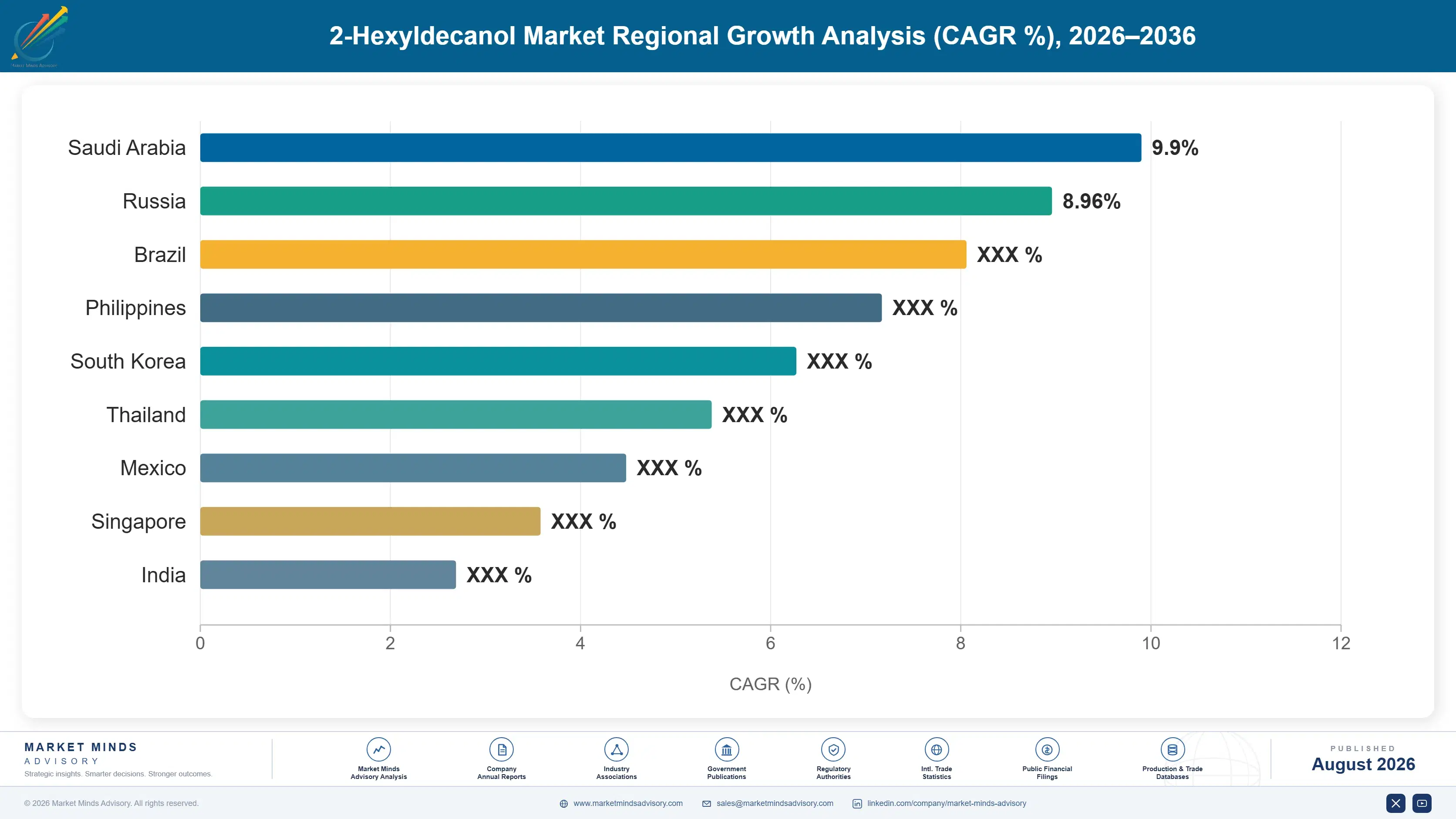
2-hexyldecanol-market-trends-country-cagr-analysis-1787463910092

Where Guerbet Alcohol Margin Actually Sits

Selling technical grade branched alcohol on price is a position that Chinese capacity will eventually take. The four moves below climb toward customers who cannot switch easily: electronic purity qualification, pharmacopoeial documentation, dual feedstock routes that remove palm exposure, and capacity commitment ahead of a regulatory conversion nobody else is building for. None of the four requires new chemistry.

Qualify Dedicated Lines for Electronic Purity Specifications

Electronic grade sells at roughly five times cosmetic pricing for chemically identical material, and the barrier is dedicated distillation, filtration, qualified packaging, and parts-per-billion analytical capability rather than any change to the condensation step. Building that costs around $9 million and takes eighteen months including customer qualification. Fabrication customers rarely revisit a qualified source afterwards, because requalification risks yield on processes worth far more than any material saving. Very few Guerbet producers have made the investment, which is precisely why the pricing has held so firmly. Yield risk beats material cost in every fabrication conversation.
Market Impact: Earns roughly 5x the cosmetic grade selling price

Build Pharmacopoeial Documentation for Excipient Supply

Once a branched alcohol enters a drug master file or marketing authorisation as an excipient, changing the source triggers regulatory variation work that no formulator undertakes for a price improvement. Establishing pharmacopoeial grade production, residual solvent control, and audit-ready quality systems costs perhaps $3.4 million and around two years. The resulting positions run eight to twelve years and price 30% to 45% above cosmetic grade. It is the most defensible tenure available to a mid-sized producer without electronic-scale capital to deploy. Nothing else available in this market delivers tenure remotely like that.
Market Impact: Prices 30 to 45% above the cosmetic grade

Run Dual Feedstock Routes to Neutralise Palm Volatility

Octanol is 51% of production cost and oleochemical-route pricing tracks palm kernel oil, which moved violently through 2021 and 2022 on Indonesian export policy. Maintaining qualified petrochemical and oleochemical octanol sources simultaneously, with formulations validated on both, converts a pass-through problem into a sourcing choice made quarterly. Producers running dual routes showed input cost variance roughly 40% below single-route competitors. It also answers customers who want palm-free documentation and those who want renewable content, without requiring separate production campaigns. Validation has to be completed before a squeeze arrives, not during one.
Market Impact: Cuts input cost variance by roughly 40% annually

Commit Capacity Ahead of the Siloxane Conversion Window

Utilisation already sits near 81% while European siloxane restriction keeps widening into leave-on personal care, and almost nobody is building. Debottlenecking an existing condensation train costs roughly $12 million against $60 million for a new one, and it can be delivered inside two years. Producers moving now capture a conversion window that closes once formulators have qualified whoever was available. Waiting for demand certainty in a market with a two-year build cycle means arriving after the specifications are already written into finished products. Two years is a long time in a regulatory conversion.
Market Impact: Adds capacity at roughly $12 million debottleneck cost

Who Controls the Margin Pool

The top five hold roughly 68% of supply, measured consistently as Guerbet alcohol product revenue at producer level. Sasol operates the reference position through its branched alcohol range, with BASF, KH Neochem, and Kokyu Alcohol Kogyo holding substantial capacity and Jarchem serving North American specialty demand. Concentration reflects catalyst know-how and distillation capability rather than capital intensity, since the plants themselves are not especially large.
Competition runs along three lines. Grade capability is the first, determining whether a producer can reach electronic and pharmacopoeial pricing or remains in cosmetic and technical supply. Feedstock flexibility is the second, since dual oleochemical and petrochemical routes both hedge palm volatility and answer differing customer sourcing requirements. The third is formulation support, where technical service into personal care reformulation programmes wins specifications that later travel worldwide through brand portfolios.

Two pressures will reshape positions. Chinese producers are entering technical and industrial grades on delivered cost, which compresses the tier Western producers use as capacity ballast. Meanwhile siloxane restriction keeps expanding personal care demand against capacity that has not grown. The exposed position is a producer holding only cosmetic and technical grades, single-route palm feedstock, and no path toward electronic or pharmacopoeial qualification.
2-hexyldecanol-market-trends-company-positioning-matrix-1787463910619

Competitive Moat and Risk Dimensions

SASOL

Moat: Guerbet Range Breadth

Sasol supplies a full range of branched Guerbet alcohols across chain lengths, which lets formulators blend for sensory profile within one qualified relationship rather than assembling from several. That breadth, combined with decades of personal care technical service, makes it the default specification in many reformulation programmes. Competitors offering a single chain length compete on price into positions Sasol wrote.
SASOL

Risk: Portfolio Capital Competition

Branched alcohols sit within a chemical portfolio spanning far larger businesses, so capacity expansion competes internally against investments with bigger absolute returns. Specialist producers focused solely on Guerbet chemistry can commit faster when a conversion window opens. Where personal care demand is growing against tight capacity, hesitation cedes specifications that then stay with whoever supplied them.
KH NEOCHEM

Moat: High-Purity Electronic Grade Capability

KH Neochem operates purification and quality capability serving semiconductor and electronics customers with parts-per-billion metal specifications, alongside conventional grades. That qualification takes years and survives customer audits few chemical producers would pass. Proximity to Japanese, Korean, and Taiwanese fabrication customers reinforces the position, since lead time and documentation responsiveness matter as much as the specification itself.
KH NEOCHEM

Risk: Semiconductor Cycle Exposure

Electronic grade demand follows fabrication capacity utilisation, which swings sharply with semiconductor cycles and can fall quickly when inventory corrections arrive. The high-value business is therefore more volatile than cosmetic supply. Balancing that with personal care volume requires holding grades whose margins differ by a factor of five, which complicates capacity allocation during any downturn.

Players Tracked

Prominent Players

Sasol
BASF
KH Neochem
Kokyu Alcohol Kogyo
Jarchem Industries

Other Key Players

Nikko Chemicals
Croda International
Evonik Industries
Oxiteno
Sabo SpA
Vantage Specialty Chemicals
Ele Corporation
Zhejiang Zanyu Technology
Jiangsu Hai'an Petrochemical
Wilmar International
Musim Mas
Godrej Industries
KLK Oleo
Emery Oleochemicals
Berg and Schmidt

Recent Developments

FEBRUARY 2025

European siloxane restriction scope extends toward leave-on cosmetics

European regulatory process continued extending restriction of cyclic siloxanes from wash-off products toward leave-on personal care applications, prompting formulators to accelerate replacement programmes across skin care, sun care, and colour cosmetics. Branched Guerbet alcohols and their esters featured prominently in the reformulation options being evaluated across major brand portfolios.
Signal: Regulatory process, not consumer preference, is writing the demand curve for branched alcohols in personal care.
SEPTEMBER 2024

Japanese producers extend high-purity capability for semiconductor customers

Japanese specialty alcohol producers extended purification and quality capability serving semiconductor and display manufacturers requiring metal ion content specified in parts per billion. The investment responds to fabrication capacity additions across Taiwan, Korea, Japan, and the United States, where qualified suppliers of branched alcohols remain few in number.
Signal: Purity qualification, rather than condensation capacity, is now what separates the highest-value participants from everyone else.
JUNE 2025

Chinese producers enter technical grade branched alcohol supply

Chinese oleochemical producers extended branched alcohol production aimed at technical and industrial grade applications across regional markets, competing on delivered cost against established European and Japanese suppliers. The entry compresses the commodity tier that Western producers have used as capacity ballast rather than as a source of margin.
Signal: The tier used to keep condensation trains loaded is being contested, which removes an easy utilisation answer.

Octanol, Catalyst, and Distillation Energy

Octanol feedstock accounts for roughly 51% of production cost, sourced either from palm kernel oleochemical processing in Malaysia and Indonesia or from petrochemical routes in Europe, China, and the Gulf. Energy for condensation and multi-stage distillation takes a further 19%, since separating the branched product from unreacted feedstock and heavier condensates is demanding. Catalyst, hydrogen, filtration media, and packaging absorb the balance.
Palm kernel oil pricing swung violently through 2021 and 2022 on Indonesian export policy changes and harvest outcomes, and oleochemical octanol followed it closely, while European industrial energy costs rose steeply across 2022 according to IEA reporting. Producers serving cosmetic customers passed increases through with difficulty because brand owners resist mid-contract adjustment. Sasol and BASF both referenced feedstock and energy cost pressure in that period, and smaller European converters absorbed more than they recovered.

Exposure varies with feedstock route and with energy siting rather than with production scale. Producers holding qualified petrochemical and oleochemical octanol sources switched between them as relative pricing moved and held margin. Single-route palm buyers absorbed the full swing. Asian producers beside oleochemical processing with cheaper power held cost position, which is why Chinese entry into technical grades has been viable.
2-hexyldecanol-market-trends-cost-volatility-analysis-1787463910814

Qualify both oleochemical and petrochemical octanol routes properly

Palm kernel and petrochemical octanol price on entirely different drivers and rarely move together, so holding both qualified converts a pass-through exposure into a quarterly sourcing decision. Validation across both routes must be completed with customers in advance rather than during a squeeze. Producers who did that work showed input cost variance roughly 40% below single-route competitors.

Index industrial contracts against published feedstock benchmarks

Cosmetic and pharmaceutical customers resist mid-contract price adjustment, but industrial and lubricant buyers accept indexation once the alternative is explained as an annual renegotiation instead. Writing published octanol or palm kernel benchmarks into those agreements removes exposure on the volume least able to absorb it, which protects the ability to hold pricing steady on premium grades.

Recover distillation heat across the condensation and separation train

Multi-stage separation dominates the energy line at roughly a fifth of total cost, and heat integration between condensation and distillation stages typically cuts thermal demand by a tenth to a fifth. Payback runs inside four years at post-2022 European energy pricing. Neither product specification nor qualification status changes, which is why the investment survives customer scrutiny.

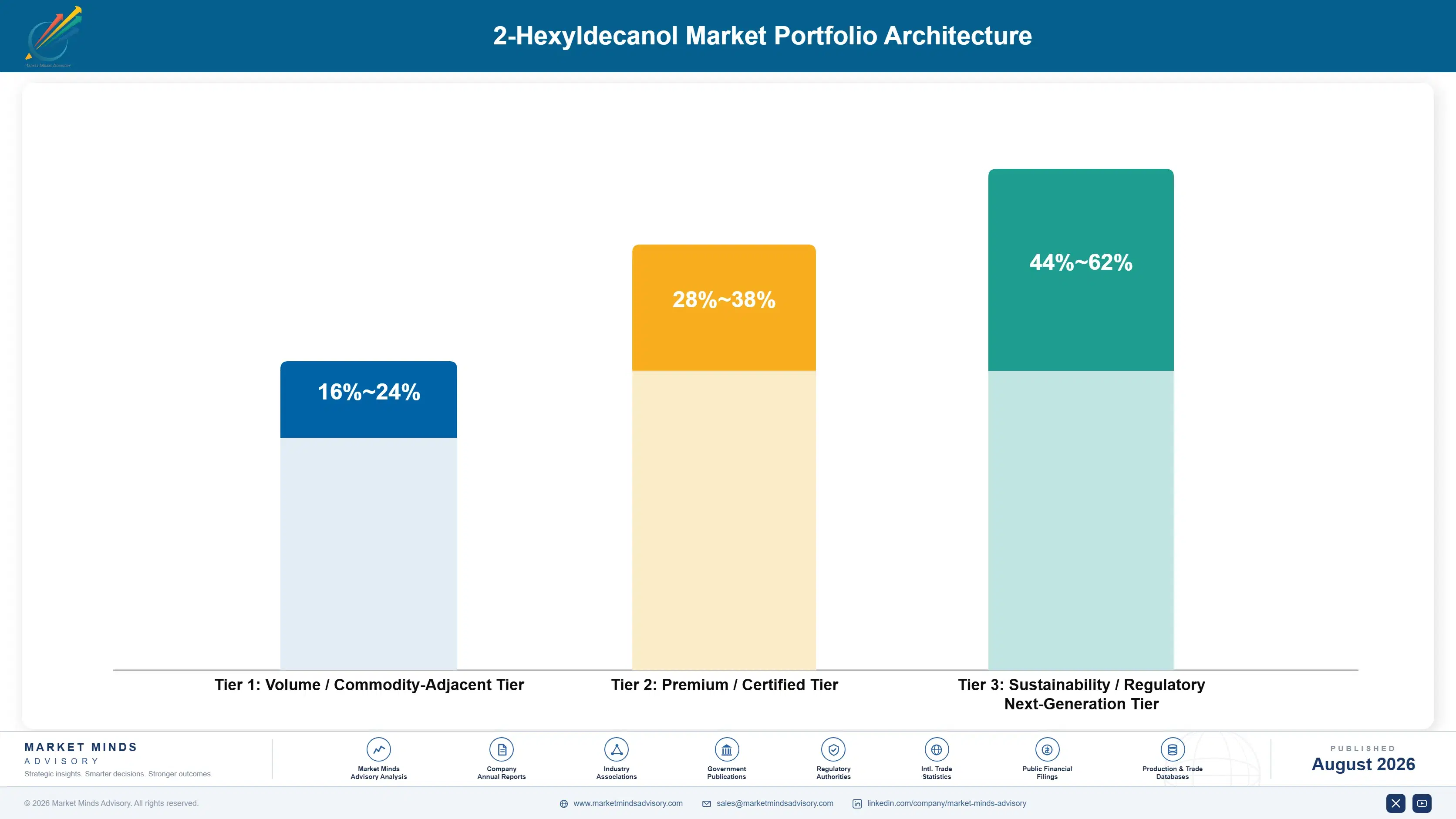
Portfolio Architecture for Margin Defence

Three tiers separate on documentation and purity rather than on chemistry, since the molecule is identical across all of them. Technical and industrial grade sold on specification alone earns 16% to 24%, competing increasingly against Chinese delivered cost with nothing defensible available. Cosmetic and surfactant intermediate grades earn 28% to 38%, supported by formulation support and regulatory dossiers. Electronic and pharmacopoeial grades earn most of all, and the gap between tiers is unusually wide for a single molecule.
The tension is between utilisation and allocation. Technical grade fills condensation trains and keeps utilisation near 81%, which matters when capacity is the constraint, yet every tonne allocated there is a tonne unavailable for electronic supply earning five times more. Producers under volume contracts make that trade routinely and then find mix never improves. With capacity tight and premium demand growing, the allocation discipline is worth more than any incremental efficiency gain.

High-value pools sit where switching triggers work the customer will not do. Electronic qualification risks fabrication yield, pharmacopoeial change triggers regulatory variation, and both make price comparison largely irrelevant once a supplier is established inside the specification. Capacity allocation, not pricing, is the decision that matters.

Volume / Commodity-Adjacent Tier

Technical and industrial grade branched alcohol sold on basic specification into metalworking, defoamer, and general chemical applications. Competes against Chinese delivered cost. The wide range reflects large differences in feedstock route and energy siting between producers.
Gross Margin: 16%-24%

Premium / Certified Tier

Cosmetic and surfactant intermediate grades supplied with regulatory dossiers, formulation support, and sourcing documentation covering palm certification. Range width separates standard cosmetic supply from fully documented silicone replacement programmes within the same tier.
Gross Margin: 28%-38%

Sustainability / Regulatory / Next-Generation Tier

High-purity electronic grade at parts-per-billion metal specification and pharmacopoeial excipient grade with audit-ready quality systems. Qualification difficulty and switching cost on the buyer side, rather than production economics, sustain the margin structure here.
Gross Margin: 44%-62%
2-hexyldecanol-market-trends-portfolio-architecture-1787463911319

High-value Sub-segments and Strategic Watch-out

High-Purity Electronic Grade

Highest value in the market at roughly five times cosmetic pricing for identical chemistry. Dedicated lines and parts-per-billion analytics are the barrier, not condensation capacity. Fabrication customers requalify reluctantly because it risks yield worth far more than materials. Very few producers have made that investment yet.
Gross Margin: 50%-62%

Pharmacopoeial Excipient Grade

High value with 8.2% growth and the longest tenure available in this market, since changing an excipient source triggers regulatory variation work nobody undertakes for price. Entry is slow at around two years. Positions typically run eight to twelve years afterwards. Slow entry is exactly what protects it.
Gross Margin: 42%-54%

Cosmetic and Personal Care Grade

The volume core and the segment regulation is expanding, as European siloxane restriction moves into leave-on products. Formulation support wins specifications that then travel worldwide through brand portfolios. Capacity rather than demand is the binding constraint here now. Building capacity now is the decision that matters.
Gross Margin: 30%-38%

Technical and Industrial Grade

The strategic watch-out. Chinese entry is compressing pricing and the grade offers nothing defensible on technical grounds anywhere. Worse, it consumes scarce condensation capacity that electronic and pharmacopoeial supply would reward five times more generously. Exit deliberately and reallocate the freed condensation capacity toward premium grades.
Gross Margin: 14%-22%

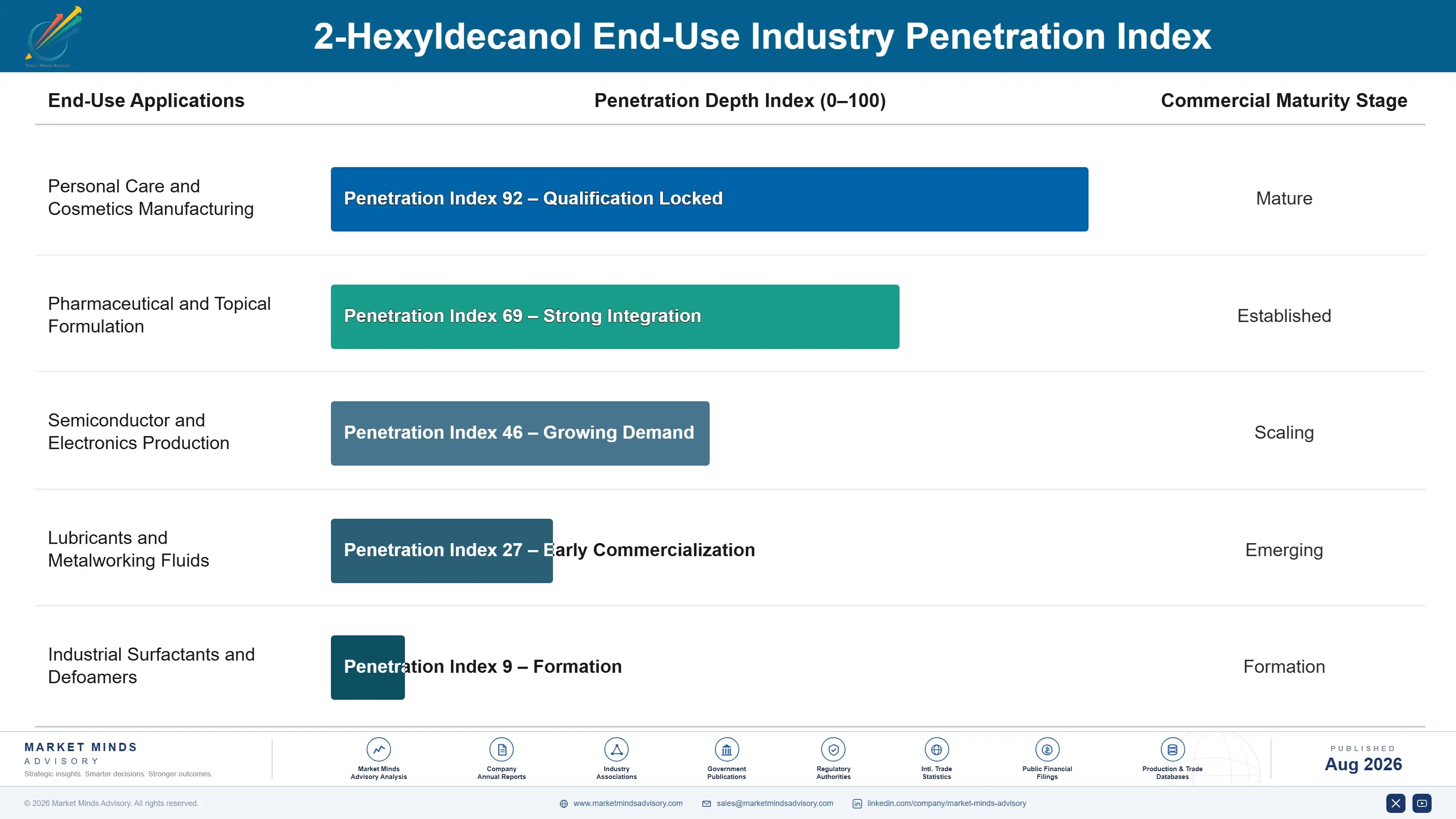
Why Formulations Rarely Get Reopened

Revenue here behaves as a long annuity because reopening a qualified formulation costs far more than any material saving could recover. A personal care brand that has completed stability testing, compatibility work, sensory panels, and regulatory notification across dozens of markets will not revisit an emollient supplier without a compelling reason. Typical cosmetic specification tenure runs six to nine years, and pharmacopoeial excipient positions run eight to twelve because a source change triggers regulatory variation filings.
Stickiness varies sharply by grade. Electronic supply is the most durable, since requalification risks fabrication yield on processes worth enormously more than the material itself, and no purchasing team accepts that trade for a price improvement. Pharmacopoeial excipient positions come next, protected by variation filing requirements across every market where the product is authorised. Technical and industrial grade is the least sticky, retendered annually on delivered cost with Chinese supply increasingly setting the reference price.

Buyer profiles have shifted noticeably. Personal care sustainability teams now ask about palm certification and feedstock origin before formulators discuss sensory performance, and regulatory affairs increasingly attends supplier selection alongside procurement. Feedstock origin questions now arrive before any technical evaluation begins at all.
2-hexyldecanol-market-trends-end-use-penetration-index-1787463911813

Where Guerbet Alcohol Capital Belongs

These are among the four positions where our research anticipates prominent divergence between winners and laggards over the coming forecast period. Each is grounded in the demand model, the regulatory perimeter, and the announced capacity pipeline.
01 / ELECTRONIC GRADE QUALIFICATION

Build dedicated purity lines and stop selling identical molecules cheaply

Electronic grade sells at roughly five times cosmetic pricing for chemically identical material, and the barrier is dedicated distillation, filtration, qualified packaging, and parts-per-billion analytics rather than anything about the condensation step itself at all. That investment costs around $9 million across eighteen months including customer qualification, which is modest against the pricing it secures more or less permanently. Fabrication customers requalify reluctantly because doing so risks yield on processes worth far more than any conceivable material saving they might achieve.
02 / EXCIPIENT DOCUMENTATION PROGRAMME

Pursue pharmacopoeial grade for the longest tenure available

Once a branched alcohol enters a drug master file or marketing authorisation, changing the source triggers regulatory variation work across every market where the product is authorised, and no formulator undertakes that for a price improvement of any conceivable size. Establishing pharmacopoeial production, residual solvent control, and audit-ready quality systems costs roughly $3.4 million spread across about two years. The resulting positions run eight to twelve years and price 30% to 45% above cosmetic grade throughout the whole of that period.
03 / DUAL FEEDSTOCK SOURCING

Qualify petrochemical and oleochemical octanol before the next swing

Octanol is 51% of production cost and the oleochemical route tracks palm kernel oil, which moved violently through 2021 and 2022 on Indonesian export policy decisions nobody outside Jakarta could anticipate. Holding both routes qualified, with customer validation completed in advance rather than during a squeeze, converts a pass-through exposure into an ordinary quarterly sourcing choice. Producers who did that work showed input cost variance roughly 40% below single-route competitors, and they can answer palm-free and renewable content questions equally well.
04 / CAPACITY COMMITMENT TIMING

Debottleneck now, because the conversion window closes on qualification

Utilisation sits near 81% while European siloxane restriction keeps widening into leave-on personal care, and almost nobody is adding condensation capacity anywhere in response to it. Debottlenecking an existing train costs roughly $12 million against $60 million for a new one and delivers inside two years, which is the only relevant comparison here. Waiting for demand certainty in a market with a two-year build cycle means arriving after formulators have already qualified whoever happened to have material available at the time.

Engagement Snapshot From the Field

A live engagement with an industry participant carrying material or product regulatory and market exposure ahead of a defining policy shift, showing how our research translates into a defensible multi-year portfolio strategy.
MARKET MINDS ADVISORY · CLIENT ENGAGEMENT SUMMARY
2-Hexyldecanol Producer Strategic Portfolio Review and Transition Roadmap 2026·Investment Scenario on 2-Hexyldecanol Exposure Evaluation 2025-26
CLIENT PROFILE
A European specialty alcohol producer operating a single Guerbet condensation and distillation train supplying branched alcohols across thirty-one countries, with annual revenue near EUR 74 million (client-reported, unverified by MMA). Cosmetic and technical grades supplied roughly 88% of volume, octanol was purchased entirely through oleochemical routes from Southeast Asian suppliers, and no electronic or pharmacopoeial capability existed.
STRATEGIC CHALLENGE
Palm kernel volatility had swung octanol costs by more than half within eighteen months while cosmetic customers refused mid-contract adjustment, compressing gross margin to 17%. Chinese entry was pressuring technical grade pricing, the train was running at 87% utilisation with no room to serve growing silicone replacement demand, and the board was weighing a greenfield plant against alternatives.
MMA APPROACH
MMA rebuilt margin by grade and by customer using actual delivered feedstock costs, then traced condensation capacity allocation to quantify what technical grade contracts were consuming. Electronic and pharmacopoeial entry were costed against debottlenecking and greenfield options. Dual feedstock qualification requirements were assessed with existing customers, with findings tested through 47 expert interviews during Q4 2025.
KEY FINDINGS
  1. Technical grade contracts consumed 29% of condensation capacity while generating 11% of gross contribution, and Chinese pricing made the tier fundamentally unattractive going forward.
  2. Debottlenecking the existing train would add 34% capacity at roughly a fifth of greenfield cost and could be delivered within twenty months of commitment.
  3. Two existing cosmetic customers were separately purchasing pharmacopoeial grade material from a competitor, having never been offered it by the client at all.
  4. Petrochemical octanol had priced below oleochemical for seven of the preceding twelve months, yet no qualification work had ever been undertaken on that route.
CLIENT PROFILE
A European specialty alcohol producer operating a single Guerbet condensation and distillation train supplying branched alcohols across thirty-one countries, with annual revenue near EUR 74 million (client-reported, unverified by MMA). Cosmetic and technical grades supplied roughly 88% of volume, octanol was purchased entirely through oleochemical routes from Southeast Asian suppliers, and no electronic or pharmacopoeial capability existed.
STRATEGIC CHALLENGE
Palm kernel volatility had swung octanol costs by more than half within eighteen months while cosmetic customers refused mid-contract adjustment, compressing gross margin to 17%. Chinese entry was pressuring technical grade pricing, the train was running at 87% utilisation with no room to serve growing silicone replacement demand, and the board was weighing a greenfield plant against alternatives.
MMA APPROACH
MMA rebuilt margin by grade and by customer using actual delivered feedstock costs, then traced condensation capacity allocation to quantify what technical grade contracts were consuming. Electronic and pharmacopoeial entry were costed against debottlenecking and greenfield options. Dual feedstock qualification requirements were assessed with existing customers, with findings tested through 47 expert interviews during Q4 2025.
KEY FINDINGS
  1. Technical grade contracts consumed 29% of condensation capacity while generating 11% of gross contribution, and Chinese pricing made the tier fundamentally unattractive going forward.
  2. Debottlenecking the existing train would add 34% capacity at roughly a fifth of greenfield cost and could be delivered within twenty months of commitment.
  3. Two existing cosmetic customers were separately purchasing pharmacopoeial grade material from a competitor, having never been offered it by the client at all.
  4. Petrochemical octanol had priced below oleochemical for seven of the preceding twelve months, yet no qualification work had ever been undertaken on that route.
RECOMMENDED STRATEGY
Phase 1: Phase 1 (months one to six): exit technical grade contracts as they expire and begin petrochemical octanol qualification with the ten largest customers. Phase 2: Phase 2 (months seven to twenty-six): debottleneck the condensation train and establish pharmacopoeial grade production with audit-ready quality systems in place. Phase 3: Phase 3 (months twenty-seven to forty): evaluate dedicated electronic grade purification once the debottlenecked capacity and premium mix are established.
OUTCOME
The producer exited most technical grade volume and reported gross margin improving from 17% to 29% within eighteen months (client-reported, unverified by MMA). Dual feedstock qualification completed with eight of ten target customers. Debottlenecking is on schedule and pharmacopoeial supply has begun with one existing customer.

Frequently Asked Questions

Foundational context covering the market sizes, CAGR, scope, country, region and competition that inform every finding below. This section is provided to cover basics and most often pre-purchase conversations, answered from the MMA Primary Research Dataset.

What is the current size of the 2-Hexyldecanol Market?

The market was valued at USD 0.20 billion in 2025, rising to an estimated USD 0.21 billion in 2026. East Asia holds the largest regional share at 30% of global value.

How large will the 2-Hexyldecanol Market be by 2036?

MMA forecasts USD 0.41 billion by 2036 under the base case, an expansion multiple of 1.95 times the 2026 level. Incremental value creation across the period reaches USD 0.20 billion.

What is the CAGR for the 2-Hexyldecanol Market 2026 to 2036?

The base case CAGR is 6.7%, with a bull case of 8.0% and a bear case of 5.4%. Historical growth between 2020 and 2025 ran at 5.6%, reflecting feedstock pass-through substantially.

Which segment is growing fastest?

High-purity electronic grade, at 11.6%, roughly 1.73 times the overall market rate. It sells at around five times cosmetic pricing for chemically identical material at higher purity.

Who are the major companies in the 2-Hexyldecanol Market?

Sasol, BASF, KH Neochem, Kokyu Alcohol Kogyo, and Jarchem Industries lead, holding roughly 68% of Guerbet alcohol supply between them. Croda and Evonik participate in derivatives.

Which country is growing fastest?

India, at 9.4%, driven by rapid expansion of personal care contract manufacturing and pharmaceutical formulation, much of it carrying silicone-free specifications written by European brand owners.

Report Segmentation Architecture

The full report scope spans multiple orthogonal segmentation dimensions, with cross-tabulated demand data provided for each dimension pair. Coverage extends further to regional breakdowns, trend trajectories, and the competitive detail needed to support segment-level decision-making.

By Specification Grade

  • Cosmetic and Personal Care Grade
  • Pharmaceutical and Excipient Grade
  • High-Purity Electronic Grade
  • Lubricant and Metalworking Grade
  • Surfactant Intermediate Grade
  • Technical and Industrial Grade

By End-Use Industry

  • Personal Care and Cosmetics Manufacturing
  • Pharmaceutical and Topical Formulation
  • Semiconductor and Electronics Production
  • Lubricants and Metalworking Fluids
  • Industrial Surfactants and Defoamers

By Commercial Dimension

  • Direct Formulator Supply
  • Specialty Chemical Distribution
  • Contract and Toll Manufacturing
  • Ingredient House Blending Supply

By Region

  • North America
  • Western Europe
  • East Asia
  • South Asia and Pacific
  • Latin America
  • Middle East and Africa
  • Eastern Europe

Scope, Methodology, and Coverage

Every figure in this report is reproducible from documented input assumptions. The scope below maps the historical period, the forecast horizon, the segmentation dimensions, and the countries covered, alongside the underlying primary and qualitative methodology.
Historical Period
2020 to 2025
Forecast Period
2026 to 2036
Base Year
2025 (USD billions; MMA Primary Research Dataset, August 2026)
Market Definition
The market comprises 2-hexyldecanol, the branched sixteen-carbon Guerbet alcohol produced by catalytic condensation of octanol, supplied across cosmetic and personal care, pharmaceutical and excipient, high-purity electronic, lubricant and metalworking, surfactant intermediate, and technical and industrial specification grades. Value is measured at producer level on a neat alcohol basis. Esters and ethoxylates derived from the alcohol, other Guerbet alcohols including 2-octyldodecanol, linear fatty alcohols, and finished formulated consumer or industrial products fall outside scope.
Quantitative Units
USD billions (current prices); tonnes of neat alcohol; USD per tonne average selling price
Segmentation Dimensions
By Specification Grade; By End-Use Industry; By Commercial Dimension; By Region
Regions Covered
North America, Western Europe, East Asia, South Asia and Pacific, Latin America, Middle East and Africa, Eastern Europe
Countries Covered
USA, China, Germany, France, UK, Japan, South Korea, India, Australia, Canada, Brazil, Mexico, Indonesia, Vietnam, Thailand, Malaysia, UAE, Saudi Arabia, South Africa, Nigeria, Turkey, Poland, Netherlands, Italy, Spain, Sweden, Switzerland, Argentina, Colombia, Singapore, and additional markets relevant to this sector
Key Companies Profiled
Sasol, BASF, KH Neochem, Kokyu Alcohol Kogyo, Jarchem Industries, Nikko Chemicals, Croda International, Evonik Industries, Oxiteno, Sabo SpA, Vantage Specialty Chemicals, Ele Corporation, Zhejiang Zanyu Technology, Jiangsu Hai'an Petrochemical, Wilmar International, Musim Mas, Godrej Industries, KLK Oleo, Emery Oleochemicals, Berg and Schmidt
Quantitative Methodology
Primary survey, n=3,800 respondents, Q4 2025, six countries; demand-side model with trade association cross-validation
Qualitative Methodology
47 expert interviews, Q4 2025; applied to validate demand model assumptions, identify emerging dynamics, and assess competitive positioning
Report Format
PDF and XLSX data workbook (Word format preview document)
Publisher
Market Minds Advisory
Report Code
MMA-2026-CHM-274
Published
August 2026
Contact
sales@marketmindsadvisory.com | www.marketmindsadvisory.com

Purchase the full 2-Hexyldecanol Market Report (2026 to 2036).

The full report sizes 2-hexyldecanol demand across six specification grades and seven regions with 2026 to 2036 forecasts under base, bull, and bear cases. It models European siloxane restriction scope against personal care reformulation volumes, quantifying how much branched alcohol demand each stage of the restriction creates. Competitive profiles cover twenty suppliers assessed consistently on Guerbet alcohol revenue, grade capability, and feedstock route flexibility. Capacity analysis compares debottlenecking and greenfield economics against the conversion timeline. Commercial guidance addresses electronic qualification, excipient documentation, dual feedstock sourcing, and capacity commitment timing.
Six specification grades sized and forecast separately
Siloxane restriction scope modelled against reformulation volumes
Twenty supplier profiles on consistent revenue basis
Oleochemical and petrochemical octanol routes compared on cost
Condensation capacity and utilisation mapped by producer
Debottlenecking and greenfield investment benchmarks provided

Built For The People Who Decide

From boardroom strategy to bench-side execution, this report is read cover-to-cover by leaders shaping the next decade of their industry, turning demand scenarios, market dynamics and valuation benchmarks into decisions.
CXOs/ Presidents/ VPs/ Managers
M&A and Corporate Development
Strategy Teams and R&D Heads
Procurement and Product Directors
Regulatory and Compliance Leaders
Investor Relations and Equity Analysts