Market Minds Advisory
2-Ethyl Anthraquinone Market

2-Ethyl Anthraquinone Market: Hydrogen Peroxide Process Chemistry Through 2036

Electronics-grade hydrogen peroxide demand and expanding water treatment capacity are pulling 2-ethyl anthraquinone consumption beyond its traditional pulp and textile bleaching base, forcing producers to defend purity specifications rather than compete on bulk volume alone.

Lead Analyst

Bilal Shaikh

Published

September 2026

Make Smarter Decisions with Customized Research Insights

Request a free sample report and evaluate market opportunities, growth trends, and competitive dynamics relevant to your business needs.

2025 MARKET VALUE$0.7BMarket Size 2025
2036 FORECAST VALUE$1.2BBase Case , 2026 to 2036
CAGR 2026 TO 20365.2 %Bull 6.5% / Bear 3.9%
INCREMENTAL OPPORTUNITY$0.5BNet 10- year value creation
EXPANSION MULTIPLE1.66x2036 value over 2026 base
Strategic Levers
M&A Pipeline
Regional Outlook
Country Rankings
Competitive Intelligence
Segmental Deep-dive
Call-Us : 91 93563 13602

Executive Snapshot and Market Trajectory

Hydrogen peroxide producers globally are shifting 2-ethyl anthraquinone procurement toward higher-purity grades as semiconductor fabrication and electronics manufacturing demand ultrapure peroxide, pulling the working carrier chemistry upstream toward tighter specification tolerances than the pulp and textile bleaching grades that historically dominated volume across most producing regions worldwide for decades.
Electronics and semiconductor-grade demand now drives the fastest incremental purchasing, concentrated among hydrogen peroxide producers in South Korea, Taiwan and Japan supplying chip fabrication plants that require trace-metal-free peroxide grades, pushing anthraquinone suppliers to document purity consistency batch by batch rather than relying on bulk industrial-grade specifications that satisfied pulp and textile bleaching customers for decades without meaningful complaint, scrutiny, third-party audit or certification demand.
Consolidation among specialty chemical producers continues even as Chinese manufacturers expand capacity aggressively, creating a genuine bifurcation between Western and Japanese producers serving high-purity electronics and pharmaceutical-adjacent applications and Chinese suppliers competing primarily on bulk industrial-grade volume and price across export markets in South Asia, Africa and Latin America, squeezing margins for mid-tier producers caught awkwardly between these two increasingly distinct positioning strategies across nearly every major consuming region worldwide today.
Market Definition
The market covers 2-ethyl anthraquinone sold as a working carrier chemical for the anthraquinone process used in hydrogen peroxide production, across technical and high-purity grades. It excludes finished hydrogen peroxide itself and other anthraquinone derivatives used outside the peroxide production process.
Base Year Value
$0.7B in 2025 (MMA Primary Research Dataset, August 2026)
Forecast Period
2026 to 2036, eleven discrete annual values
CAGR
5.2% base case. Bull 6.5%. Bear 3.9%.
Fastest Growth Segment
Electronics and Semiconductor Grade: 9.4% CAGR
Fastest Growth Country
South Korea: 7.2% CAGR
Fastest Growth Region
South Asia and Pacific: 7.2% CAGR
Largest Region
East Asia: 29% of 2025 global value
Market Leaders
Evonik Industries, Solvay, Arkema, Nouryon, Mitsubishi Gas Chemical. Source: MMA Analysis based on company annual reports.
Primary Survey
n=3,800 procurement and R&D decision-makers, Q4 2025, six countries
Methodology
Demand-side build-up, cross-validated against public data, 47 expert interviews

2-Ethyl Anthraquinone Market Forecast Scenarios

2-ethyl-anthraquinone-market-trends-size-forecast-scenario-1787463820798
Between 2020 and 2025 the market grew steadily as hydrogen peroxide demand expanded across pulp bleaching and chemical synthesis applications, with electronics-grade demand emerging as a distinct growth driver only toward the latter half of the period as semiconductor fabrication capacity expanded considerably across East Asia and South Korea specifically, before Chinese bulk capacity additions began pressuring pricing into 2024 and 2025.
The base case assumes continued electronics-grade hydrogen peroxide demand growth tied directly to semiconductor fabrication capacity expansion across multiple countries and continents worldwide, steady water treatment application growth as municipal and industrial buyers increasingly adopt hydrogen peroxide over chlorine-based alternatives, and gradual capacity consolidation among Western producers responding to sustained Chinese bulk-grade competition, reinforced by rising purity specification requirements across an expanding range of downstream applications and end markets globally.
A bull scenario hinges on faster-than-expected semiconductor fabrication capacity expansion pulling electronics-grade demand forward well ahead of current projections and industry forecasts worldwide; the bear case centers on Chinese capacity additions flooding the bulk industrial-grade market, compressing pricing across the category faster than premium electronics-grade growth can meaningfully offset it across most producing regions globally.

Purity Specification Economics Across End-Use Applications

Three forces are converging across the category at once: electronics and semiconductor-grade hydrogen peroxide demand pulling purity specifications tighter than the industry has previously required at any scale or production volume across the entire supply chain and customer base, water treatment application growth expanding the addressable market beyond traditional pulp and textile bleaching uses, and Chinese capacity expansion pressuring bulk industrial-grade pricing across export markets worldwide and domestically each year.
AVERAGE SELLING PRICE$18.50/kgblended price across technical and high-purity grades sold
TOP PRODUCER SHAREChina 38%share of global production capacity based in this country
CAPACITY UTILISATION74%average utilisation rate across all major production facilities
TRADE INTENSITY46%share of finished product volume crossing a border before use
COGS FEEDSTOCK SHARE52%ethylbenzene and anthracene feedstock share of production cost
CR5 CONCENTRATION48%combined revenue share held by the five largest producers
Commercially, the category increasingly rewards producers who can document trace-metal purity consistency batch by batch for electronics-grade customers demanding certificate-level traceability and third-party verification at every shipment and production run, while bulk industrial-grade suppliers face intensifying price competition from Chinese capacity additions squeezing their historical volume base across most major export destinations and domestic accounts alike nationwide and internationally.
Over the next decade, purity specification investment, capacity consolidation among Western and Japanese producers, and semiconductor fabrication demand growth will keep separating high-purity specialists from bulk-grade producers competing purely on price and basic industrial specification rather than documented trace-metal purity, certified quality control processes and long-term supply reliability commitments to major electronics and semiconductor customers worldwide.
"Semiconductor customers don't care about the price per kilogram, they care about the parts-per-billion metal contamination on the certificate of analysis."
Director, Specialty Chemicals and Process Intermediates Practice · MMA Chemicals and Materials Practice · August 2026

Market Trends

Semiconductor Fabrication Growth Pulls Electronics-Grade Demand

Semiconductor fabrication capacity has expanded considerably across South Korea, Taiwan and Japan since 2023, pulling electronics-grade hydrogen peroxide demand upward and forcing anthraquinone suppliers serving that value chain to meet parts-per-billion trace-metal contamination specifications far tighter than pulp or textile bleaching grades ever required. Chip fabrication plants treat peroxide purity as a yield-critical input, since even trace metal contamination can damage sensitive wafer surfaces during cleaning and etching steps. Anthraquinone suppliers who invested early in ultrapure production capability are capturing disproportionate share of this fast-growing, high-margin electronics-grade segment across major fabrication hubs.
Market Impact: Grows water treatment demand 3 fold
Chinese Capacity Expansion Pressures Bulk Industrial-Grade Pricing

Chinese anthraquinone producers have added significant bulk industrial-grade production capacity since 2023, pressuring pricing across export markets in South Asia, Africa and Latin America where price sensitivity generally outweighs purity specification requirements for pulp and textile bleaching applications used across most local mills and processing facilities throughout those developing regions. This capacity growth is squeezing margins for Western and Japanese bulk-grade producers who cannot match Chinese production costs, accelerating a strategic shift toward premium electronics-grade positioning where Chinese producers have not yet achieved comparable purity consistency or customer trust built over time.
Market Impact: Commands 20 to 35 percent premium

Market Opportunities and Growth Drivers

Water Treatment Adoption Expands Hydrogen Peroxide Demand Base

Municipal and industrial water treatment operators are shifting away from chlorine-based disinfection toward hydrogen peroxide-based advanced oxidation processes since 2023, expanding the addressable market for anthraquinone-process peroxide production beyond its traditional pulp, textile and chemical synthesis base into an entirely new growth category. This shift is driven partly by tightening disinfection byproduct regulations that favor peroxide over chlorine chemistry in sensitive watershed applications. Water treatment now represents a meaningfully larger share of total hydrogen peroxide demand than five years earlier, pulling incremental anthraquinone volume into a genuinely new application category.
Market Impact: Chinese capacity grew 30 percent

Pharmaceutical-Adjacent Applications Support Premium Grade Demand

Pharmaceutical manufacturing and personal care product formulation increasingly require ultrapure hydrogen peroxide meeting pharmacopeia-grade specifications, supporting premium anthraquinone demand beyond the electronics segment alone across a growing range of applications and end markets. These applications typically command price premiums of 20 to 35 percent over bulk industrial grades given the additional purification and quality documentation required at every production stage and shipment. Suppliers with existing pharmaceutical-grade manufacturing certification are capturing disproportionate share of this smaller but high-margin demand segment as personal care and pharmaceutical companies tighten their own supplier qualification requirements.
Market Impact: Feedstock prices swing 24 percent

Market Restraints and Challenges

Chinese Bulk Capacity Pressures Western Producer Economics

Chinese anthraquinone production capacity has expanded by more than 30 percent since 2022, pressuring pricing across bulk industrial-grade export markets and squeezing margins for Western and Japanese producers unable to match Chinese production costs on comparable technical-grade specifications and quality tolerances. The root cause is China's lower feedstock, labor and energy costs combined with substantial state-supported chemical manufacturing investment over the past decade. Western producers are mitigating this pressure by shifting product mix toward premium electronics and pharmaceutical-adjacent grades where Chinese producers have not yet achieved comparable purity consistency yet.
Market Impact: Requires under 1 ppb purity

Ethylbenzene Feedstock Price Volatility Squeezes Producer Margins

Ethylbenzene and anthracene feedstock prices swung more than 24 percent between 2022 and 2024 on broader petrochemical commodity volatility, squeezing margins for anthraquinone producers without multi-year feedstock supply contracts locked in ahead of the swings and subsequent price spikes. The underlying cause is anthraquinone feedstock sourcing from the same global petrochemical markets that many other chemical industries depend on, offering no meaningful insulation from broader commodity price swings affecting the wider sector. Larger producers are mitigating exposure through forward purchasing agreements and vertically integrated feedstock production where economically feasible today.
Market Impact: Adds capacity across 3 new facilities
3 additional market trends, 4 additional growth drivers, and 3 additional restraints and challenges are covered in the full report. Contact sales@marketmindsadvisory.com to access the complete intelligence.

Segment CAGR and Growth Architecture

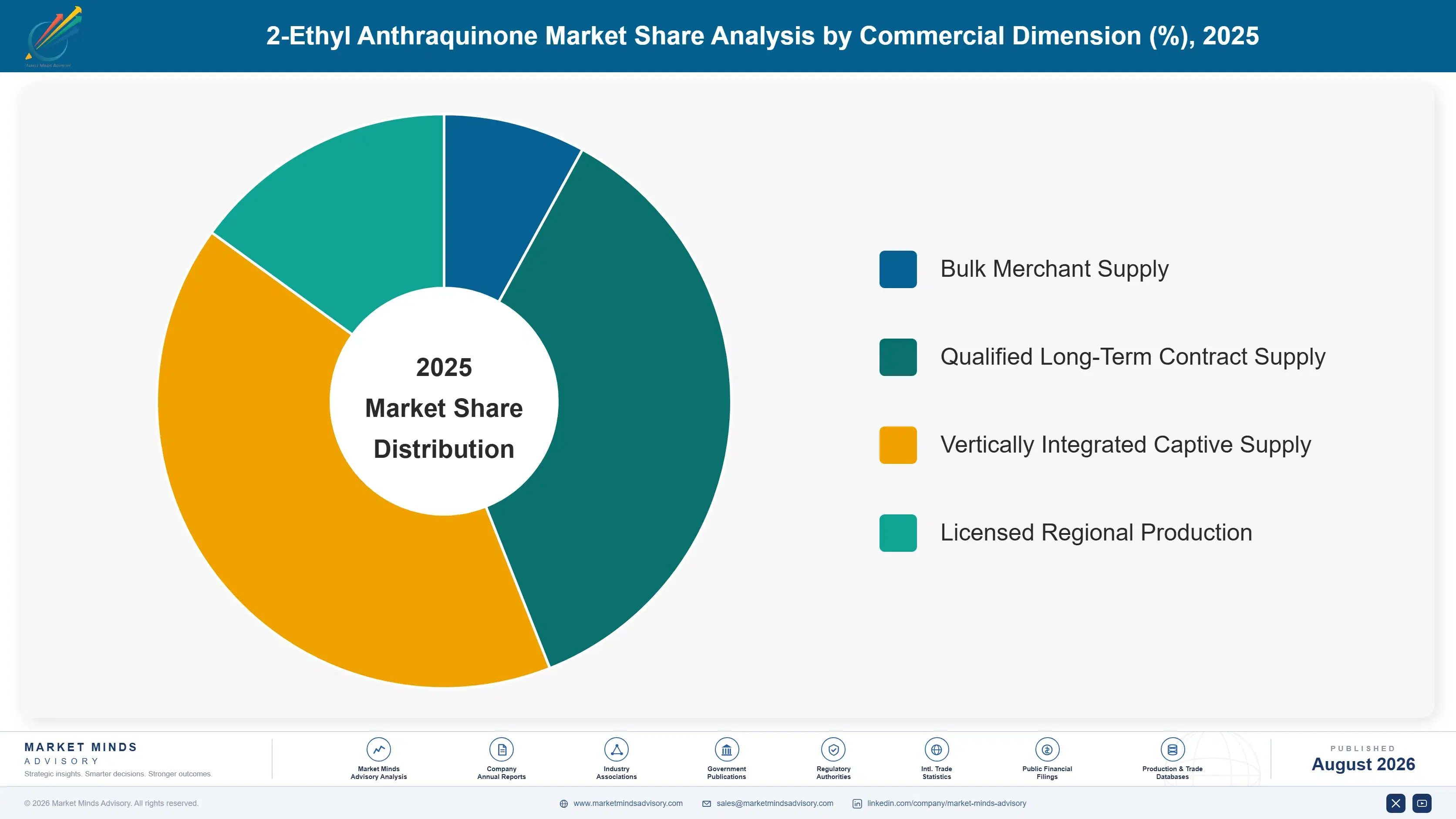
Segmentation follows downstream hydrogen peroxide end-use application rather than anthraquinone purity grade alone, since demand economics, purchase criteria and pricing power differ meaningfully across pulp bleaching, textile bleaching, chemical synthesis, electronics and water treatment applications even when the underlying working carrier chemistry itself remains essentially identical across every single downstream application category served worldwide.
2-ethyl-anthraquinone-market-trends-market-share-analysis-1787463821360

Electronics and Semiconductor Grade

Electronics and semiconductor-grade demand is the fastest-growing application as chip fabrication capacity expands across South Korea, Taiwan and Japan, requiring trace-metal-free hydrogen peroxide that only the very highest-purity anthraquinone can support economically at commercial scale and volume today. Suppliers with established ultrapure production capability and long-term semiconductor customer relationships are capturing disproportionate share of this segment, since qualification cycles with chip fabrication customers can take eighteen months or longer given the yield-critical nature of peroxide purity in wafer cleaning applications. Premium pricing on electronics-grade anthraquinone persists despite thinner volume than bulk industrial grades, reflecting the genuine technical difficulty of achieving and maintaining parts-per-billion contamination specifications across every single production batch.
CAGR 9.4%

Environmental and Water Treatment

Water treatment applications represent the second-fastest-growing segment as municipal and industrial operators shift from chlorine-based disinfection toward hydrogen peroxide advanced oxidation processes across an expanding range of facilities and treatment plants nationwide and abroad. This shift is partly regulatory, driven by tightening disinfection byproduct rules that favor peroxide chemistry in sensitive watershed applications, and partly economic, as peroxide handling and storage costs have declined relative to chlorine gas infrastructure requiring specialized safety systems and staff training. Anthraquinone suppliers serving this segment compete primarily on reliable bulk supply and consistent technical-grade quality rather than the extreme purity specifications electronics customers demand, making this a genuinely distinct commercial motion from premium-grade sales entirely.
CAGR 8.1%
Full segment breakdown across 6 segments available in the complete report.

Regional Architecture and Country Demand Map

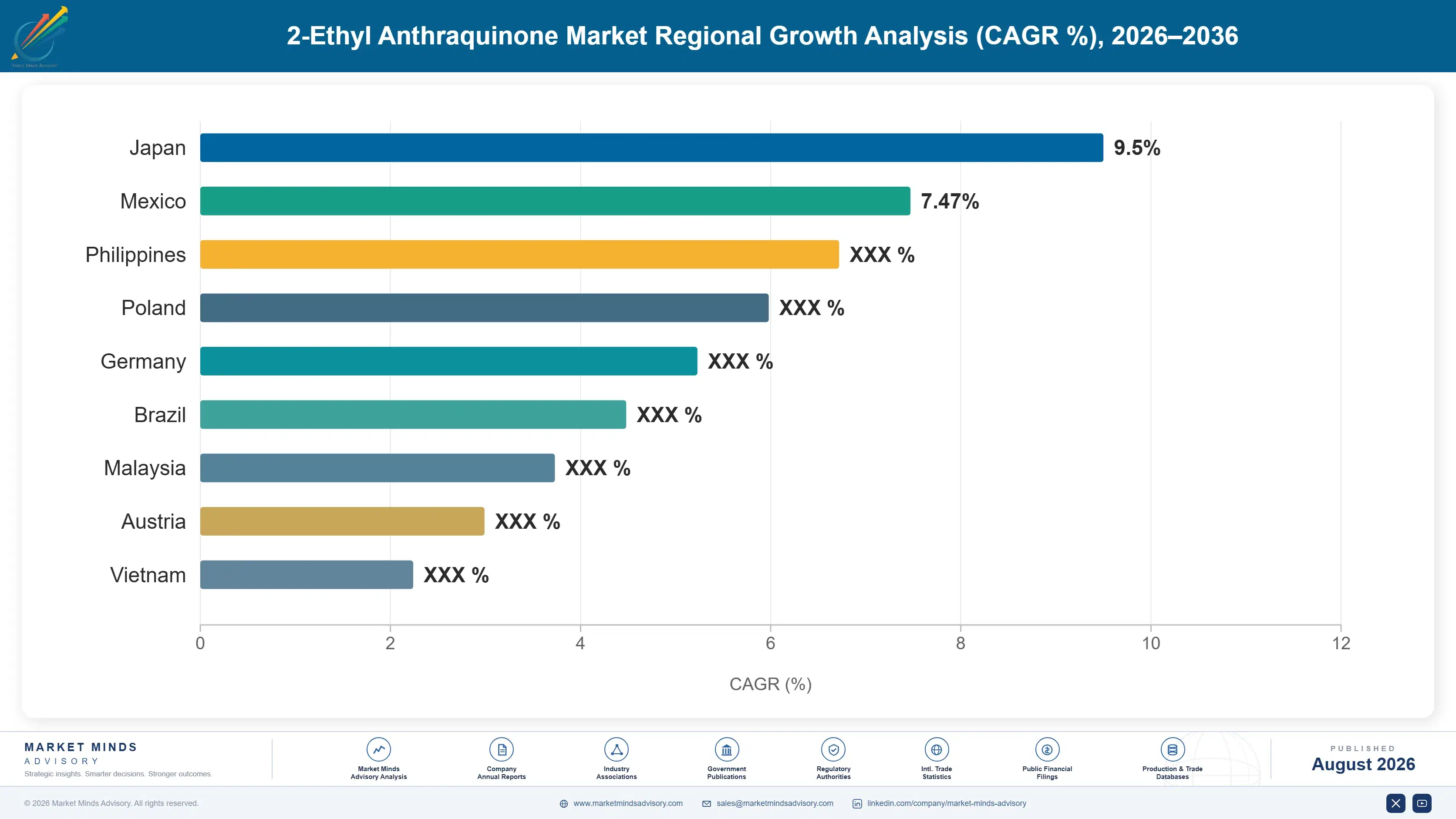
East Asia leads on production capacity and consumption volume, anchored heavily by China's dominant position in bulk anthraquinone manufacturing and export activity. South Korea and Japan drive electronics-grade premium demand, while South Asia and Pacific shows the fastest growth rate as water treatment adoption expands steadily regionally.

North America

North America combines established chemical synthesis and pulp bleaching demand with growing water treatment adoption as municipal operators shift away from chlorine-based disinfection toward peroxide advanced oxidation processes across an expanding number of treatment facilities nationwide and internationally. United States semiconductor fabrication capacity expansion, supported by recent federal manufacturing incentive programs, is beginning to pull incremental electronics-grade demand into the region for the first time at meaningful scale. Domestic anthraquinone production capacity remains limited relative to consumption, leaving the region moderately import-dependent on Western European and East Asian suppliers for a meaningful share of total demand. Canada's smaller market mirrors similar pulp bleaching and water treatment trends at reduced scale.
Share: 25% | CAGR: 6.6% (2026 to 2036)

Western Europe

Western Europe combines mature chemical synthesis and pharmaceutical-adjacent demand with strict environmental regulation shaping producer investment decisions across the entire region and its many member states. Germany and France anchor the region's chemical manufacturing base, hosting several of the specialty producers serving pharmaceutical-grade and electronics-adjacent applications across the continent and beyond. European Union chemical regulation, among the world's most rigorous, pushes producers toward documented quality management systems that smaller Chinese competitors have historically struggled to match on comparable terms and standards. Water treatment adoption trails North America somewhat given the region's already extensive existing chlorine-based disinfection infrastructure, which slows the pace of the underlying transition to peroxide-based alternatives across most facilities.
Share: 19% | CAGR: 3.5% (2026 to 2036)
Regional intelligence for 5 additional markets available in the complete report: East Asia, South Asia and Pacific, Latin America, Middle East and Africa, Eastern Europe. Contact sales@marketmindsadvisory.com.
2-ethyl-anthraquinone-market-trends-country-cagr-analysis-1787463821918

Where Producers Can Defend Margin

Margin defense in 2-ethyl anthraquinone increasingly depends on purity documentation and long-cycle customer qualification rather than raw production scale, since electronics and pharmaceutical customers pay for trust that Chinese bulk producers have not yet earned in comparable volume across most major consuming markets worldwide and increasingly abroad each successive year, contract cycle and product generation.

Pursue Semiconductor Customer Qualification Programs Early

Producers securing semiconductor customer qualification early are locking in multi-year supply relationships that competitors cannot easily displace, since chip fabrication customers rarely requalify an alternative supplier once an existing relationship demonstrates consistent parts-per-billion purity over an extended production history. This qualification process commands price premiums of 25 to 40 percent over bulk industrial grades once secured, reflecting genuine switching cost for the customer rather than simple brand loyalty. Producers who invested early in ultrapure capability are now capturing disproportionate share of new fabrication capacity coming online across South Korea, Taiwan and Japan.
Market Impact: Commands a 25 to 40 percent price premium

Build Pharmaceutical-Grade Manufacturing Certification Capability Now

Producers securing pharmaceutical-grade manufacturing certification are capturing premium demand from personal care and pharmaceutical formulators willing to pay 20 to 35 percent more for documented quality management systems meeting pharmacopeia specifications and third-party verification standards required by global regulators and auditors. This certification requires meaningful investment in quality documentation infrastructure and third-party auditing that smaller regional producers often cannot justify given the segment's smaller total volume relative to bulk industrial applications. Producers with existing pharmaceutical-grade capability are increasingly bundling technical support services alongside product supply to deepen customer relationships further.
Market Impact: Commands a 20 to 35 percent price premium

Diversify Feedstock Sourcing to Protect Margin Stability

Producers with geographically diversified ethylbenzene and anthracene feedstock sourcing across multiple petrochemical suppliers absorb commodity price volatility more comfortably than competitors dependent on a single regional feedstock source, protecting margin predictability that increasingly matters to customers negotiating their own long-term supply agreements with anthraquinone producers directly and predictably each contract cycle, renewal and negotiation. This diversification requires meaningful working capital investment and supplier relationship management across multiple regions simultaneously, but the largest producers report roughly 15 percent more stable quarterly margins than single-source competitors exposed to any individual feedstock disruption or shortage.
Market Impact: Delivers up to 15 percent more stable margins

License Ultrapure Production Technology to Regional Partners

Rather than building manufacturing capacity in every consuming region, several ultrapure anthraquinone developers are licensing proprietary purification technology to regional producers in South Asia and Latin America instead of doing so directly themselves at scale, collecting royalty income of roughly 7 to 11 percent of resulting sales without the capital cost of building local production facilities themselves in each individual market entered and served. This model captures growth in geographically dispersed markets while avoiding the regulatory complexity of exporting controlled chemical intermediates directly across multiple national trade and customs jurisdictions worldwide.
Market Impact: Earns roughly 7 to 11 percent royalty income

Who Controls the Margin Pool

Concentration is meaningful on a revenue basis, with the top five producers holding a combined 48 percent of category revenue, reflecting a category where a handful of major specialty chemical companies and large Chinese bulk producers compete alongside smaller regional specialists. The gap between the largest producer and the fifth-ranked challenger remains considerable given the scale advantages that vertically integrated hydrogen peroxide producers bring to anthraquinone manufacturing.
Current competitive activity centers on three fronts: semiconductor customer qualification investment as producers race to lock in multi-year electronics-grade supply relationships, pharmaceutical-grade certification pursuit as buyers demand documented quality management systems, and feedstock diversification as producers seek to protect margin predictability from petrochemical commodity volatility. Several producers have also begun licensing purification technology to regional partners to capture growth in geographically dispersed markets.

Emerging pressure comes from Chinese producers investing in higher-purity production capability to capture premium electronics-grade demand currently dominated by Western and Japanese suppliers, a trend that could reshuffle rankings within a few years if Chinese producers achieve comparable purity consistency and customer trust. Smaller regional specialists without a clear premium or bulk positioning strategy remain acquisition targets for exactly this reason.
2-ethyl-anthraquinone-market-trends-company-positioning-matrix-1787463822451

Competitive Moat and Risk Dimensions

EVONIK INDUSTRIES

Moat: Vertically Integrated Peroxide Chain

Evonik Industries' vertically integrated hydrogen peroxide production, spanning anthraquinone manufacturing through finished peroxide delivery, gives it cost and quality control advantages that standalone anthraquinone producers without downstream peroxide operations cannot easily replicate, particularly valuable when serving demanding electronics-grade customers requiring documented traceability across every stage.
EVONIK INDUSTRIES

Risk: Internal Capital Competition Risk

Evonik's scale across many chemical business lines means anthraquinone-specific research investment competes internally for capital against larger, higher-revenue divisions, risking slower innovation pace than smaller, more focused specialty anthraquinone competitors able to concentrate resources entirely on purity chemistry advancement, testing infrastructure and dedicated customer support.
SOLVAY

Moat: Established Semiconductor Relationships

Solvay's deep peroxide chemistry expertise built over decades and established relationships with major semiconductor customers give it qualification advantages that newer entrants cannot easily replicate, since chip fabrication customers rarely requalify suppliers once an existing relationship proves reliable over an extended production history and track record.
SOLVAY

Risk: European Cost Base Exposure

Solvay's concentrated exposure to European manufacturing costs and regulation leaves it more exposed to regional energy price volatility and compliance cost than geographically diversified competitors operating production facilities across multiple lower-cost regions simultaneously, particularly as European energy prices remain elevated relative to Asian and North American alternatives.

Players Tracked

Prominent Players

Evonik Industries
Solvay
Arkema
Nouryon
Mitsubishi Gas Chemical

Other Key Players

Kemira
OCI Company
Mitsui Chemicals
Taekwang Industrial
Aditya Birla Chemicals
National Peroxide Limited
Ercros
PCC Group
Chang Chun Group
Gujarat Alkalies and Chemicals
Sasol
Hansol Chemical
Osaka Soda
DuPont
Foshan Zhongxin Chemical

Recent Developments

MARCH 2025

Evonik Industries Commissions Electronics-Grade Production Line in Germany

Evonik Industries commissioned a dedicated electronics-grade anthraquinone production line in Germany adding significant ultrapure capacity aimed at serving expanding European and Asian semiconductor fabrication demand, its largest single electronics-grade chemistry investment yet as it races to secure long-term qualification with major global chip manufacturing customers.
Signal: Signals traditional bulk-focused producers are prioritising ultrapure electronics-grade capacity investment over commodity volume expansion plans entirely.
OCTOBER 2024

Solvay Signs Multi-Year Supply Agreement With South Korean Semiconductor Customer

Solvay signed a multi-year supply agreement with a major South Korean semiconductor fabrication customer, committing dedicated ultrapure production capacity in exchange for guaranteed annual volume purchases across the entire multi-year contract duration, an arrangement neither party had previously disclosed publicly at this considerable financial scale.
Signal: Signals long-term qualification-based supply agreements are increasingly replacing spot-market anthraquinone purchasing patterns among most electronics customers.
JUNE 2025

Mitsubishi Gas Chemical Acquires Stake in Chinese Bulk-Grade Producer

Mitsubishi Gas Chemical acquired a controlling stake in a Chinese anthraquinone producer focused on bulk industrial-grade manufacturing, gaining direct access to lower-cost Chinese production capacity while retaining its premium electronics-grade positioning across Japan and South Korea's demanding semiconductor customer base and broader supply chain relationships.
Signal: Signals established Japanese producers pursuing dual bulk and premium positioning through targeted acquisition rather than organic capacity buildout.

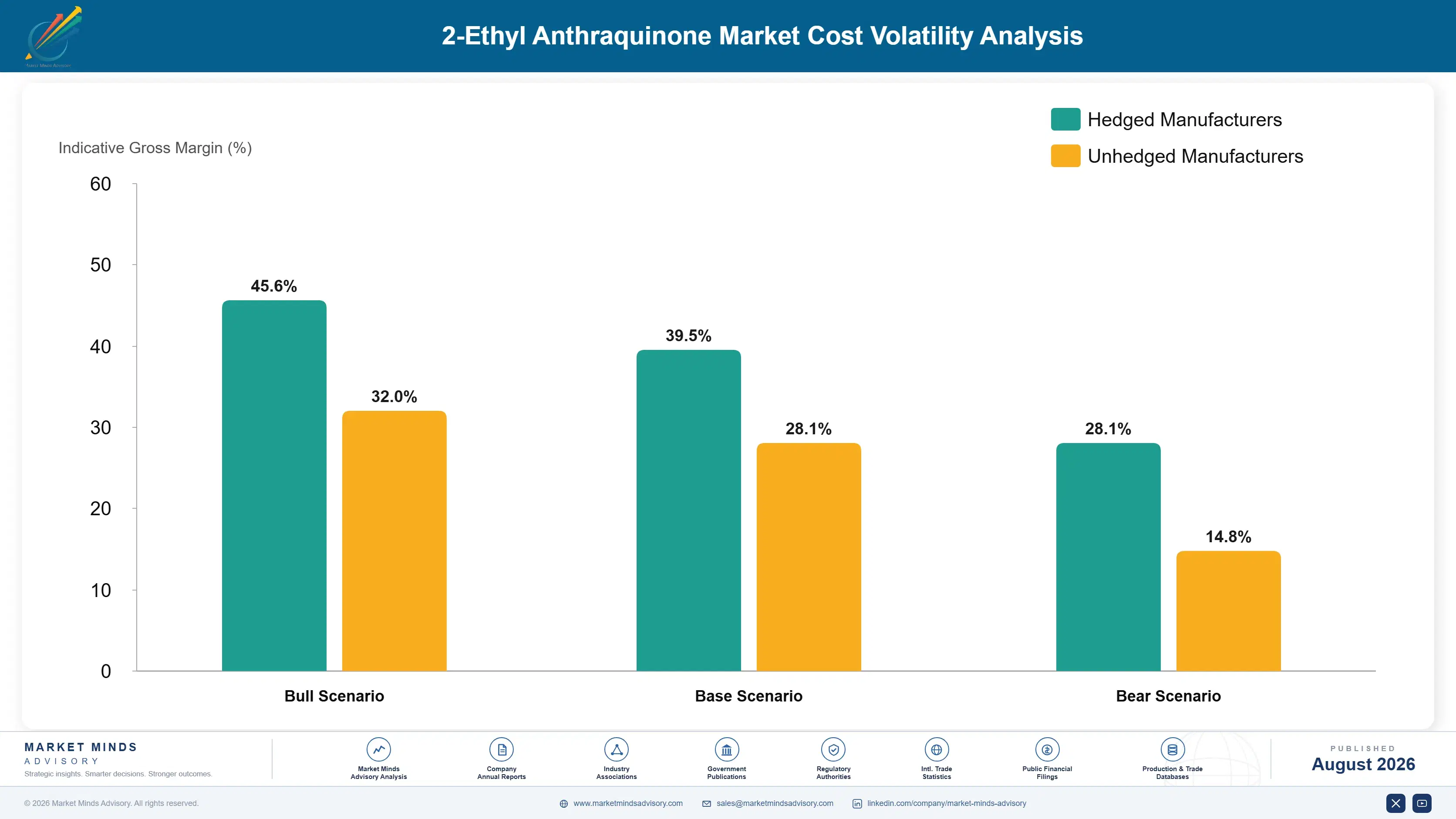
Ethylbenzene and Anthracene Feedstock Exposure

Ethylbenzene and anthracene feedstocks together represent roughly 52 percent of finished anthraquinone cost of goods sold, sourced predominantly from petrochemical refining byproduct streams and coal tar distillation supplied by major chemical manufacturing regions across East Asia, North America and Western Europe. Energy costs for the multi-step alkylation and hydrogenation process add a further meaningful cost share to overall total production economics.
Ethylbenzene and anthracene feedstock prices swung more than 24 percent between 2022 and 2024 according to ACC petrochemical market reporting, driven by broader petrochemical refining margin volatility and coal tar supply constraints affecting multiple downstream chemical industries simultaneously and unpredictably. This squeezed margins for anthraquinone producers without multi-year feedstock supply contracts locked in ahead of the volatility affecting global production and pricing across major manufacturing regions.

Larger producers with multi-year feedstock supply contracts and geographically diversified sourcing across multiple petrochemical suppliers absorb volatility far more comfortably than smaller regional producers buying on spot markets, creating a durable cost advantage that compounds during periods of sustained feedstock price volatility across the industry and shows few clear signs of meaningfully stabilising in the near term ahead.
2-ethyl-anthraquinone-market-trends-cost-volatility-analysis-1787463822647

Multi-Year Feedstock Purchase Contracting

Leading producers lock in two to three year ethylbenzene and anthracene feedstock purchase agreements at fixed or capped pricing directly with petrochemical suppliers, insulating margin from spot-market swings that hit smaller regional producers hardest during 2022 and 2023 volatility and the subsequent price spikes that followed across the entire wider chemical industry and its export markets.

Geographic Diversification of Feedstock Sourcing

Sourcing ethylbenzene and anthracene feedstocks across multiple regions and suppliers simultaneously reduces exposure to any single supply chain disruption, currency swing or sudden trade policy shift, a strategy the largest producers have already pursued aggressively while smaller regional producers remain concentrated with single suppliers and correspondingly exposed to localized shocks and sudden pricing spikes.

Alternative Feedstock Route Development Investment

Several producers are actively investing in alternative synthesis routes to reduce dependence on traditional petrochemical feedstock swings entirely, though commercial-scale cost parity with conventional feedstock remains several years away according to current pilot program economics, available yield data and the current processing infrastructure available at meaningful commercial scale, production volume and process consistency today.

Portfolio Architecture for Margin Defence

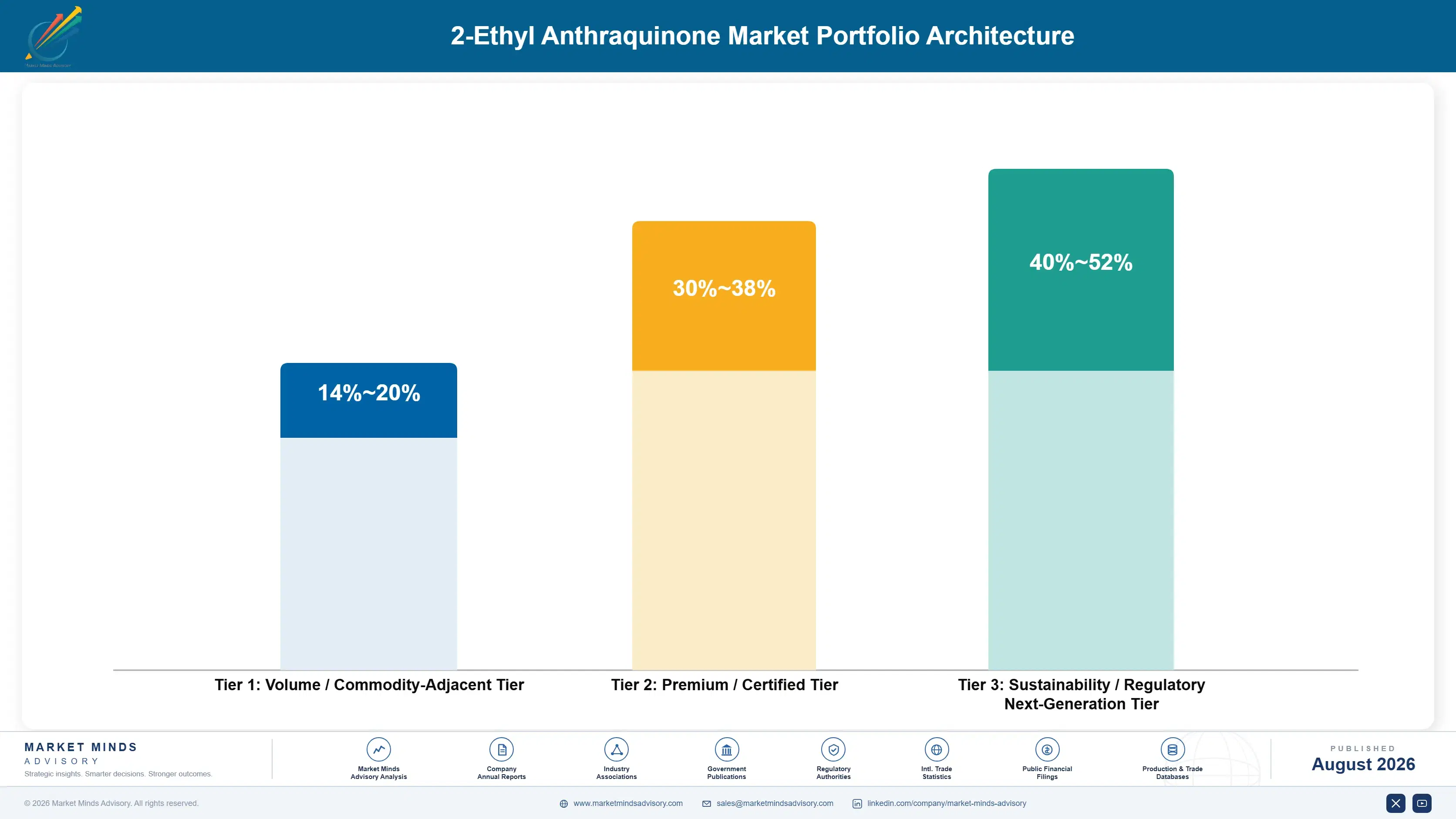
Portfolio economics split into three tiers with materially different gross margin profiles: commodity-adjacent bulk industrial-grade anthraquinone competes almost entirely on price and delivery reliability across pulp and textile bleaching applications worldwide, premium certified grades command a meaningful markup tied to pharmaceutical and personal care qualification, and next-generation electronics and semiconductor-grade chemistry carry the highest margins in the category, reflecting genuine technical differentiation and multi-year customer qualification barriers.
The tension between volume and premium tiers is intensifying as Chinese bulk-grade producers push pricing lower across commodity applications worldwide, compressing what had been a comfortable margin gap and forcing established Western and Japanese producers to defend premium positioning through faster electronics-grade qualification and pharmaceutical certification rather than relying on established brand reputation alone to hold key customer relationships.

High-value margin pools concentrate overwhelmingly in electronics-grade anthraquinone carrying documented parts-per-billion purity and long-cycle customer qualification, where competitors cannot simply match specification on cost alone without years of qualification history behind them, giving early movers a durable pricing advantage that persists even as commodity-tier margins continue to compress under sustained Chinese pricing pressure across most bulk industrial export markets.

Volume / Commodity-Adjacent Tier

Bulk industrial-grade anthraquinone sold largely on price and delivery reliability into pulp and textile bleaching applications, with minimal formulation differentiation between competing suppliers across the segment worldwide, domestically and regionally.
Gross Margin: 14-20%

Premium / Certified Tier

Certified pharmaceutical and personal care grade anthraquinone carrying documented quality management systems, sold into formulators willing to pay a meaningful premium for pharmacopeia-grade purity specifications, traceability and batch consistency nationwide.
Gross Margin: 30-38%

Sustainability / Regulatory / Next-Generation Tier

Next-generation electronics and semiconductor-grade anthraquinone representing the newest and most technically defensible portion of the category, commanding correspondingly higher margins as fabrication purity demands intensify further nationwide, regionally and abroad.
Gross Margin: 40-52%
2-ethyl-anthraquinone-market-trends-portfolio-architecture-1787463823147

High-value Sub-segments and Strategic Watch-out

Electronics and Semiconductor Grade

Electronics and semiconductor grade, growing fastest and commanding the highest margins in the category as chip fabrication capacity expands and purity requirements tighten beyond what bulk producers can economically achieve at scale across most major fabrication hubs, equipment types, customer accounts and supply contracts nationwide.
Gross Margin: 42-52%

Environmental and Water Treatment

Environmental and water treatment applications expanding steadily as municipal operators shift from chlorine-based disinfection toward hydrogen peroxide advanced oxidation processes across an increasing number of facilities nationwide and internationally each year, budget cycle, infrastructure plan, regulatory review process and long-term capital investment decision made worldwide.
Gross Margin: 28-36%

Bulk Industrial-Grade Anthraquinone

Bulk industrial-grade anthraquinone sold into pulp and textile bleaching applications, providing steady but increasingly price-competitive volume that underwrites producer fixed costs even as growth remains limited relative to premium tiers steadily gaining share nationwide each successive year, quarter, budget cycle and long-term strategic planning period.
Gross Margin: 12-18%

Textile Bleaching Applications

Textile bleaching applications facing gradual volume erosion as synthetic fiber substitution and declining natural fiber processing volume reduce demand; producers concentrated here risk meaningful share loss within the coming decade as consumption patterns continue shifting steadily nationwide, regionally and abroad each successive calendar year and quarter.
Gross Margin: 13-19%

Qualification Cycles and Customer Retention

Once a hydrogen peroxide producer qualifies an anthraquinone supplier through purity testing and extended production trials, switching cost runs genuinely high given the yield-critical role the working carrier plays in continuous peroxide production, giving incumbent suppliers annuity-like revenue predictability that persists for years once a qualification is won and locked into an ongoing production process that a competitor would need equivalent testing, trial history and documentation to displace.
Adoption depth varies sharply by end-use vertical: electronics and pharmaceutical customers qualify suppliers through rigorous multi-month testing and rarely switch absent a genuine quality failure or documented performance gap worth the operational disruption, while bulk industrial buyers in pulp and textile bleaching switch more readily based on price given the considerably lower purity stakes involved in their applications and processes.

A generational shift in buyer profiles is underway as younger procurement leads at hydrogen peroxide producers increasingly demand digital traceability and documented supply chain resilience before qualification, replacing an older generation of buyers who accepted supplier relationships built primarily on price and delivery history alone rather than documented purity performance, long-term reliability and certified quality control processes.
2-ethyl-anthraquinone-market-trends-end-use-penetration-index-1787463823640

Where Producers Should Focus Now

These are among the four positions where our research anticipates prominent divergence between winners and laggards over the coming forecast period. Each is grounded in the demand model, the regulatory perimeter, and the announced capacity pipeline.
01 / ELECTRONICS QUALIFICATION SPEED

Pursue Semiconductor Certification Before the Window Closes

Producers without electronics-grade qualification are missing the fastest-growing, highest-margin segment of the category entirely, and the qualification gap keeps widening as chip fabrication capacity expands across South Korea, Taiwan and Japan each year. The eighteen-month-plus qualification cycle means delayed applicants face a widening gap against early movers already locked into multi-year supply relationships with major customers. Pursuing semiconductor customer qualification now, even before additional fabrication capacity is confirmed, is cheaper than the catch-up competitors face once category leaders have secured reference customers.
02 / PHARMACEUTICAL CERTIFICATION INVESTMENT

Build Pharmacopeia-Grade Capability Now

Producers without pharmaceutical-grade manufacturing certification are missing a smaller but genuinely high-margin segment that rewards documented quality management systems over raw production scale alone. The certification investment is real, but the price premium of 20 to 35 percent over bulk grades justifies it for producers with the volume to support dedicated quality infrastructure and staff. Producers should treat this certification as a near-term priority rather than a longer-term consideration given how quickly personal care and pharmaceutical companies are tightening supplier qualification requirements.
03 / FEEDSTOCK DIVERSIFICATION DISCIPLINE

Diversify Feedstock Sourcing Geographically Now

Producers relying on single-region feedstock sourcing remain exposed to the petrochemical volatility that has already squeezed margins across the category since 2022, and the pattern is likely to repeat as commodity markets remain unpredictable across major producing regions each year and production cycle. Producers that diversify feedstock sourcing geographically protect margin predictability that increasingly matters as customers negotiate their own long-term supply agreements. Those same customers increasingly require documented sourcing stability from their anthraquinone suppliers before committing to multi-year supply contracts.
04 / PREMIUM POSITIONING CLARITY

Choose a Clear Position Before Chinese Pressure Intensifies

Chinese bulk-grade capacity expansion has already compressed pricing across commodity applications, and the pattern is likely to intensify as Chinese producers continue adding capacity faster than global demand growth can absorb it across most export markets and price tiers. Western and Japanese producers without a clear premium positioning strategy risk getting squeezed between Chinese bulk-grade competition below and established electronics-grade incumbents above. Strategic clarity on positioning has therefore become a genuine near-term priority rather than something to defer any longer.

Engagement Snapshot From the Field

A live engagement with an industry participant carrying material or product regulatory and market exposure ahead of a defining policy shift, showing how our research translates into a defensible multi-year portfolio strategy.
MARKET MINDS ADVISORY · CLIENT ENGAGEMENT SUMMARY
2-Ethyl Anthraquinone Producer Strategic Portfolio Review and Transition Roadmap 2026·Investment Scenario on 2-Ethyl Anthraquinone Exposure Evaluation 2025-26
CLIENT PROFILE
The client is a mid-sized European anthraquinone producer generating approximately 95 million dollars in annual revenue (client-reported, unverified by MMA), manufacturing bulk and technical-grade product from a single facility in Germany and supplying primarily pulp bleaching and chemical synthesis customers across Western Europe through long-established distributor relationships built over more than two decades of operation.
STRATEGIC CHALLENGE
The client sought to diversify into electronics-grade production to capture premium margins as bulk industrial pricing compressed under sustained Chinese competition, but lacked the ultrapure manufacturing capability and semiconductor customer relationships needed to compete against established Japanese and South Korean suppliers already serving that fast-growing, high-margin segment directly and at meaningful scale.
MMA APPROACH
MMA conducted a thorough capability gap assessment comparing the client's existing production infrastructure against electronics-grade purity requirements, benchmarking the capital investment and qualification timeline against category-leading electronics-grade producers, then modeled realistic market entry scenarios given the client's existing customer base and manufacturing footprint across Germany and several neighboring European markets.
KEY FINDINGS
  1. Achieving parts-per-billion purity would require approximately 6 million dollars in facility upgrades and construction of an entirely dedicated new ultrapure production line.
  2. Semiconductor customer qualification cycles typically run eighteen months, meaning the client would not see electronics-grade revenue until at least 2027 at the earliest.
  3. Two mid-tier European semiconductor fabrication customers had already expressed genuine interest in qualifying a regional supplier to reduce their Asian import dependence.
  4. The client's existing bulk-grade customer relationships provided limited but genuine credibility with semiconductor buyers seeking a proven, established and reliable regional producer.
CLIENT PROFILE
The client is a mid-sized European anthraquinone producer generating approximately 95 million dollars in annual revenue (client-reported, unverified by MMA), manufacturing bulk and technical-grade product from a single facility in Germany and supplying primarily pulp bleaching and chemical synthesis customers across Western Europe through long-established distributor relationships built over more than two decades of operation.
STRATEGIC CHALLENGE
The client sought to diversify into electronics-grade production to capture premium margins as bulk industrial pricing compressed under sustained Chinese competition, but lacked the ultrapure manufacturing capability and semiconductor customer relationships needed to compete against established Japanese and South Korean suppliers already serving that fast-growing, high-margin segment directly and at meaningful scale.
MMA APPROACH
MMA conducted a thorough capability gap assessment comparing the client's existing production infrastructure against electronics-grade purity requirements, benchmarking the capital investment and qualification timeline against category-leading electronics-grade producers, then modeled realistic market entry scenarios given the client's existing customer base and manufacturing footprint across Germany and several neighboring European markets.
KEY FINDINGS
  1. Achieving parts-per-billion purity would require approximately 6 million dollars in facility upgrades and construction of an entirely dedicated new ultrapure production line.
  2. Semiconductor customer qualification cycles typically run eighteen months, meaning the client would not see electronics-grade revenue until at least 2027 at the earliest.
  3. Two mid-tier European semiconductor fabrication customers had already expressed genuine interest in qualifying a regional supplier to reduce their Asian import dependence.
  4. The client's existing bulk-grade customer relationships provided limited but genuine credibility with semiconductor buyers seeking a proven, established and reliable regional producer.
RECOMMENDED STRATEGY
Phase 1: Phase 1 (Months 1 to 6): Secure project financing and begin construction of the dedicated new ultrapure production line and facility. Phase 2: Phase 2 (Months 7 to 20): Commission the facility and begin formal qualification testing with the two interested semiconductor customers. Phase 3: Phase 3 (Months 21 to 24): Complete formal qualification testing and begin initial electronics-grade shipments under new long-term supply agreements.
OUTCOME
The client completed facility construction on schedule and began formal qualification testing with both interested semiconductor customers within twenty months (client-reported, unverified by MMA). One customer completed qualification and signed a three-year supply agreement, while the second remained in final-stage testing as of the most recent reporting period.

Frequently Asked Questions

Foundational context covering the market sizes, CAGR, scope, country, region and competition that inform every finding below. This section is provided to cover basics and most often pre-purchase conversations, answered from the MMA Primary Research Dataset.

What is the current size of the 2-Ethyl Anthraquinone Market?

The global 2-ethyl anthraquinone market reached an estimated 0.68 billion dollars in 2025. Growth is driven by semiconductor fabrication expansion pulling electronics-grade hydrogen peroxide demand upward.

How large will the 2-Ethyl Anthraquinone Market be by 2036?

MMA projects the market will reach approximately 1.19 billion dollars by 2036, growing roughly 1.7 times from its 2026 base. Electronics-grade chemistry is expected to drive most incremental growth.

What is the CAGR for the 2-Ethyl Anthraquinone Market 2026 to 2036?

The market is forecast to grow at a 5.2 percent compound annual rate between 2026 and 2036. Bull-case scenarios reach 6.5 percent if semiconductor fabrication capacity expansion accelerates faster than expected.

Which segment is growing fastest?

Electronics and semiconductor grade leads at a 9.4 percent CAGR, roughly 1.8 times the overall market rate. Parts-per-billion purity requirements for chip fabrication are the primary driver behind that lead.

Who are the major companies in the 2-Ethyl Anthraquinone Market?

Leading producers include Evonik Industries, Solvay, Arkema, Nouryon and Mitsubishi Gas Chemical. Together they hold roughly 48 percent of category revenue, competing on purity documentation and qualification.

Which country is growing fastest?

South Korea leads country-level growth at a 7.2 percent CAGR, driven by expanding semiconductor fabrication capacity requiring ultrapure hydrogen peroxide inputs. Taiwan and Japan follow closely on similar dynamics.

Report Segmentation Architecture

The full report scope spans multiple orthogonal segmentation dimensions, with cross-tabulated demand data provided for each dimension pair. Coverage extends further to regional breakdowns, trend trajectories, and the competitive detail needed to support segment-level decision-making.

By Hydrogen Peroxide End-Use Application

  • Pulp and Paper Bleaching
  • Textile Bleaching
  • Chemical Synthesis
  • Electronics and Semiconductor Grade
  • Environmental and Water Treatment
  • Other Industrial Applications

By Purity Grade

  • Technical Grade
  • High-Purity Grade
  • Electronics Grade
  • Pharmacopeia Grade

By Commercial Dimension

  • Bulk Merchant Supply
  • Qualified Long-Term Contract Supply
  • Vertically Integrated Captive Supply
  • Licensed Regional Production

By Region

  • North America
  • Western Europe
  • East Asia
  • South Asia and Pacific
  • Latin America
  • Middle East and Africa
  • Eastern Europe

Scope, Methodology, and Coverage

Every figure in this report is reproducible from documented input assumptions. The scope below maps the historical period, the forecast horizon, the segmentation dimensions, and the countries covered, alongside the underlying primary and qualitative methodology.
Historical Period
2020 to 2025
Forecast Period
2026 to 2036
Base Year
2025 (USD billions; MMA Primary Research Dataset, August 2026)
Market Definition
The market covers 2-ethyl anthraquinone sold as a working carrier chemical for the anthraquinone process used in hydrogen peroxide production, across technical and high-purity grades. It excludes finished hydrogen peroxide itself and other anthraquinone derivatives used outside the peroxide production process.
Quantitative Units
USD billions (current prices); metric tonnes for volume-referenced segments
Segmentation Dimensions
By Hydrogen Peroxide End-Use Application; By Purity Grade; By Commercial Dimension; By Region
Regions Covered
North America, Western Europe, East Asia, South Asia and Pacific, Latin America, Middle East and Africa, Eastern Europe
Countries Covered
USA, China, Germany, France, UK, Japan, South Korea, India, Australia, Canada, Brazil, Mexico, Indonesia, Vietnam, Thailand, Malaysia, UAE, Saudi Arabia, South Africa, Nigeria, Turkey, Poland, Netherlands, Italy, Spain, Sweden, Switzerland, Argentina, Colombia, Singapore, and additional markets relevant to this sector
Key Companies Profiled
Evonik Industries, Solvay, Arkema, Nouryon, Mitsubishi Gas Chemical, Kemira, OCI Company, Mitsui Chemicals, Taekwang Industrial, Aditya Birla Chemicals, National Peroxide Limited, Ercros, PCC Group, Chang Chun Group, Gujarat Alkalies and Chemicals, Sasol, Hansol Chemical, Osaka Soda, DuPont, Foshan Zhongxin Chemical
Quantitative Methodology
Primary survey, n=3,800 respondents, Q4 2025, six countries; demand-side model with trade association cross-validation
Qualitative Methodology
47 expert interviews, Q4 2025; applied to validate demand model assumptions, identify emerging dynamics, and assess competitive positioning
Report Format
PDF and XLSX data workbook (Word format preview document)
Publisher
Market Minds Advisory
Report Code
MMA-2026-CHM-101
Published
August 2026
Contact
sales@marketmindsadvisory.com | www.marketmindsadvisory.com

Purchase the full 2-Ethyl Anthraquinone Market Report (2026 to 2036).

The full report delivers detailed segment-level sizing across all six hydrogen peroxide end-use application categories, country-level forecasts for thirty markets, and a competitive benchmarking module covering all twenty profiled producers on a single consistent revenue basis. It includes primary survey data from 3,800 respondents across six countries alongside 47 qualitative expert interviews conducted in the fourth quarter of 2025. Analysts provide a standalone semiconductor fabrication and purity specification tracker covering major producing regions worldwide. Clients also receive quarterly update briefings through the twelve months following publication.
Segment-level sizing across six end-use application categories
Country-level forecasts spanning thirty individual markets
Competitive benchmarking across twenty profiled producers
Standalone semiconductor and purity specification tracker
Quarterly post-publication analyst update briefings included
Primary survey and expert interview datasets

Built For The People Who Decide

From boardroom strategy to bench-side execution, this report is read cover-to-cover by leaders shaping the next decade of their industry, turning demand scenarios, market dynamics and valuation benchmarks into decisions.
CXOs/ Presidents/ VPs/ Managers
M&A and Corporate Development
Strategy Teams and R&D Heads
Procurement and Product Directors
Regulatory and Compliance Leaders
Investor Relations and Equity Analysts