Market Minds Advisory
1,6-Hexanediol Diacrylate Market

1,6-Hexanediol Diacrylate Market: Radiation-Curing Growth Meets Chinese Capacity Scale

HDDA producers are chasing 3D printing and electronics coatings demand even as Chinese commodity capacity keeps compressing pricing for standard reactive diluent grades, forcing Western suppliers to defend margin through specialty formulation rather than volume.

Lead Analyst

Bilal Shaikh

Published

September 2026

Make Smarter Decisions with Customized Research Insights

Request a free sample report and evaluate market opportunities, growth trends, and competitive dynamics relevant to your business needs.

2025 MARKET VALUE$0.8BMarket Size 2025
2036 FORECAST VALUE$1.6BBase Case , 2026 to 2036
CAGR 2026 TO 20366.5 %Bull 7.8% / Bear 5.2%
INCREMENTAL OPPORTUNITY$0.8BNet 10- year value creation
EXPANSION MULTIPLE1.88x2036 value over 2026 base
Strategic Levers
M&A Pipeline
Regional Outlook
Country Rankings
Competitive Intelligence
Segmental Deep-dive
Call-Us : 91 93563 13602

Executive Snapshot and Market Trajectory

HDDA suppliers are shifting from commodity reactive diluent sales toward specialty formulation partnerships, as 3D printing resin and electronics coating manufacturers demand purity and consistency specifications that standard industrial-grade monomer was never engineered to guarantee across every production batch and supply chain tier.
Growth concentrates in 3D printing and additive manufacturing grades used as viscosity-reducing reactive diluents in SLA and DLP resins, and in electronics-grade material formulated for conformal coating and circuit protection applications. East Asia hosts the overwhelming majority of global production and formulation capacity, while India's expanding electronics manufacturing base is pulling demand faster than any other country tracked as domestic assembly volume scales rapidly nationwide across every major manufacturing hub.
Competitive character splits between integrated radiation-curing giants like Arkema that supply HDDA alongside a broader acrylate portfolio and specialty formulators like Allnex that lead on coatings-specific chemistry. Regulatory pressure around occupational exposure limits and REACH-style registration is rising steadily, pushing suppliers toward compliance investment that smaller regional blenders increasingly cannot match without losing volume elsewhere in their broader chemical operations across multiple product lines, regions, and customer segments worldwide each fiscal year without exception.
Market Definition
This report covers 1,6-hexanediol diacrylate produced and sold as a reactive diluent and crosslinking monomer for UV and electron-beam curable coatings, printing inks, adhesives, sealants, 3D printing resins, and electronics conformal coatings. It excludes other diacrylate and monoacrylate monomers and finished, pre-formulated radiation-curable products that already incorporate HDDA internally.
Base Year Value
$0.8B in 2025 (MMA Primary Research Dataset, August 2026)
Forecast Period
2026 to 2036, eleven discrete annual values
CAGR
6.5% base case. Bull 7.8%. Bear 5.2%.
Fastest Growth Segment
3D Printing and Additive Manufacturing Grade HDDA: 11.5% CAGR
Fastest Growth Country
India: 9.8% CAGR
Fastest Growth Region
South Asia and Pacific: 8.6% CAGR
Largest Region
East Asia: 43% of 2025 global value
Market Leaders
Arkema (Sartomer), Allnex Group, BASF SE, Evonik Industries AG, Nippon Shokubai Co., Ltd. Source: MMA Analysis based on company annual reports.
Primary Survey
n=3,800 procurement and R&D decision-makers, Q4 2025, six countries
Methodology
Demand-side build-up, cross-validated against public data, 47 expert interviews

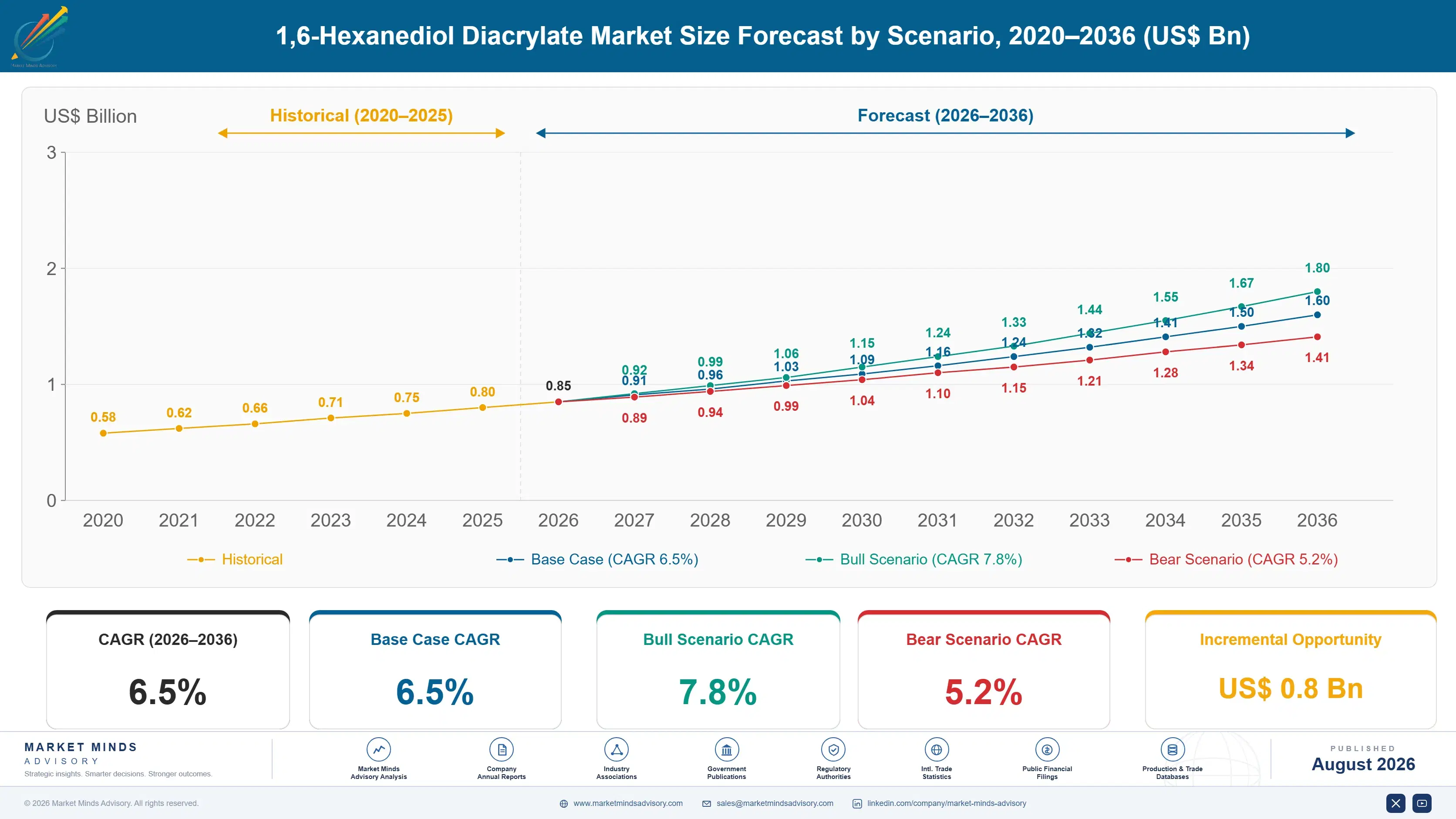
1,6-Hexanediol Diacrylate Market Forecast Scenarios

16-hexanediol-diacrylate-market-trends-size-forecast-scenario-1787463859350
HDDA demand grew steadily between 2020 and 2025 as radiation-curing adoption expanded across coatings and printing while 3D printing resin demand began accelerating from a modest base. A historical CAGR of 5.3% reflects that steady build, with 3D printing and electronics grades gaining share fastest as formulators sought purity specifications legacy industrial-grade monomer could not consistently satisfy.
The base case assumes 6.5% annual growth through 2036, anchored by three mechanisms: expanding SLA and DLP 3D printing resin demand requiring reactive diluent purity beyond commodity grade, rising electronics conformal coating adoption tied to growing circuit board manufacturing volume, and steady coatings and printing ink demand across mature Western markets. Together these push suppliers to serve both a stable commodity diluent base and an increasingly demanding specialty-formulation tier simultaneously.
A bull scenario assumes 3D printing resin adoption accelerates faster than expected across both mature and emerging markets, pushing growth toward 7.8%. The bear case turns on Chinese commodity capacity expansion compressing pricing across standard industrial grades faster than specialty reformulation can offset, dragging growth down toward roughly 5.2% across the most exposed suppliers lacking a defensible specialty niche of their own.

Reactive Diluent Economics and the Purity Premium

HDDA sits downstream of the broader acrylic acid and hexanediol chemical chain, converting two commodity feedstocks into a difunctional monomer that determines viscosity, crosslink density, and cure speed across a wide range of radiation-curable formulations. This function gives HDDA outsized influence over finished product performance relative to its modest share of total formulation cost, a dynamic few reactive diluents share as directly across the broader specialty chemical value chain.
MARKET CONCENTRATION (CR5)44%Integrated chemical giants hold meaningful combined production scale
AVERAGE INDUSTRIAL PRICE$3.60 per kilogramBlended commodity and specialty grade pricing across major markets
TOP PRODUCING COUNTRY SHAREChina, 38%Largest single national base for monomer production capacity
SPECIALTY GRADE PENETRATION23% of revenueElectronics and additive manufacturing grades capture rising revenue share
CAPACITY UTILIZATION RATE76%Average utilization across major global production facilities today
KEY INPUT COST SHARE55% of COGSHexanediol and acrylic acid feedstock dominate total production cost
Commercially, the category splits between standard industrial-grade monomer sold on tight tonnage contracts to coatings and ink formulators, and a smaller but rapidly growing specialty tier built on 3D printing and electronics-grade purity. Suppliers with dedicated purification capability, Allnex among them, capture disproportionate margin even where their standard tonnage share stays flat against integrated giants like Arkema and BASF year after year.
Over the next decade, capacity additions concentrate around dedicated purification lines serving 3D printing and electronics customers rather than expanding standard industrial capacity, since commodity coatings demand alone does not justify new volume at the pace specialty demand is growing. Rising Chinese capacity will keep pressuring standard grade pricing even as Western suppliers defend margin through reformulation across their broader specialty portfolios.
"HDDA used to be a line item nobody negotiated hard on. Now the suppliers winning 3D printing resin contracts are the ones who invested in purification years before formulators asked for it."
Director, Specialty and Performance Chemicals Practice · MMA Specialty & Performance Chemicals Practice · August 2026

Market Trends

3D Printing Resin Demand Pulling Purity Specifications Higher

SLA and DLP 3D printing resin formulators increasingly specify high-purity HDDA grades that minimize odor, discoloration, and trace impurities far beyond what standard industrial-grade monomer typically delivers, since print resolution and mechanical properties depend directly on consistent monomer quality. Suppliers including Allnex have invested in dedicated purification lines separate from standard production, since the two grades require different distillation and quality control processes entirely. This demand is concentrated among resin formulators serving dental, jewelry, and engineering prototyping applications, where print consistency failures carry meaningful reputational and commercial cost for equipment manufacturers.
Market Impact: Adds 5-7% radiation-curing demand growth
Electronics Conformal Coating Demand From PCB Manufacturing Growth

Rising printed circuit board assembly volume across Asia is pulling demand for electronics-grade HDDA formulated into conformal coatings that protect circuits from moisture, dust, and corrosion during operation. Suppliers including Nippon Shokubai have expanded dedicated electronics-grade production capacity to meet this rising qualified customer base, since formulation qualification with coating manufacturers requires extensive reliability testing. This trend is pulling HDDA demand into an electronics manufacturing supply chain that historically sourced conformal coating monomers through a narrower set of specialized suppliers rather than broad-based commodity chemical distributors serving multiple unrelated industries at once.
Market Impact: Adds 9.8% India demand growth

Market Opportunities and Growth Drivers

Expanding Radiation-Curing Adoption Across Coatings and Inks

Coatings and printing ink formulators across North America, Western Europe, and East Asia continue converting from solvent-based to UV and electron-beam curable systems to cut volatile organic compound emissions and speed production line throughput, each conversion requiring qualified HDDA supply as a reactive diluent. Arkema and similar suppliers have expanded radiation-curing technical service capability to support this transition, since formulation conversion requires considerable customer testing and support time. This driver is measurable in radiation-curable coatings volume growth consistently outpacing solvent-based coatings volume across every major region tracked in this report.
Market Impact: Raises feedstock cost volatility 10-16%

India's Rapidly Expanding Electronics Manufacturing Base

India's rapidly growing electronics assembly and printed circuit board manufacturing sector is pulling new HDDA demand domestically as government manufacturing incentive programs support continued expansion of the country's assembly capacity. International suppliers have expanded distribution relationships with Indian formulators to capture this demand ahead of domestic production capacity fully maturing, since dedicated purification investment requires meaningful capital most Indian producers have been slower to commit. This shift is gradually reducing India's historical dependence on imported finished conformal coating and 3D printing resin products across both mainstream and premium electronics manufacturing tiers.
Market Impact: Cuts margin 180 basis points

Market Restraints and Challenges

Hexanediol and Acrylic Acid Feedstock Volatility

Hexanediol and acrylic acid feedstock pricing tracks volatile global petrochemical markets, squeezing supplier margins during periods when formulators resist passing higher monomer costs through to already price-sensitive coatings and ink customers. The root cause is the category's dependence on globally traded commodity chemical inputs whose pricing is set well outside the HDDA industry's own supply and demand dynamics. The commercial impact falls hardest on smaller regional producers without long-term feedstock contracts or diversified sourcing relationships. Larger suppliers are mitigating exposure through multi-year supply agreements and geographic sourcing diversification across multiple producing regions.
Market Impact: Adds 11.5% 3D printing segment growth

Chinese Commodity Capacity Compressing Standard Grade Pricing

Rapidly expanding Chinese production capacity for standard industrial-grade HDDA has compressed pricing across commodity coatings and ink applications, squeezing margin for Western suppliers competing on tonnage rather than specialty formulation. The root cause is China's chemical manufacturing scale advantage across the broader acrylate value chain, not any quality or service differentiation. The commercial impact falls hardest on mid-sized regional producers without a defensible specialty niche to retreat toward. Larger suppliers are mitigating exposure by shifting mix decisively toward 3D printing and electronics grades that Chinese commodity producers have not yet matched on purity.
Market Impact: Adds 9.0% electronics segment growth
3 additional market trends, 2 additional growth drivers, and 4 additional restraints and challenges are covered in the full report. Contact sales@marketmindsadvisory.com to access the complete intelligence.

Segment CAGR and Growth Architecture

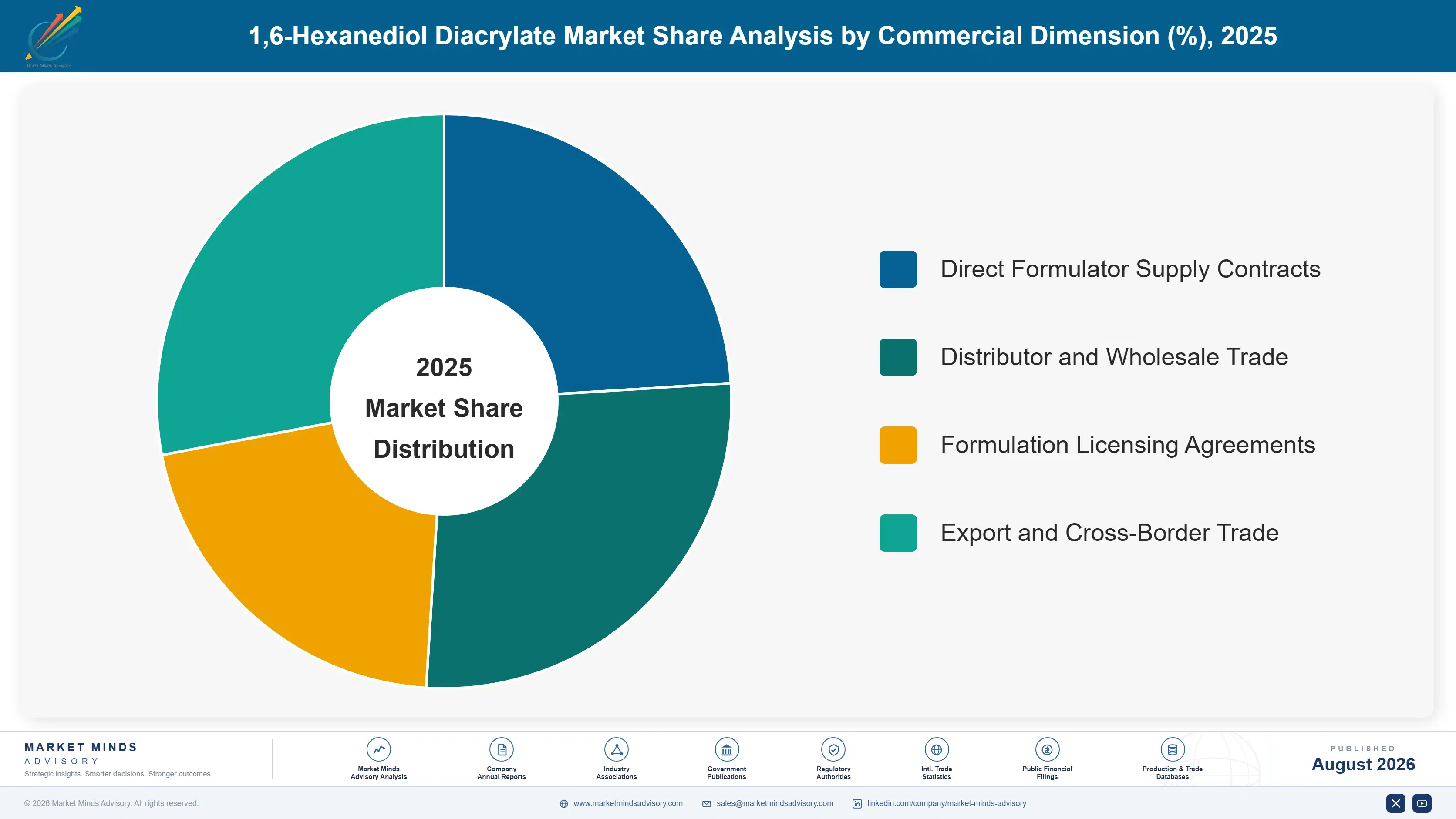
MMA segments the HDDA market by end-use application rather than by production process, since purity and formulation requirements, not how the monomer is synthesized, determine cost structure and margin more than any single production method across coatings, inks, or 3D printing uses today across every single producing country this report tracks in full detail.
16-hexanediol-diacrylate-market-trends-market-share-analysis-1787463859889

3D Printing and Additive Manufacturing Grade HDDA

3D printing and additive manufacturing grade HDDA is the fastest-growing segment, pulled by SLA and DLP resin formulators requiring purity specifications that minimize odor, discoloration, and trace impurities well beyond standard industrial-grade monomer. Allnex and similar suppliers have built dedicated purification lines entirely separate from standard production, since the two grades require different distillation and quality control processes altogether. This segment commands the strongest price premium in the category, since print consistency failures carry meaningful reputational cost for resin and equipment manufacturers that purity specifications directly address. Demand concentrates in North America, Western Europe, and East Asia, where 3D printing resin formulation is most developed, though the format is beginning to appear across emerging additive manufacturing hubs as well.
CAGR 11.5%

Electronics and Conformal Coating Grade HDDA

Electronics and conformal coating grade HDDA is the second-fastest segment, driven by rising printed circuit board assembly volume across Asia that requires monomer formulated for moisture, dust, and corrosion protection during circuit operation. Nippon Shokubai and similar suppliers have expanded dedicated electronics-grade production capacity to meet this rising qualified customer base, since formulation qualification with coating manufacturers requires extensive reliability testing over time. This segment commands meaningful margin over standard industrial grade, since electronics manufacturers value formulation consistency enough to pay a specification-driven premium. Growth concentrates in China, South Korea, and increasingly India, where electronics assembly capacity continues expanding rapidly across the region's major manufacturing hubs and export processing zones.
CAGR 9.0%
Full segment breakdown across 6 segments available in the complete report.

Regional Architecture and Country Demand Map

HDDA production and formulation capacity concentrates overwhelmingly in East Asia given China's dominant acrylate monomer manufacturing base, while India's expanding electronics manufacturing sector is pulling demand faster than any other country tracked in this analysis across the entire ten-year forecast period that lies directly ahead.

North America

The United States hosts the region's largest HDDA formulation and distribution base, with Arkema's Sartomer business anchoring domestic production alongside meaningful import volume from Asian commodity suppliers. Coatings and printing ink formulators across the country continue converting from solvent-based to radiation-curable systems, sustaining steady demand for standard industrial-grade monomer. Specialty grade penetration runs meaningfully higher here than in most other regions, tracking the concentration of 3D printing resin and electronics coating formulation activity across the country. Canada contributes a smaller but meaningful distribution base, closely integrated with United States supply chains through cross-border trade relationships and shared regulatory frameworks across both countries' major chemical manufacturing hubs and formulator networks nationwide.
Share: 22% | CAGR: 5.8% (2026 to 2036)

Western Europe

Germany and France host the region's largest HDDA markets, with Allnex and BASF anchoring established production infrastructure tied to the region's mature coatings and printing ink industry. The region's stricter regulatory environment around occupational exposure limits and REACH registration has pushed suppliers toward documentation and compliance capability as a genuine competitive requirement rather than a background cost. Specialty grade demand continues rising steadily here, tracking Europe's advanced electronics and precision manufacturing base. Growth trails East Asia and North America since the region's coatings demand is already mature and volume gains depend on specialty reformulation rather than expansion across most major national markets tracked here in full and quite complete detail.
Share: 18% | CAGR: 5.0% (2026 to 2036)
Regional intelligence for 5 additional markets available in the complete report: East Asia, South Asia and Pacific, Latin America, Middle East and Africa, Eastern Europe. Contact sales@marketmindsadvisory.com.
16-hexanediol-diacrylate-market-trends-country-cagr-analysis-1787463860405

Purification Investment and Specialty Value Capture

HDDA producers extract more value from existing feedstock and production relationships by moving into 3D printing and electronics-grade purification rather than competing purely on standard industrial tonnage. The levers below concentrate on capturing specialty purity premium, formulation technical service value, and supply security that commodity-only producers cannot easily replicate without dedicated capital investment of their own.

Dedicated Purification Capacity for 3D Printing Contracts

Suppliers that built dedicated purification lines separate from standard industrial production are capturing 3D printing resin formulator contracts worth roughly 35 to 45% more per kilogram than standard industrial-grade monomer, since purity specifications directly address print consistency requirements formulators cannot compromise on. This capacity requires meaningful capital investment and typically takes 2 to 3 years to fully commission and qualify with resin formulators, but it lets suppliers serve a buyer base standard producers cannot reach. Suppliers without dedicated purification capability increasingly lose 3D printing contracts entirely to established competitors already validated with resin formulators.
Market Impact: Adds a 35 to 45% specialty price premium overall

Electronics-Grade Qualification for Conformal Coating Customers

Suppliers that built electronics-grade qualification meeting reliability and trace-impurity specifications distinct from standard industrial requirements are winning conformal coating manufacturer contracts that standard producers cannot fulfill without requalifying their entire production process. These contracts generate roughly 20 to 28% higher margin than standard industrial tonnage, since electronics manufacturers value formulation consistency enough to pay a specification-driven premium. Suppliers without electronics-grade qualification increasingly lose this growing customer base entirely to better-positioned competitors already serving circuit board manufacturers across multiple regions and technical specifications simultaneously, closing off the opportunity almost completely for latecomers.
Market Impact: Adds 20 to 28% electronics grade margin overall

Multi-Region Feedstock Diversification for Supply Security

Suppliers that diversify hexanediol and acrylic acid feedstock sourcing across multiple producing regions rather than depending on a single source reduce their exposure to sudden petrochemical supply tightness that can strand smaller competitors mid-contract with formulator customers. Building this diversified sourcing base typically takes 3 to 4 years of supplier qualification across multiple regions, but it lets a supplier maintain production continuity for customers when any single feedstock source faces disruption. Suppliers without diversified sourcing risk losing formulator contracts during supply disruptions, since customers cannot pause production waiting for a single blocked source to reopen.
Market Impact: Cuts supply disruption risk by roughly 30% overall

Technical Formulation Support for Radiation-Curing Conversion

Suppliers that build dedicated technical service teams supporting customers converting from solvent-based to radiation-curable formulations win preferential access to conversion contracts that require extensive reformulation testing and support most producers cannot provide alongside standard monomer sales. This technical investment requires meaningful upfront cost and typically takes 2 years to build a fully staffed applications team, but it pays back through access to conversion contracts undocumented competitors cannot win. Suppliers without technical support capability remain confined to commodity-tier contracts regardless of their underlying monomer quality, since technical service increasingly determines contract eligibility more than raw chemistry alone.
Market Impact: Wins 14 to 19% more conversion contracts overall

Who Controls the Margin Pool

CR5 in HDDA sits near 44%, reflecting meaningful concentration among integrated radiation-curing giants alongside a long tail of Chinese commodity producers. Arkema leads through global radiation-curing portfolio scale, with Allnex close behind through integrated coatings resin technology, while the gap to smaller regional producers remains wide enough that specialty qualification requirements continue raising the capital bar to compete effectively.
Current competitive activity centers on three fronts: dedicated purification capacity investment to capture 3D printing resin contracts, electronics-grade qualification to serve the growing conformal coating customer base, and technical formulation support to win radiation-curing conversion business ahead of competitors. Larger suppliers with purification and technical capability are moving fastest on all three, while smaller regional producers without capital access risk losing both specialty contracts and conversion-driven formulator relationships.

Emerging pressure comes from Chinese domestic producers scaling specialty purification capacity fast enough to reduce their historical dependence on Western suppliers for 3D printing and electronics-grade material. Arkema's continued Asian capacity expansion signals established specialty suppliers are treating the region as a genuine growth priority rather than simply a cost-competitive commodity source for standard tonnage sold at scale.
16-hexanediol-diacrylate-market-trends-company-positioning-matrix-1787463860940

Competitive Moat and Risk Dimensions

ARKEMA (SARTOMER)

Moat: Global Radiation-Curing Portfolio Scale

Arkema's Sartomer business gives it a broad radiation-curable monomer and oligomer portfolio that lets it bundle HDDA alongside complementary chemistry for the same formulator customer base, a scale advantage specialty-only producers cannot match. This portfolio breadth also funds continued purification capacity investment across multiple regions simultaneously.
ARKEMA (SARTOMER)

Risk: Commoditization From Chinese Imports

Arkema's standard industrial-grade HDDA faces meaningful commoditization pressure from Chinese producers replicating similar chemistry at lower cost, meaning the company must continually shift mix toward specialty purification tiers to defend margin across its broader monomer portfolio and customer base each successive product cycle and fiscal year.
ALLNEX GROUP

Moat: Integrated Coatings Resin Technology

Allnex's deep coatings resin technology base lets it bundle HDDA formulation expertise alongside broader resin system sales, giving it customer relationships and technical credibility that pure monomer suppliers struggle to replicate across premium coatings and 3D printing accounts spanning multiple end-use industries and geographic regions worldwide.
ALLNEX GROUP

Risk: Feedstock Price Pass-Through Risk

Allnex's HDDA margin remains exposed to volatile hexanediol and acrylic acid feedstock pricing that it cannot always pass through to formulator customers quickly, particularly during periods of sustained petrochemical price inflation across its production network and broader specialty chemical portfolio worldwide each and every fiscal year.

Players Tracked

Prominent Players

Arkema (Sartomer)
Allnex Group
BASF SE
Evonik Industries AG
Nippon Shokubai Co., Ltd.

Other Key Players

IGM Resins B.V.
Eternal Materials Co., Ltd.
Double Bond Chemical Ind. Co., Ltd.
Jiangsu Sanmu Group Corporation
Tianjin Jiuri New Materials Co., Ltd.
Miwon Specialty Chemical Co., Ltd.
Osaka Organic Chemical Industry Ltd.
Longchang Chemical
Toagosei Co., Ltd.
Mitsubishi Chemical Corporation
Nippon Kasei Chemical Co., Ltd.
Dymax Corporation
Kromachem Ltd
Changzhou Tronly New Electronic Materials Co., Ltd.
Kyoeisha Chemical Co., Ltd.

Recent Developments

APRIL 2025

Arkema Expands UV-Curable Acrylate Capacity in Asia

Arkema's Sartomer business expanded UV-curable acrylate production capacity in Asia, adding HDDA grades tailored for high-speed inkjet, 3D printing, and electronics coatings applications across multiple regional markets. The expansion supports rising formulator demand across the region's fastest-growing specialty end markets and export customers alike each year.
Signal: Confirms leading radiation-curing suppliers are prioritizing Asian specialty capacity ahead of anticipated demand growth nationwide and regionally.
AUGUST 2025

Allnex Launches High-Purity HDDA Grade for 3D Printing

Allnex launched a new high-purity HDDA grade specifically formulated for SLA and DLP 3D printing resin manufacturers, meeting tighter odor and discoloration specifications than its standard industrial-grade product line. The launch reflects continued investment in dedicated purification capability across its global network and technical service organization.
Signal: Signals established coatings resin suppliers are treating 3D printing as a genuine standalone growth category worldwide.
JANUARY 2026

Nippon Shokubai Expands Electronics-Grade Production in Japan

Nippon Shokubai expanded electronics-grade HDDA production capacity at one of its Japanese facilities to serve rising conformal coating demand from regional circuit board manufacturers across multiple countries. The expansion followed sustained order growth from electronics customers over the prior two fiscal years across multiple product categories.
Signal: Confirms Japanese specialty producers are scaling capacity specifically for electronics demand rather than general industrial use.

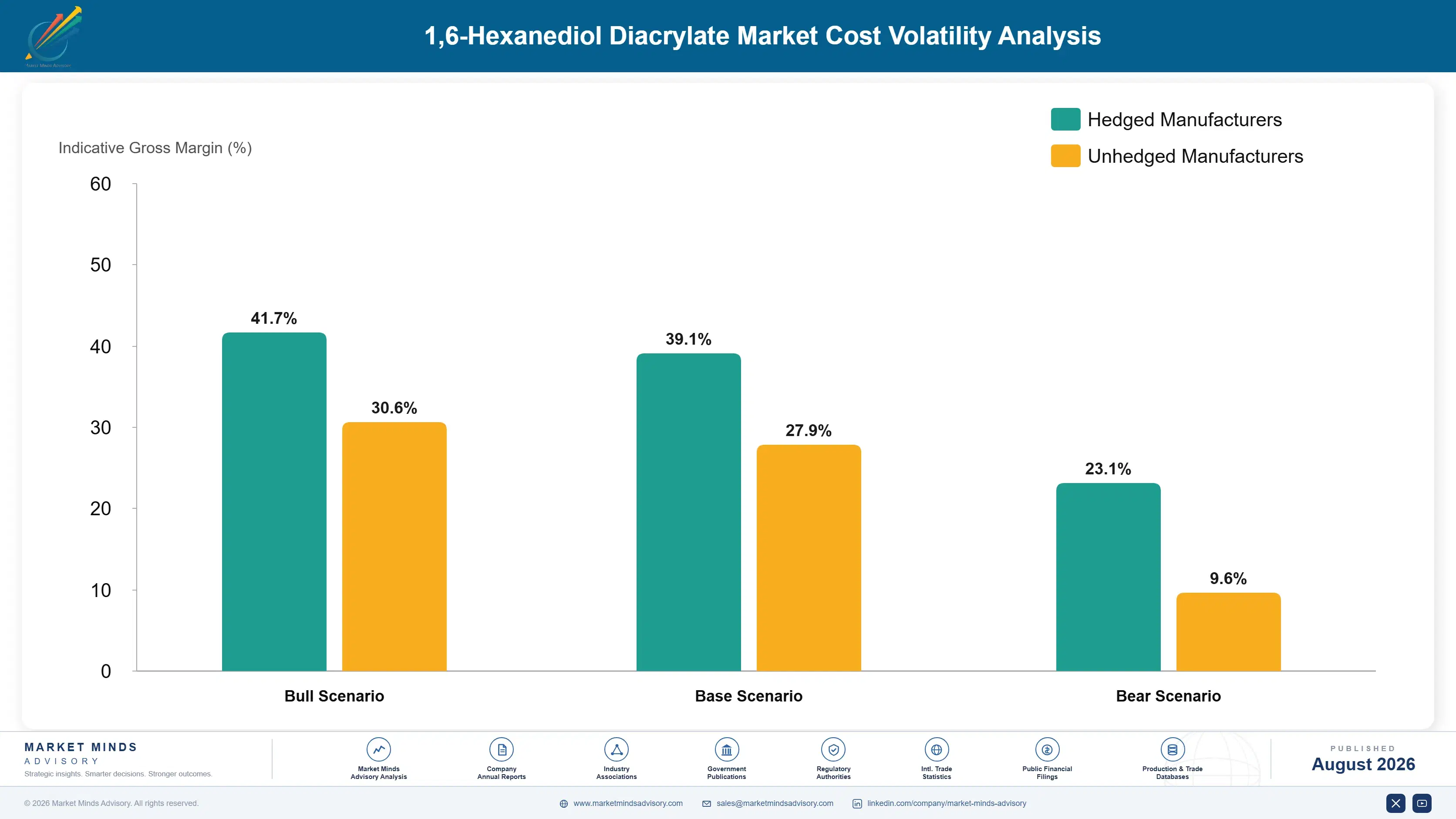
Hexanediol and Acrylic Acid Feedstock Exposure

Hexanediol and acrylic acid feedstock account for roughly 55% of processor cost of goods sold, sourced from global petrochemical producers whose pricing tracks broader commodity and energy markets rather than HDDA-specific demand alone. This exposure sits meaningfully higher than in more mechanized specialty chemical categories, given how concentrated the category's core feedstock inputs remain among a small number of global suppliers.
Global acrylic acid and hexanediol prices rose sharply following energy market volatility across 2022 and 2023, with the IEA's industrial energy market reports documenting sustained cost pressure across major petrochemical producing regions through 2024. Suppliers without long-term feedstock agreements or diversified sourcing absorbed meaningfully higher per-kilogram production costs than competitors with existing multi-year supply contracts already established well before the volatility began, according to company disclosures from that period.

Exposure varies by producer type: large integrated chemical producers with captive feedstock production and multi-region sourcing absorb volatility more evenly than smaller regional blenders dependent on spot market purchasing. Specialty purification suppliers face additional processing cost layers that standard industrial-grade producers do not carry, widening the margin gap between the two producer types during sustained feedstock inflation.
16-hexanediol-diacrylate-market-trends-cost-volatility-analysis-1787463861138

Multi-Year Feedstock Supply Agreements

Larger producers increasingly lock in multi-year hexanediol and acrylic acid feedstock agreements directly with petrochemical producers, trading some pricing flexibility for predictable long-term input cost visibility across consecutive production cycles. Smaller producers without the volume commitments to negotiate multi-year terms remain more exposed to spot feedstock price spikes during periods of tight supply each cycle across the region.

Captive Feedstock Production Integration

Some larger producers increasingly maintain captive hexanediol and acrylic acid production rather than depending entirely on merchant feedstock purchasing, reducing exposure to spot market volatility that drives petrochemical cost swings sharply. This integration requires substantial upfront capital but meaningfully smooths input cost volatility across consecutive years of energy market cycles and feedstock price swings alike.

Multi-Region Feedstock Sourcing Diversification

Producers are increasingly sourcing hexanediol and acrylic acid feedstock from multiple producing regions rather than depending on a single source, reducing exposure to localized supply disruption or regional feedstock cost spikes. This diversification requires supplier qualification investment but meaningfully smooths input cost volatility across multiple sourcing regions and production cycles over time each year.

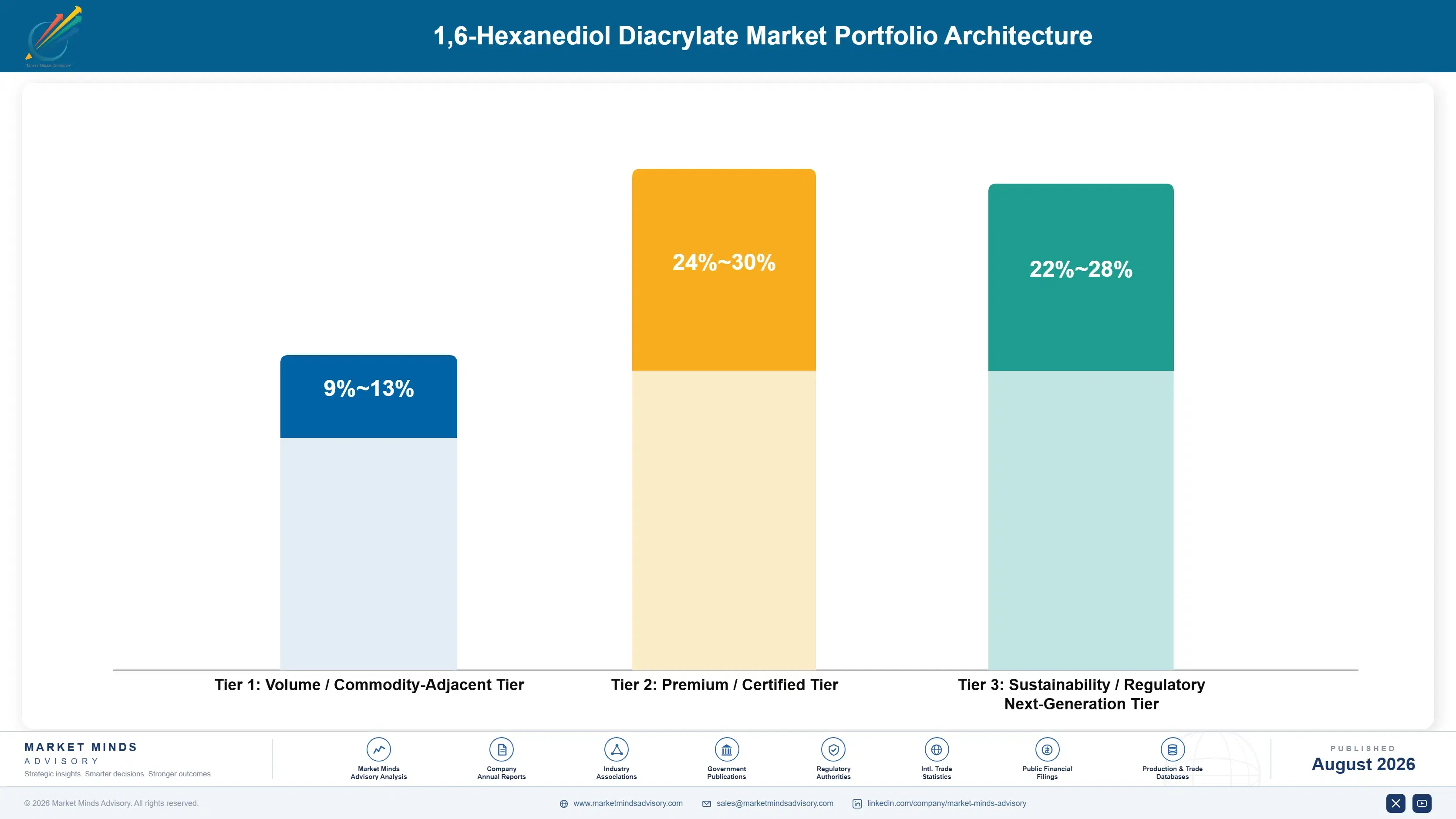
Portfolio Architecture for Margin Defence

HDDA portfolios split across three tiers with different margin economics: a volume tier built on standard industrial-grade monomer sold to coatings and ink formulators, a premium tier built on 3D printing and electronics-grade purification, and an emerging next-generation tier tied to bio-based and fully documented formulations that formulators are only beginning to pay a defined premium for consistently.
The tension between volume and premium runs deep in how producers allocate limited purification capacity: every kilogram dedicated to 3D printing or electronics-grade output is a kilogram unavailable for standard industrial volume that still generates the bulk of category revenue today. Get the mix wrong and a producer either misses premium specialty contracts or overinvests in purification capacity that outpaces actual formulator demand for it right now across the wider category.

High-value margin pools concentrate overwhelmingly in 3D printing and electronics-grade chemistry sold to specialty formulators, not in standard industrial tonnage alone. Producers that built purification and technical service capability early, Allnex and Arkema among them, now capture a share of total category profit well above their share of total tonnage sold each year across their combined product lines and regions.

Volume / Commodity-Adjacent Tier

Standard industrial-grade HDDA sold on tight tonnage contracts to coatings and printing ink formulators, priced close to petrochemical feedstock benchmarks with thin processing margin above input cost across most accounts.
Gross Margin: 9-13%

Premium / Certified Tier

3D printing and electronics-grade HDDA sold to specialty formulators requiring purity and reliability specifications, commanding meaningful price premiums through purification science and qualification capability that commodity producers cannot easily replicate.
Gross Margin: 24-30%

Sustainability / Regulatory / Next-Generation Tier

Bio-based and fully documented HDDA formulations aimed at formulators with public sustainability and regulatory transparency commitments, still a small volume tier but growing as documentation expectations continue to rise across major markets.
Gross Margin: 22-28%
16-hexanediol-diacrylate-market-trends-portfolio-architecture-1787463861651

High-value Sub-segments and Strategic Watch-out

3D Printing and Additive Manufacturing Grade HDDA (High-Value, High-Growth)

3D printing grade HDDA combines the fastest unit growth in the category with meaningfully above-average margins, making it the single most attractive segment for producers with dedicated purification capacity already in place. Demand continues to outpace available certified capacity across North America and Western Europe combined.
Gross Margin: 24-30%

Electronics and Conformal Coating Grade HDDA (High-Value, Moderate-Growth)

Electronics-grade HDDA carries better margin than standard industrial monomer and continues gaining conformal coating contracts, though growth is more moderate than 3D printing formats since it depends on qualification cycles that take real time to establish at meaningful commercial scale across new customer accounts each year.
Gross Margin: 20-26%

Standard Industrial-Grade HDDA (Volume Core)

Standard industrial-grade HDDA remains the largest single category by volume and the backbone of producer cash flow, even though margin sits well below the specialty tiers. Nearly every producer depends on this volume base to fund purification investment elsewhere in the wider portfolio each year.
Gross Margin: 9-13%

Non-Purified Commodity Exports (Strategic Watch-Out)

Commodity HDDA exported without purification investment or quality documentation carries the thinnest margin in the portfolio and faces the most direct exposure to being displaced as specialty formulators tighten qualification requirements across major end-use categories each year, especially in the most heavily regulated markets tracked in this report.
Gross Margin: 5-9%

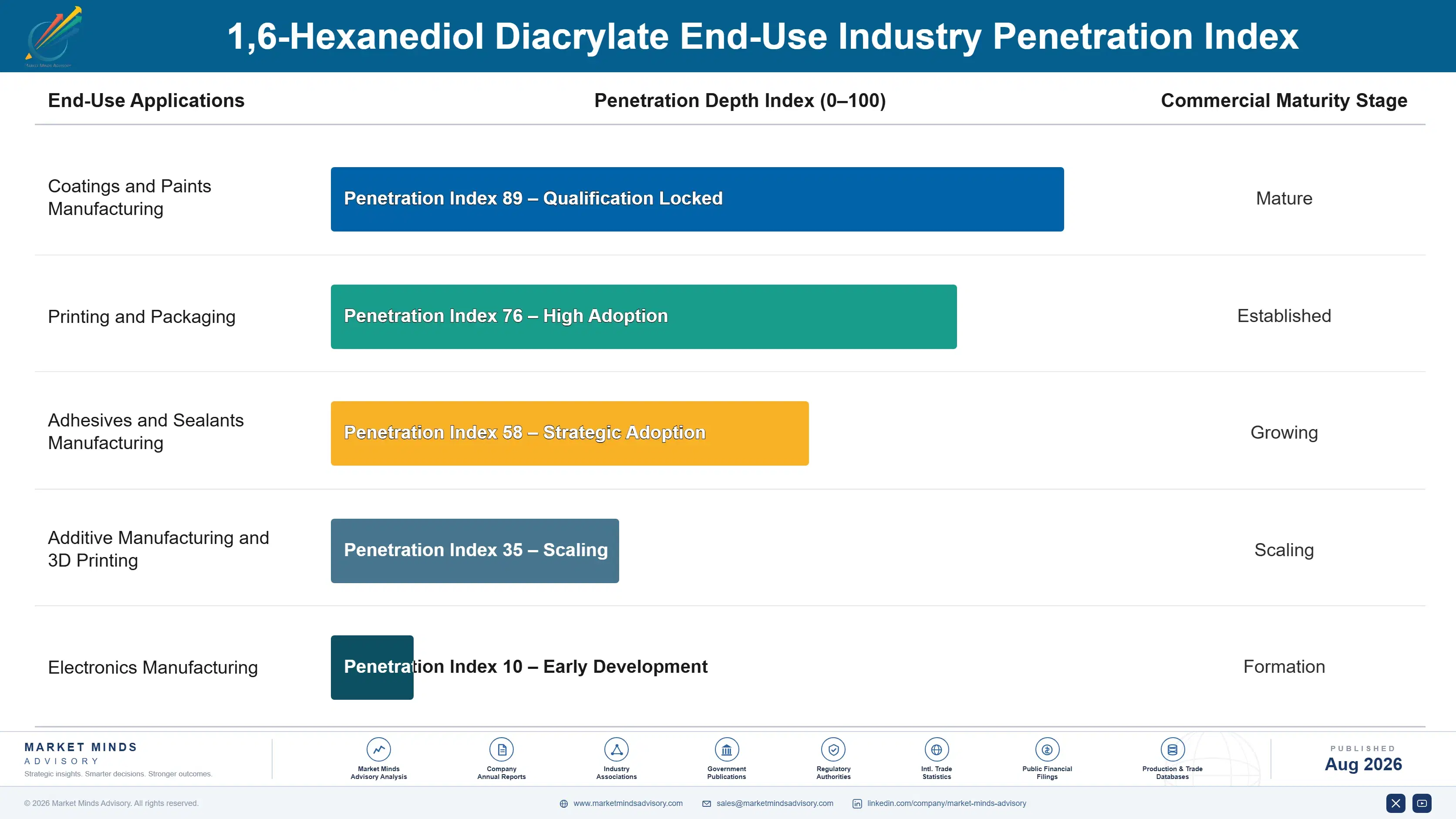
Formulation Qualification and Switching Costs

HDDA demand runs on multi-year supply contracts tied directly to validated formulations, since coatings, ink, and 3D printing resin manufacturers must requalify an entire product formulation, often including regulatory relabeling, before switching to a different monomer supplier. This gives incumbent suppliers a meaningful retention advantage once a customer's formulation depends on their specific monomer purity and consistency profile.
Adoption depth varies sharply by customer type: standard coatings and ink formulators treat industrial-grade HDDA suppliers as relatively interchangeable within quality specifications, switching more readily on price at contract renewal, while 3D printing resin and electronics coating formulators show far stronger supplier lock-in since switching means requalifying an entire validated formulation. Formulators serving regulated electronics and medical device markets show the least willingness to switch of any group, given the compliance risk of adopting an unfamiliar monomer source.

A generational shift is underway among formulation chemists too: younger technical teams increasingly scrutinize full purity documentation and traceability credentials during supplier qualification in ways their predecessors treated as secondary to price, rewarding producers that invested early in purification and documentation over those still competing purely on standard industrial cost.
16-hexanediol-diacrylate-market-trends-end-use-penetration-index-1787463862149

Where HDDA Margin Concentrates

These are among the four positions where our research anticipates prominent divergence between winners and laggards over the coming forecast period. Each is grounded in the demand model, the regulatory perimeter, and the announced capacity pipeline.
01 / PURIFICATION TIMING ADVANTAGE

Early specialty investment now defends a durable formulator contract lead

Producers that built dedicated purification capacity ahead of rising 3D printing and electronics demand now hold validated formulator relationships that later movers cannot quickly replicate, since customers rarely requalify an established, validated monomer supplier once a formulation is locked in. This timing advantage matters more than raw production scale, because specialty contracts increasingly require purification capability as a baseline qualification rather than a differentiator. Producers without early purification investment now face a multi-year capital and validation process before they can compete for the same premium specialty contracts.
02 / CHINESE CAPACITY EXPOSURE

Commodity-only producers face the sharpest margin compression risk

Producers dependent entirely on standard industrial-grade HDDA face the sharpest exposure to continued Chinese capacity expansion, since commodity pricing compression shows no sign of reversing given the country's persistent cost advantage across the broader acrylate value chain. This risk concentrates specifically among mid-sized regional producers lacking a defensible specialty niche to retreat toward. Producers that shifted mix toward specialty purification early face meaningfully less margin pressure than those still dependent on commodity tonnage for the bulk of their revenue each fiscal year.
03 / EMERGING MARKET CAPACITY RACE

India is where the next wave of electronics-driven demand gets built

India's rapidly expanding electronics manufacturing base is pulling HDDA demand faster than any other market tracked in this report, as domestic assembly capacity scales toward genuine self-sufficiency in conformal coating supply. This capacity race reflects genuinely new category formation rather than share shifting among already-established Western and Japanese competitors. Suppliers and distributors that build relationships in India now will be better positioned than those waiting for the shift to become obvious in import and trade data several years from now.
04 / PURITY DOCUMENTATION GAP

Undocumented suppliers are quietly being excluded from specialty contracts

Producers without formal purity documentation and traceability systems increasingly find themselves excluded from premium 3D printing and electronics contracts regardless of their underlying monomer quality, since formulators treat verified documentation as a baseline requirement rather than a differentiator today. This documentation gap compounds over time, since formulators rarely revisit undocumented suppliers once a validated relationship has been established elsewhere. Producers investing in documentation now will close this gap faster than competitors waiting for customers to mandate it outright across every major distribution channel.

Engagement Snapshot From the Field

A live engagement with an industry participant carrying material or product regulatory and market exposure ahead of a defining policy shift, showing how our research translates into a defensible multi-year portfolio strategy.
MARKET MINDS ADVISORY · CLIENT ENGAGEMENT SUMMARY
1,6-Hexanediol Diacrylate Producer Strategic Portfolio Review and Transition Roadmap 2026·Investment Scenario on 1,6-Hexanediol Diacrylate Exposure Evaluation 2025-26
CLIENT PROFILE
The client is a mid-sized regional HDDA producer supplying standard industrial-grade monomer to coatings and ink formulators across a single national market, with no dedicated 3D printing or electronics-grade purification capability. Revenue approached $85 million in the most recent fiscal year (client-reported, unverified by MMA), though margins had compressed steadily as Chinese commodity imports expanded and larger competitors captured specialty formulator contracts the client had not pursued.
STRATEGIC CHALLENGE
The producer had no dedicated purification capacity and no formal purity documentation systems, leaving it entirely dependent on standard industrial pricing at a moment when Chinese commodity competition was intensifying and specialty formulator customers were consolidating purchases with certified, purified suppliers. Leadership needed to decide whether to invest in purification capacity, documentation systems, or both simultaneously given limited available capital.
MMA APPROACH
MMA benchmarked the producer's cost structure against specialty-diversified competitors, modeled the capital and timeline required for both purification capacity and purity documentation systems, and evaluated a phased sequencing that would let documentation-driven contract wins help fund the larger purification capital investment over time without straining existing working capital reserves during the transition.
KEY FINDINGS
  1. The producer's standard industrial margin had compressed meaningfully faster than regional peers already diversified into 3D printing or electronics-grade purified products over recent years.
  2. Purity documentation systems required substantially less upfront capital than purification capacity, making it the faster near-term path to premium contract qualification for the business.
  3. Specialty formulator customers confirmed that purity documentation, not price, was the binding constraint on awarding new supply contracts to the regional producer under evaluation.
  4. Competitors that invested earliest in both documentation and purification capacity already held multi-year validated contracts that would be difficult to displace quickly once established.
CLIENT PROFILE
The client is a mid-sized regional HDDA producer supplying standard industrial-grade monomer to coatings and ink formulators across a single national market, with no dedicated 3D printing or electronics-grade purification capability. Revenue approached $85 million in the most recent fiscal year (client-reported, unverified by MMA), though margins had compressed steadily as Chinese commodity imports expanded and larger competitors captured specialty formulator contracts the client had not pursued.
STRATEGIC CHALLENGE
The producer had no dedicated purification capacity and no formal purity documentation systems, leaving it entirely dependent on standard industrial pricing at a moment when Chinese commodity competition was intensifying and specialty formulator customers were consolidating purchases with certified, purified suppliers. Leadership needed to decide whether to invest in purification capacity, documentation systems, or both simultaneously given limited available capital.
MMA APPROACH
MMA benchmarked the producer's cost structure against specialty-diversified competitors, modeled the capital and timeline required for both purification capacity and purity documentation systems, and evaluated a phased sequencing that would let documentation-driven contract wins help fund the larger purification capital investment over time without straining existing working capital reserves during the transition.
KEY FINDINGS
  1. The producer's standard industrial margin had compressed meaningfully faster than regional peers already diversified into 3D printing or electronics-grade purified products over recent years.
  2. Purity documentation systems required substantially less upfront capital than purification capacity, making it the faster near-term path to premium contract qualification for the business.
  3. Specialty formulator customers confirmed that purity documentation, not price, was the binding constraint on awarding new supply contracts to the regional producer under evaluation.
  4. Competitors that invested earliest in both documentation and purification capacity already held multi-year validated contracts that would be difficult to displace quickly once established.
RECOMMENDED STRATEGY
Phase 1: Phase 1 (Year 1): Implement purity documentation and traceability systems across existing production to qualify for specialty formulator contract consideration and evaluation. Phase 2: Phase 2 (Years 2 to 3): Use improved documented contract volume and margin to fund dedicated purification capacity investment for 3D printing grade production. Phase 3: Phase 3 (Years 3 to 4): Pursue multi-year electronics and 3D printing supply contracts using newly certified and purified capacity as validated proof of capability.
OUTCOME
Within eighteen months, the producer's documented contract volume reached a meaningful share of total revenue and funded purification capacity planning ahead of the original timeline (client-reported, unverified by MMA). The phased approach let the business diversify without straining working capital, positioning it to compete for specialty contracts it could not have pursued previously.

Frequently Asked Questions

Foundational context covering the market sizes, CAGR, scope, country, region and competition that inform every finding below. This section is provided to cover basics and most often pre-purchase conversations, answered from the MMA Primary Research Dataset.

What is the current size of the 1,6-Hexanediol Diacrylate Market?

The global HDDA market was valued at approximately $0.8 billion in 2025. This covers standard industrial, 3D printing, and electronics-grade monomer sold to coatings, ink, and additive manufacturing formulators.

How large will the 1,6-Hexanediol Diacrylate Market be by 2036?

MMA projects the market will reach approximately $1.6 billion by 2036, up from roughly $0.85 billion in 2026. That represents an expansion multiple of about 1.88 times over the ten-year forecast period.

What is the CAGR for the 1,6-Hexanediol Diacrylate Market 2026 to 2036?

The base case CAGR is 6.5% annually, with a bull scenario near 7.8% and a bear scenario near 5.2%. This range reflects sensitivity to feedstock costs and Chinese commodity capacity expansion.

Which segment is growing fastest?

3D printing and additive manufacturing grade HDDA is the fastest-growing segment, expanding at roughly 11.5% annually, about 1.8 times the overall market's pace. Electronics and conformal coating grade follows at approximately 9.0% annually.

Who are the major companies in the 1,6-Hexanediol Diacrylate Market?

Leading players include Arkema (Sartomer), Allnex Group, BASF SE, Evonik Industries AG, and Nippon Shokubai Co., Ltd. Together these five hold an estimated 44% combined market concentration today.

Which country is growing fastest?

India is the fastest-growing national market, expanding near 9.8% annually as its electronics manufacturing base rapidly scales domestic demand. China remains the dominant production hub for the category overall.

Report Segmentation Architecture

The full report scope spans multiple orthogonal segmentation dimensions, with cross-tabulated demand data provided for each dimension pair. Coverage extends further to regional breakdowns, trend trajectories, and the competitive detail needed to support segment-level decision-making.

By Application Grade

  • Coatings Grade HDDA
  • Printing Ink Grade HDDA
  • Adhesive and Sealant Grade HDDA
  • 3D Printing and Additive Manufacturing Grade HDDA
  • Electronics and Conformal Coating Grade HDDA
  • Industrial Reactive Diluent Grade HDDA

By End-Use Industry

  • Coatings and Paints Manufacturing
  • Printing and Packaging
  • Adhesives and Sealants Manufacturing
  • Additive Manufacturing and 3D Printing
  • Electronics Manufacturing

By Commercial Dimension

  • Direct Formulator Supply Contracts
  • Distributor and Wholesale Trade
  • Formulation Licensing Agreements
  • Export and Cross-Border Trade

By Region

  • North America
  • Western Europe
  • East Asia
  • South Asia and Pacific
  • Latin America
  • Middle East and Africa
  • Eastern Europe

Scope, Methodology, and Coverage

Every figure in this report is reproducible from documented input assumptions. The scope below maps the historical period, the forecast horizon, the segmentation dimensions, and the countries covered, alongside the underlying primary and qualitative methodology.
Historical Period
2020 to 2025
Forecast Period
2026 to 2036
Base Year
2025 (USD billions; MMA Primary Research Dataset, August 2026)
Market Definition
This report defines the HDDA market as 1,6-hexanediol diacrylate produced and sold as a reactive diluent and crosslinking monomer for UV and electron-beam curable coatings, printing inks, adhesives, sealants, 3D printing resins, and electronics conformal coatings globally. It excludes other diacrylate and monoacrylate monomers and finished, pre-formulated radiation-curable products that already incorporate HDDA internally.
Quantitative Units
USD billions (current prices); metric tonnes product weight where cited
Segmentation Dimensions
By Application Grade; By End-Use Industry; By Commercial Dimension; By Region
Regions Covered
North America, Western Europe, East Asia, South Asia and Pacific, Latin America, Middle East and Africa, Eastern Europe
Countries Covered
USA, China, Germany, France, UK, Japan, South Korea, India, Australia, Canada, Brazil, Mexico, Indonesia, Vietnam, Thailand, Malaysia, UAE, Saudi Arabia, South Africa, Nigeria, Turkey, Poland, Netherlands, Italy, Spain, Sweden, Switzerland, Argentina, Colombia, Singapore, and additional markets relevant to this sector
Key Companies Profiled
Arkema (Sartomer), Allnex Group, BASF SE, Evonik Industries AG, Nippon Shokubai Co., Ltd., IGM Resins B.V., Eternal Materials Co., Ltd., Double Bond Chemical Ind. Co., Ltd., Jiangsu Sanmu Group Corporation, Tianjin Jiuri New Materials Co., Ltd., Miwon Specialty Chemical Co., Ltd., Osaka Organic Chemical Industry Ltd., Longchang Chemical, Toagosei Co., Ltd., Mitsubishi Chemical Corporation, Nippon Kasei Chemical Co., Ltd., Dymax Corporation, Kromachem Ltd, Changzhou Tronly New Electronic Materials Co., Ltd., Kyoeisha Chemical Co., Ltd.
Quantitative Methodology
Primary survey, n=3,800 respondents, Q4 2025, six countries; demand-side model with trade association cross-validation
Qualitative Methodology
47 expert interviews, Q4 2025; applied to validate demand model assumptions, identify emerging dynamics, and assess competitive positioning
Report Format
PDF and XLSX data workbook (Word format preview document)
Publisher
Market Minds Advisory
Report Code
MMA-2026-CHM-109
Published
August 2026
Contact
sales@marketmindsadvisory.com | www.marketmindsadvisory.com

Purchase the full 1,6-Hexanediol Diacrylate Market Report (2026 to 2036).

The full 1,6-Hexanediol Diacrylate Market report delivers detailed sizing and forecasts across all six application-grade segments, all seven world regions, and twenty profiled companies through 2036. It includes granular regional data tables, competitive benchmarking on a consistent production volume basis, and input cost sensitivity modeling tied to global hexanediol and acrylic acid markets. Subscribers receive access to the underlying primary survey dataset (n=3,800 respondents, Q4 2025, six countries) and qualitative expert interview findings (n=47 interviews, Q4 2025). The report also includes segment-level margin analysis and a portfolio tiering framework analysts can apply directly to company assessments.
Full segmentation across six application-grade categories
Seven-region market sizing with growth forecasts
Twenty-company competitive benchmarking on consistent basis
Input cost sensitivity modeling tied to petrochemical markets
Access to primary survey dataset of 3,800 respondents
Portfolio tiering framework for margin benchmarking

Built For The People Who Decide

From boardroom strategy to bench-side execution, this report is read cover-to-cover by leaders shaping the next decade of their industry, turning demand scenarios, market dynamics and valuation benchmarks into decisions.
CXOs/ Presidents/ VPs/ Managers
M&A and Corporate Development
Strategy Teams and R&D Heads
Procurement and Product Directors
Regulatory and Compliance Leaders
Investor Relations and Equity Analysts